
The units for heat capacity are expressed as energy per unit of temperature, typically measured in joules per kelvin (J/K) in the International System of Units. When you examine how much energy is required to raise the temperature of an object, you’re looking at the relationship between thermal energy and the resulting change in the internal kinetic energy of the material’s molecules. Understanding these units is essential for anyone working in thermodynamics, engineering, or chemistry, as it allows for the precise calculation of heat transfer in various physical systems.
Key Takeaways
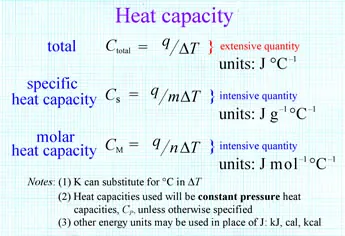
- Recognize that heat capacity is an extensive property, meaning it depends on the total mass of the object being measured.
- Distinguish between specific heat capacity, which is mass-independent, and total heat capacity, which is mass-dependent.
- Use the joule per kelvin as your primary unit for standard scientific calculations involving energy transfer.
- Convert between Celsius and Kelvin when necessary, as a change of one degree Celsius is equivalent to a change of one kelvin.
- Apply these values to determine how materials will respond to heating or cooling processes in industrial or laboratory settings.
What Are the Units for Heat Capacity?
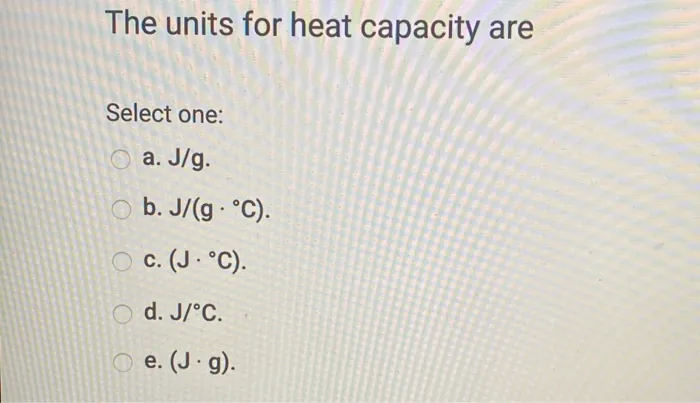
Heat capacity is defined as the amount of heat energy required to raise the temperature of an object by one degree. Because heat is a form of energy measured in joules (J) and temperature change is measured in kelvins (K) or degrees Celsius (°C), the standard SI unit for heat capacity is J/K.
It’s important to note that because these units represent a change in temperature rather than an absolute value, the magnitude of a change in Celsius is identical to a change in Kelvin.
Understanding the Scientific Notation
When dealing with very large or very small systems, scientists often use prefixes to simplify the expression of these values. For instance, kilojoules per kelvin (kJ/K) might be used for large industrial heat exchangers, while millijoules per kelvin (mJ/K) could be used in micro-scale calorimetry.
Regardless of the prefix, the core relationship remains the ratio of energy input to thermal response. Thermal energy storage is the practical application of this constant, helping engineers design systems that can maintain stable temperatures over time.
Comparing Heat Capacity and Specific Heat
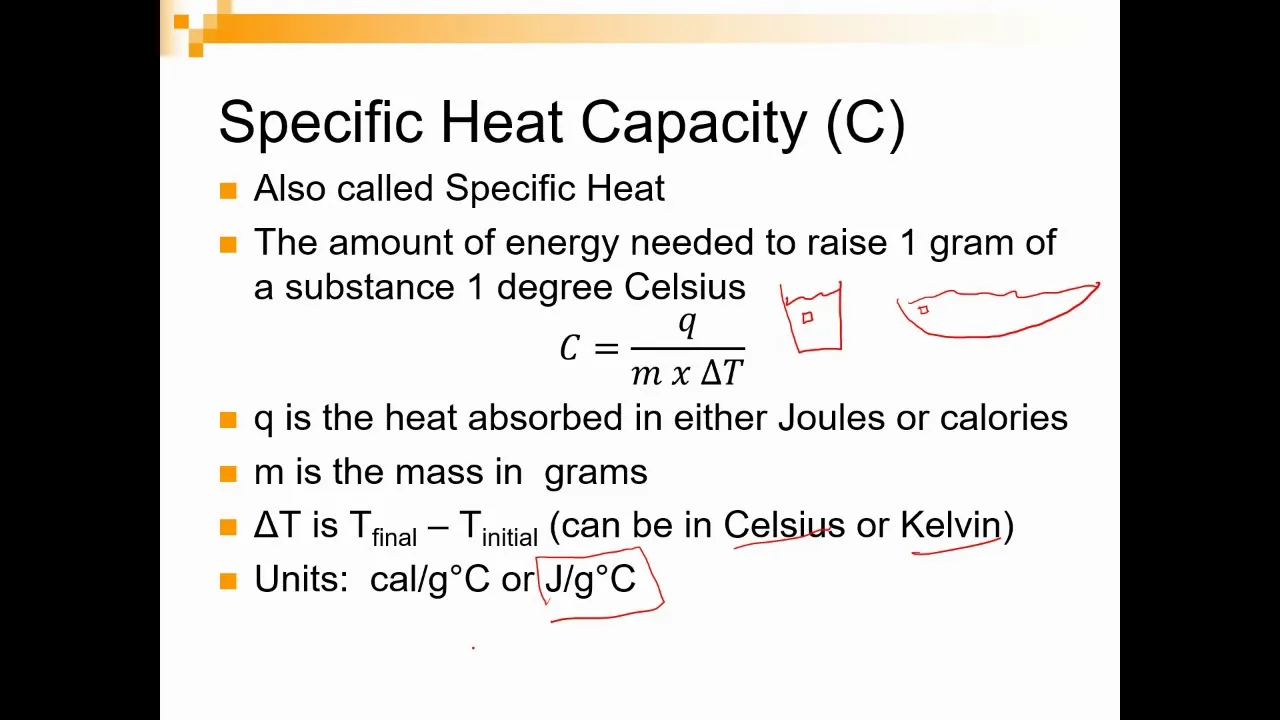
While heat capacity describes an entire object, specific heat capacity describes the material itself regardless of its size. This distinction is vital for accurate material selection in manufacturing. If you have a block of copper, its heat capacity will increase if you add more copper, but its specific heat capacity remains constant.
According to the NIST Chemistry WebBook, specific heat capacity is defined as the heat capacity of a sample divided by the mass of that sample, resulting in units of joules per gram-kelvin (J/g·K).
| Property | Symbol | Units | Dependence |
|---|---|---|---|
| Heat Capacity | C | J/K | Mass of object |
| Specific Heat | c | J/(g·K) | Material type |
| Molar Heat Capacity | Cm | J/(mol·K) | Molecular weight |
How to Calculate Total Heat Capacity
To find the total heat capacity of an object, you must multiply the mass of the material by its specific heat capacity. This calculation is a fundamental step in determining how a component, such as a heat sink in a computer, will perform under load. By identifying the thermal mass of the object, you can predict how quickly it will reach a steady state when exposed to a consistent heat source.
The Calculation Process
- Identify the mass of your material in grams or kilograms.
- Determine the specific heat capacity of that material from a reference table.
- Ensure your units for mass and specific heat are consistent (e.g., if using grams, the specific heat must be in J/g·K).
- Multiply the mass by the specific heat capacity to reach the final value in J/K.
Factors Influencing Heat Capacity Measurements
Several variables can alter the observed heat capacity of a substance. Pressure is a significant factor, especially for gases, where constant pressure (Cp) and constant volume (Cv) measurements yield different results.
Solids and liquids are less sensitive to pressure changes, but phase transitions—such as melting or boiling—will cause the heat capacity to fluctuate dramatically as energy is diverted to changing the state of the matter rather than raising its temperature. Phase transition dynamics are therefore critical when measuring materials near their melting points.
Units Used in Engineering and Industry
Engineers often rely on imperial units when working on legacy systems or specific regional projects. In these cases, you might encounter British Thermal Units (BTU) used instead of joules. The unit for heat capacity in the imperial system is often expressed as BTU per degree Fahrenheit (BTU/°F). While less common in modern research, these units remain standard in many HVAC applications where equipment ratings are traditionally stated in BTU.
| Unit System | Energy Unit | Temperature Unit | Heat Capacity Unit |
|---|---|---|---|
| SI System | Joule (J) | Kelvin (K) | J/K |
| CGS System | Calorie (cal) | Celsius (°C) | cal/°C |
| Imperial System | BTU | Fahrenheit (°F) | BTU/°F |
Troubleshooting Common Measurement Errors
When experimental results don’t match theoretical expectations, the cause is often an overlooked variable. One common mistake is failing to account for the heat capacity of the container itself, known as the calorimeter constant. If you’re measuring the heat capacity of a liquid, you must subtract the energy absorbed by the flask or probe from your total energy input. Calorimetric precision is the only way to ensure that your data reflects the substance being tested rather than the testing apparatus.
Warning: Always ensure your temperature sensors are calibrated before beginning any heat capacity experiment, as even a one-degree deviation can lead to significant percentage errors in your final calculation.
Why Do Materials Have Different Capacities?
The variations in heat capacity between materials are largely due to their atomic structure and the way their molecules store energy. Metals, for example, have high thermal conductivity and often lower specific heat capacities compared to substances like water. Water has a uniquely high heat capacity due to its hydrogen bonding, which allows it to absorb significant amounts of energy before the molecules begin to move faster, which is what we perceive as a rise in temperature.
Molecular Energy Storage
- Translational motion: Molecules moving through space.
- Rotational motion: Molecules spinning around their axes.
- Vibrational motion: Bonds stretching and bending within the molecule.
Related guides
- Best Foosball Tables Standard Size: Top 5 Picks in 2026
- Best Garbage Disposals: How to Choose the Right Unit in 2026
- Foosball Table Weight: How Heavy Is a Standard Table in 2026
Frequently Asked Questions
Is heat capacity the same as specific heat?
No, they’re different. Heat capacity is an extensive property that applies to a specific object or sample regardless of its composition. Specific heat capacity is an intensive property that describes the energy-absorbing capability of a material per unit of mass. While heat capacity is measured in J/K, specific heat is measured in J/(g·K) or J/(kg·K).
Why is water used as a standard for heat capacity?
Water is used as a standard because it has an exceptionally high heat capacity. This property makes it an ideal medium for cooling systems and a vital regulator of climate on Earth. Because it requires so much energy to increase the temperature of water, it acts as a thermal buffer, absorbing heat without experiencing rapid or dangerous temperature spikes in natural environments.
How does pressure affect heat capacity values?
Pressure has a negligible effect on the heat capacity of solids and liquids, but it significantly impacts gases. For gases, the capacity is much higher when measured at constant pressure compared to constant volume. This happens because, at constant pressure, the gas is allowed to expand, which requires additional energy to do work against the surrounding environment, thereby increasing the total heat input required.
Can heat capacity be a negative number?
In standard thermodynamic systems, heat capacity is always positive. A positive value indicates that adding heat increases the temperature of the system. While some exotic theoretical models in astrophysics or certain unstable systems might show negative responses, these aren’t representative of standard materials or the common thermodynamic processes encountered in chemistry, engineering, or physics laboratories.
What is the difference between Cp and Cv?
Cp represents the heat capacity measured at constant pressure, while Cv represents the heat capacity measured at constant volume. For gases, Cp is always greater than Cv because the energy supplied at constant pressure must account for both the rise in internal temperature and the work performed by the gas as it expands against the external pressure of its container.
Pro Tip: If you’re performing calculations in a professional setting, always verify whether the specific heat values you’re using were measured at constant pressure or constant volume, as using the wrong constant can introduce errors of 30% or more when working with gases.
Conclusion
Understanding the units for heat capacity is the foundation for mastering thermodynamics and thermal engineering. By correctly utilizing joules per kelvin and distinguishing between mass-dependent capacity and material-specific heat, you can accurately predict how systems react to thermal energy. To continue your learning, perform a practice calculation using the specific heat capacity of a common metal like aluminum or iron.

2 thoughts on “What Are the Units for Heat Capacity: The Standard Explained”