
The best hammer or mallet depends entirely on the material you’re hitting. A 16-ounce steel claw hammer drives nails into framing lumber, while a 24-ounce urethane dead blow mallet seats wood joints without bruising the surface. Using the wrong tool will either dent your project or strain your arm.
Types of hammers and mallets

Here’s every tool covered on this page in one place so you can compare them quickly. Each row names the tool, the job it handles best, and a specific version you’d recognize at a hardware store.
| Tool name | Best used for | Concrete example |
|---|---|---|
| Claw hammer | Driving and pulling finish nails | Estwing 16 oz curved claw |
| Framing hammer | Heavy construction nail driving | Stanley 22 oz fat max |
| Dead blow mallet | Assembling joints without bounce | Tekton 3 lb urethane mallet |
| Rubber mallet | Tapping tile or sheet metal | Craftsman 16 oz rubber mallet |
| Wooden mallet | Striking chisels during joinery | Narex 5 inch beech mallet |
| Ball peen hammer | Shaping and riveting soft metals | Picard 300 gram ball peen |
Claw hammer
A claw hammer pairs a flat striking face with a split back for pulling nails, making it the default choice for carpentry and repairs.
- Drives 8d common nails flush in two or three strikes when using a standard 16-ounce head.
- Extracts bent or broken nails using the curved claw as a lever against the wood surface.
- Sets finish nails below the surface when paired with a separate nail set punch.
- Hangs picture frames on drywall using small brads without splitting the plaster edge.
Swing a 16-ounce Estwing curved claw hammer to sink an 8d nail into pine framing, holding the handle near its end to let the weight do the work instead of forcing it down with your shoulder.
Framing hammer
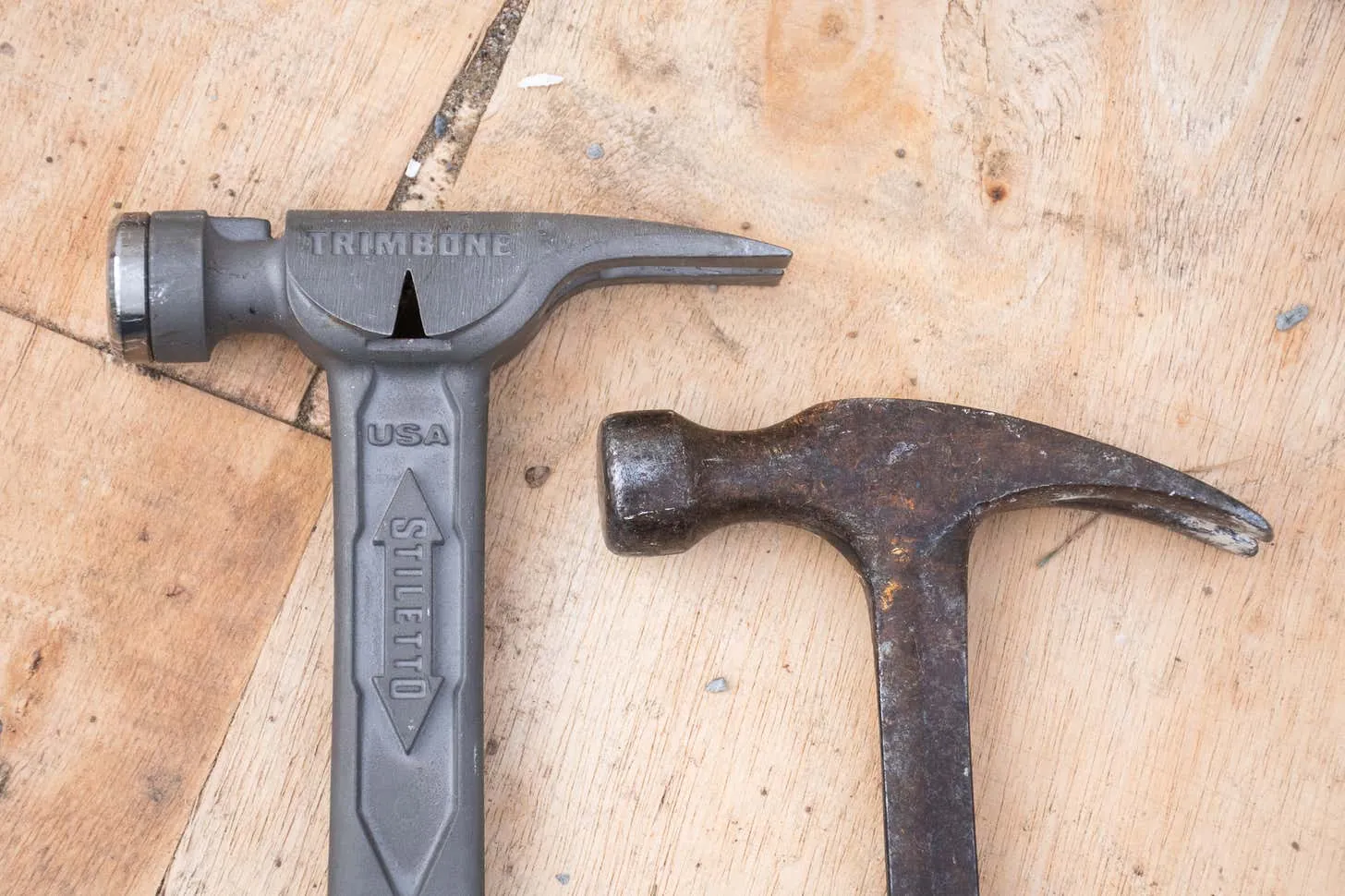
A framing hammer trades precision for raw driving power, carrying a heavier head—usually between 20 and 32 ounces—and a straight claw built for prying apart lumber rather than pulling individual nails. It suits carpenters and builders who spend their day sinking large fasteners into structural timber. You won’t use this for assembling cabinets or hanging pictures because the extra mass crushes delicate surfaces instantly.
- Drives 16d framing nails deep into dense lumber with fewer swings than a standard claw hammer.
- Pries apart nailed boards using the straight claw as a heavy-duty lever.
- Checks stud spacing by hooking the straight claw over a board edge and measuring from there.
- Starts large nails safely by gripping them in the milled waffle face before swinging.
The trade-off is clear: the heavier head tires your arm faster but finishes the wall sooner. Swing a 22-ounce Stanley FatMax to frame a standard stud wall, letting the waffle-patterned face bite into the nail head so it doesn’t slide off mid-strike.
Dead blow mallet
A dead blow mallet holds loose steel shot inside a hollow head, which shifts forward to absorb rebound. It suits woodworkers, mechanics, and anyone assembling tight-fitting parts where a ricocheting strike ruins alignment or damages fingers.
- Seats mortise-and-tenon joints fully without marring the visible faces of the wood.
- Aligns automotive body panels by delivering force that stops exactly where it lands.
- Taps machinery components onto shafts without transferring shock back into the bearings.
- Adjusts jigs and fixtures on a workbench without shifting the surrounding setup.
The striking force you feel depends entirely on the weight printed on the side of the head and the amount of fill inside it, so read the manufacturer’s spec sheet before buying. Strike a glued chair leg with a 3-pound Tekton urethane dead blow mallet to seat the tenon fully, watching how the head stays flat against the wood instead of bouncing back toward your knuckles.
Rubber mallet
A rubber mallet uses a molded rubber head, offering a softer strike than steel but more rebound than a dead blow. It suits tile setters, sheet metal workers, and hobbyists who need to nudge materials into place without scratching or cracking them.
- Taps ceramic tiles level during installation without chipping the glazed edges.
- Bends thin sheet metal over a form block by spreading the impact across a wider area.
- Assembles knock-down furniture by pushing dowels into pre-drilled holes gently.
Rubber degrades over time, especially if left in direct sunlight or exposed to solvents, so check the face for cracks before trusting it on expensive tile. Press a 16-ounce Craftsman rubber mallet against a porcelain floor tile to adjust its height in the mortar bed, keeping the strike light enough to avoid cracking the glaze.
Wooden mallet
A wooden mallet is a solid block of hardwood shaped into a rectangular head, designed to strike chisel handles.
- Delivers a crisp, controlled blow to a chisel handle without deforming the brass hoop.
- Absorbs vibration through the natural grain structure, reducing fatigue during long carving sessions.
- Provides enough mass to chop through hardwood fibers when paired with a sharp bevel.
This tool requires occasional maintenance because wood shrinks and swells with seasonal humidity changes. Sand any rough spots lightly and apply a coat of boiled linseed oil once a year to keep the head from checking. Strike a Narex 5-inch beech mallet against a 1/2-inch bench chisel to pare away waste inside a dovetail socket, letting the weight of the head push the blade rather than forcing it with your wrist.
Ball peen hammer
A ball peen hammer features a flat face for striking and a rounded dome for shaping metal. It suits machinists, metal fabricators, and mechanics working with soft steel, aluminum, copper, or brass fasteners.
- Rounds off the protruding end of a rivet by rolling the peen across the metal surface.
- Shapes sheet metal curves by stretching the material outward with repeated dome strikes.
- Drives center punches and pin punches accurately when setting up drill holes.
Tap the rounded peen over a 1/8-inch aluminum pop rivet until the tail curls flat against the joint, creating a permanent mechanical bond without needing a pneumatic tool.
Other striking tools worth knowing
- Sledgehammer: Delivers massive demolition force using an 8 to 16-pound head on a long hickory or fiberglass handle, meant for breaking concrete or driving stakes into frozen ground.
- Brass mallet: Strikes delicate machine parts without sparking or leaving steel marks, essential for gunsmiths and watchmakers adjusting pins inside tight tolerances.
- Cross peen hammer: Uses a wedge-shaped peen perpendicular to the handle for drawing out metal in one direction, favored by blacksmiths forging blades and hinges.
- Drywall hammer: Features a hatchet blade on the back for cutting board and a convex face that dimples paper without tearing it during nail setting.
Picking the right hammer or mallet

Your choice comes down to the material you’re hitting, the fastener or joint you’re closing, and how long you’ll be swinging each day.
For tile, sheet metal, or plastic parts that scratch easily, the rubber mallet spreads the force gently enough to prevent damage. For metal fabrication involving rivets or shaping, the ball peen hammer won’t deform under its own use.
Frequently asked questions
Can I use a regular hammer instead of a mallet?
No, not for assembly work. A steel hammer face concentrates force into a tiny circle, denting wood and cracking plastic immediately. Mallets spread that same energy across a wider, softer surface. Use steel for driving fasteners and softer heads for pushing parts together.
Why does my mallet bounce off the wood?
Solid rubber and wooden mallets rebound because they lack internal damping. A dead blow mallet stops this by shifting sand or shot forward inside the head during impact. If the bounce is ruining your alignment, switch to a dead blow design for that specific task.
How long does a rubber mallet last?
A rubber mallet lasts roughly two to five years under weekly workshop use, assuming it stays away from direct sunlight and chemical solvents. UV exposure dries out the rubber until chunks break off mid-swing.
Is it safe to use a chipped hammer face?
No, a chipped steel face is dangerous because the hardened metal can shear off at high speed during a strike. Inspect the striking surface before every use. If you see missing steel or deep cracks radiating from the edge, replace the head or the entire tool immediately.
What happens if I use a wooden mallet on nails?
The wood splits along its grain lines. Wooden mallets are shaped to strike flat chisel handles, not narrow steel points. Driving a nail with one crushes the striking face and sends splinters toward your hands. Switch to a steel claw hammer for any fastener work.
Does hammer weight really matter for beginners?
Yes, because a heavier head drives the nail but tires your arm faster. Start with a 16-ounce claw hammer for general tasks around the house. Moving to a 20-ounce or heavier model only helps when you’re sinking large framing nails all day and need fewer strikes per fastener.
How often should I oil a wooden mallet?
Apply boiled linseed oil once or twice a year, depending on your shop’s humidity level. Dry climates pull moisture from the wood faster, causing surface checks that weaken the head. Wipe a thin coat over the entire block, let it soak overnight, and buff off the excess.
Your first step with striking tools
Start by matching the tool to the material sitting on your bench right now. Grab the claw hammer for nails, the dead blow mallet for glue-ups, or the ball peen for metalwork. You’ll know you picked correctly when the fastener sinks or the joint closes in two or three clean strikes without leaving a mark on the surrounding surface. Stop and get help if the handle bends, the head loosens, or the tool chips during a normal swing.
