
Piping systems use a variety of components to divert flow from a main run, and the different types of branch connections are primarily classified by how they reinforce the opening in the header pipe. These fittings ensure the system maintains its structural integrity under pressure and temperature changes. Choosing the right connection depends on the pipe size, the fluid being transported, and the required pressure rating for the specific application.
Common branch connection types

When selecting a fitting, engineers look at the size of the run pipe versus the branch pipe. This table summarizes the most frequent options found in industrial piping systems.
| Connection Type | Best Use Case | Typical Example |
|---|---|---|
| Weldolet | High pressure lines | 2-inch branch on 8-inch pipe |
| Threadolet | Small bore, low pressure | 1-inch instrument line |
| Sockolet | Small bore, high pressure | 1-inch drain connection |
| Tee fitting | Equal size branches | 4-inch branch on 4-inch pipe |
| Lateral | Flow direction changes | 45-degree branch takeoff |
Weldolet
A weldolet is a self-reinforced branch connection designed to be butt-welded onto the run pipe. It’s ideal for high-pressure systems where extra strength is required to prevent stress concentrations around the opening.
- Provides a smooth transition of stress from the branch to the header.
- Eliminates the need for a separate reinforcement pad on smaller branches.
- Matches the contour of the header pipe for a precise welding fit.
If you’re working on a high-pressure steam line, use a weldolet to ensure structural stability; if you’re working on a low-pressure utility line, you may use a standard tee or a lighter fitting.
A common mistake is failing to match the weldolet’s schedule to the pipe’s wall thickness, which creates a mismatch that weakens the weld. You can verify the required specifications for these fittings through the ASME B31.3 Process Piping code, which outlines the design requirements for pressure piping systems.
Tee fitting
A tee fitting is a standard three-way component used when the branch pipe is the same size as the main header pipe. It’s the most common method for creating a full-size diversion in a pipeline.
- Allows for equal flow distribution to the branch and the main run.
- Ensures consistent material properties across the entire connection.
- Simplifies alignment during the installation of long piping runs.
This method is best for systems where fluid velocity needs to remain constant through the junction. For example, a 6-inch header feeding into a 6-inch branch would typically use a standard equal tee. This isn’t for systems where space is extremely limited, as the physical size of a tee is significantly larger than an olet-style connection.
Sockolet
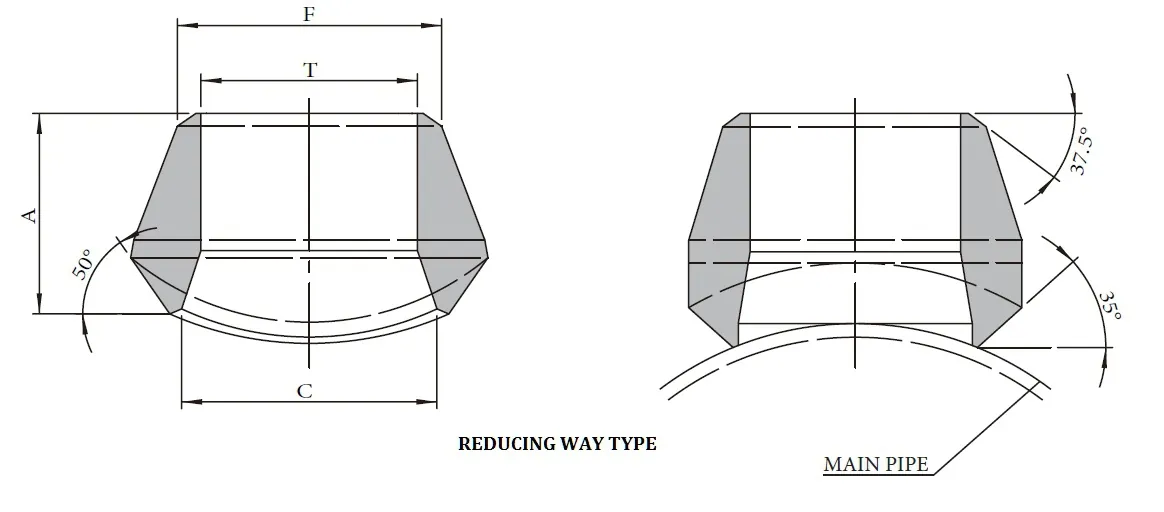
A sockolet is designed for small-bore branch connections where the branch pipe is inserted into the socket of the fitting and fillet-welded. It’s frequently used in systems that handle hazardous fluids because the socket design makes it easier to achieve a leak-proof seal.
- Ensures reliable sealing for small diameter pipes.
- Requires minimal space compared to a full tee fitting.
- Supports higher pressures than threaded connections in similar sizes.
If your branch pipe is 2 inches or smaller, a sockolet is often the preferred choice. However, it isn’t for use in systems with high vibration, as the fillet weld is more susceptible to fatigue than a butt weld. The limit for this fitting is the pipe diameter; always check the manufacturer’s catalog for the maximum allowable size, as using a sockolet on a pipe larger than its rated diameter can lead to premature failure.
Threadolet
A threadolet is a specialized fitting that features a threaded outlet, allowing for the easy attachment of instruments or small-bore pipes without welding. It’s primarily used for non-critical, low-pressure applications where maintenance might require frequent removal of the branch line.
- Enables quick installation and removal of branch piping.
- Avoids the need for hot work when adding small connections.
- Works well with gauges, drains, and sampling points.
For instance, you might use a threadolet to attach a pressure gauge to a 10-inch water line. This isn’t for use in high-temperature or high-pressure service because threaded connections are prone to leaking under significant thermal cycling. Always ensure the thread type matches your local standard, such as NPT, to prevent cross-threading during the initial assembly.
Additional branch connection types
- Lateral: A lateral is a branch connection that takes off at a 45-degree angle rather than the standard 90 degrees. It’s used to reduce turbulence and pressure drop when joining two flows.
- Sweepolet: A sweepolet is a contoured fitting that provides a long-radius sweep into the branch pipe. It’s used in critical service where flow efficiency and fatigue resistance are the highest priorities.
- Nipolet: This is a combination of a nipple and a weld-o-let in one piece. It’s used for direct, short-run connections to instruments, saving time by reducing the number of individual weld joints.
Choosing the right connection
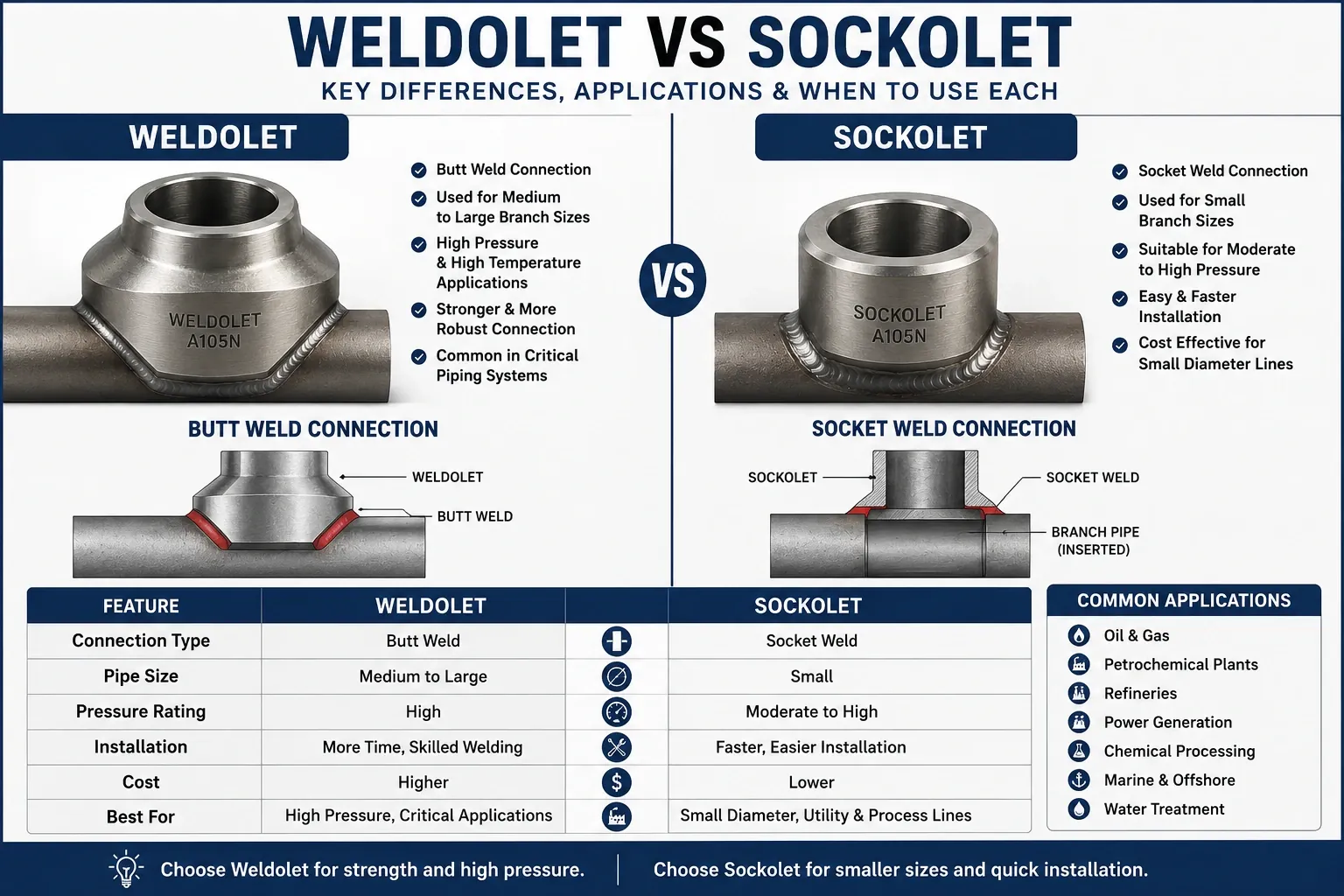
The primary factor for choosing a connection is the ratio between the branch pipe size and the run pipe size. If the branch is the same size as the run, you must use a tee; if the branch is significantly smaller, an olet-style fitting is more efficient.
Another factor is the fluid pressure: if the system operates above 300 psi, opt for butt-welded connections like a weldolet. Finally, the service temperature dictates the material grade; you must ensure the fitting matches the temperature rating of the run pipe. These choices can be combined in a single system, but you must maintain consistent welding standards across every junction.
Related guides
Frequently asked questions
Can I use a threadolet for high pressure steam?
No, threadolets aren’t recommended for high-pressure steam because threaded joints are prone to leaking under thermal expansion and vibration. For high-pressure steam service, standard practice requires butt-welded or socket-welded connections, such as a weldolet or sockolet, to ensure the integrity of the pressure boundary under extreme conditions.
What is the difference between a tee and a weldolet?
A tee is a full-size fitting used when the branch pipe matches the header diameter, while a weldolet is a branch-reinforcement fitting used when the branch is smaller than the header. Tees require three butt welds to install, whereas a weldolet requires one butt weld to the header and one fillet weld to the branch.
Is it safe to weld a branch connection while the pipe is pressurized?
No, it’s never safe to perform welding on a pressurized pipeline. You must isolate the line, drain the fluid, and verify that the system is at atmospheric pressure before attempting any branch connection work, as the heat from welding can cause a catastrophic failure of the pressurized pipe wall.
How do I know which size fitting to buy?
You must match the fitting size to the nominal pipe size (NPS) of both your run pipe and your branch pipe. Check the pipe’s stamp or your system’s piping and instrumentation diagram (P&ID) to confirm the wall thickness and diameter, as these specs determine the exact fitting schedule you need to order.
Why do some branches use a 45-degree angle?
Branches use a 45-degree angle, known as a lateral, to minimize flow turbulence and pressure loss at the junction. This design is common in gravity-fed lines or high-velocity systems where a 90-degree turn would cause excessive friction, cavitation, or wear on the internal pipe walls over many years of service.
Does the material of the fitting have to match the pipe?
Yes, the fitting must be made from the same material grade as the pipe to ensure they expand and contract at the same rate during temperature changes. Mixing different metals can also lead to galvanic corrosion, which significantly weakens the connection and can cause the branch to fail prematurely.
Conclusion
Start by identifying the nominal size and pressure rating of your existing header pipe. Once you confirm these specs, select the fitting that matches your specific flow requirements and welding capability. If you notice any signs of cracking, heavy corrosion, or weeping at an existing branch, stop all work immediately and contact a qualified piping engineer to assess the safety of the system before attempting any repairs.

5 thoughts on “What are the different types of branch connections”