
Links in this article may be Amazon affiliate links. As an Amazon Associate we earn from qualifying purchases, and that support costs the reader nothing.
Many options look similar, but the real difference lies in how often they cycle air and what they truly capture. A poor choice might leave your space feeling stuffy or prove too loud for your bedroom at night. Every pick below is judged on three things: what it’s strong at, what it gives up, and what living with it would ask of you.
1. Honeywell PowerPlus HEPA Air Purifier

Best for: Medium to large rooms needing reliable, consistent air circulation.
This air purifier focuses on high-performance air changes, circulating air 4.8 times per hour in 200-square-foot spaces. It uses a combination of a HEPA filter and a carbon pre-filter to trap microscopic particles like pet dander, smoke, and pollen. The unit includes four cleaning levels, a dedicated Auto Mode, and touch controls for simple operation.
Strengths:
- AHAM Verified performance for air cleaning.
- Four distinct cleaning levels for control.
- Built-in Auto Mode adjusts to needs.
- Captures 99.99% of microscopic airborne particles.
Trade-offs:
- Limited to specific room size coverage.
- No smart app connectivity included.
Living with this unit means you’ll rely on the touch controls for manual adjustments throughout the day. You’ll need to keep the area around the intake clear to ensure the 4.8 air changes per hour remain effective. You can stop worrying about whether the unit is performing, as the AHAM verification provides a standard for its cleaning power.
| Best for | Why |
|---|---|
| Allergy sufferers | Captures 99.99% of dust |
| Medium room owners | Cleans 200 square feet |
| Hands-on users | Simple touch control interface |
2. Dreo Air Purifier
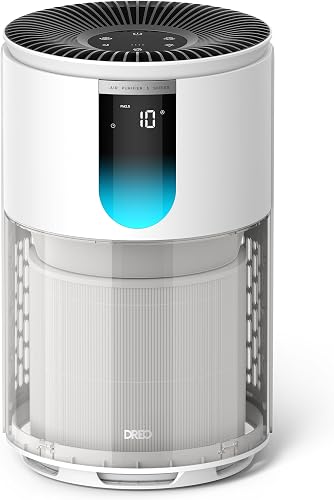
Best for: Light sleepers needing quiet, automated air quality control.
The Dreo Air Purifier uses a 360-degree spiral airflow design to pull in air from all directions and refresh a 245-square-foot room every 12.4 minutes. It features a high-precision PM2.5 sensor that monitors air quality in real time, showing levels on an LED screen with a color-coded light. The unit is Energy Star certified and includes a specialized Sleep Mode that dims all lights for undisturbed rest.
Strengths:
- AHAM Verified with 158 CFM rating.
- Real-time PM2.5 air quality monitoring.
- Energy Star certified for efficiency.
- Quiet operation via BLDC motor.
Trade-offs:
- Requires periodic filter status checks.
- Filter window needs occasional cleaning.
You’ll appreciate the transparent filter window, which lets you see when it’s time for maintenance without guessing. During the week, the Auto Mode will handle speed changes based on the air quality it detects, so you don’t have to manually toggle settings. If you’re a light sleeper, the Sleep Mode allows you to keep the air clean without any intrusive display lights.
| Best for | Why |
|---|---|
| Light sleepers | Includes dedicated Sleep Mode |
| Data-focused users | Real-time PM2.5 sensor display |
| Energy-conscious homes | Energy Star certified motor |
3. Levoit Smart Purifier
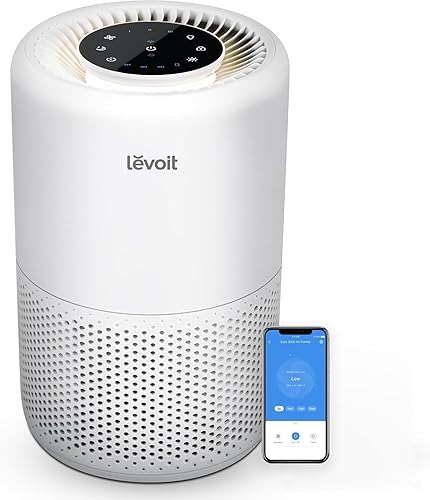
Best for: Users wanting app-based control and voice-activated convenience.
This smart purifier offers 360-degree intake and is designed for smaller spaces, refreshing a 140-square-foot room 4.8 times per hour. It features app and voice control, allowing you to monitor filter life and adjust settings remotely. The unit includes a display-off button for dark rooms and operates at noise levels as low as 27dB.
Strengths:
- Includes smart app and voice control.
- Quiet operation at 27dB level.
- AHAM Verified performance and efficiency.
- Compact design for smaller rooms.
Trade-offs:
- Requires genuine Levoit replacement filters.
- Smaller coverage area than others.
Living with this device means you’ll likely spend most of your time using the mobile app to check filter health or change the fan speed. the listing doesn’t mention specific home network requirements. Because it’s lightweight, you can easily move it between a bedroom and a home office as your needs change.
| Best for | Why |
|---|---|
| Tech-savvy users | Smart app and voice control |
| Bedroom users | Quiet 27dB operation mode |
| Small space owners | Compact 140 square foot coverage |
4. Clorox Small Room Air Purifiers

Best for: Those needing a compact unit for tabletops or small bedrooms.
The Clorox Small Room Purifier is a 360-degree tabletop unit designed to pull in air from all directions for areas up to 200 square feet. It uses a two-stage filter system to capture 99.97% of particles as small as 0.1 microns. You can set an optional timer for 2, 4, or 8 hours, and the unit includes an adjustable night light with three brightness settings.
Strengths:
- True HEPA filtration for particles.
- Includes convenient 2/4/8 hour timer.
- Adjustable night light for bedrooms.
- The air intake design draws in air from every direction around the unit.
Trade-offs:
- Limited to smaller room sizes.
- Filter replacement is required periodically.
You’ll find this unit easy to place on a nightstand or desk due to its compact frame. The timer feature is helpful if you want the unit to run while you fall asleep and then turn off automatically. You’ll need to keep track of the 6 to 12-month filter replacement schedule to maintain its capture efficiency.
| Best for | Why |
|---|---|
| Dorm or office | Compact tabletop footprint |
| Nighttime use | Adjustable dimmable night light |
| Scheduled use | Built-in 8-hour timer options |
5. Mooka HEPA Purifier

Best for: Households dealing with pet dander and larger open spaces.
The Mooka HEPA Purifier uses a high-efficiency 3-stage filtration system with a washable pre-filter to trap pet hair and larger debris. It covers larger areas and includes an aromatherapy pad where you can add essential oils to help manage odors. The unit features a child lock, a timer, and a very quiet 20dB Sleep Mode for nighttime use.
Strengths:
- Includes useful aromatherapy pad feature.
- Quiet 20dB mode for sleep.
- Washable pre-filter extends the life of the HEPA filter.
- Child lock prevents accidental changes.
Trade-offs:
- Requires manual essential oil application.
- Filter reset requires button hold.
Living with this purifier is straightforward because the washable pre-filter reduces the frequency of total filter replacements. You’ll need to remember to moisten the aromatherapy pad if you choose to use scents. The child lock is a helpful addition if you have curious pets or children who might bump the touch controls.
| Best for | Why |
|---|---|
| Pet owners | Traps pet hair effectively |
| Families | Includes child lock feature |
| Light sleepers | Quiet 20dB Sleep Mode |
Side by Side
The table below helps you compare the core capabilities of these air purifiers to see which matches your room size and feature requirements.
How to Judge One of These
Understanding Air Change Rates
The air change rate tells you how many times the unit cycles the air in a room every hour. A higher number means the purifier works faster to clean the space. You can verify this by checking the AHAM Verified seal on the product listing, which provides a standard measurement for performance. Higher rates are better for rooms with heavy smoke or pet dander, while lower rates may suffice for clean, quiet bedrooms.
Filtration Stages
Most units use a multi-stage system: a pre-filter for large debris, a HEPA filter for microscopic particles, and a carbon layer for odors. The Energy Star program provides guidance on performance and efficiency for these appliances. Check if the pre-filter is washable, as this can extend the life of the HEPA filter. Always confirm the availability of replacement filters before purchasing, as you’ll need these for long-term use.
Noise Levels
An air purifier in a bedroom needs a quiet mode. Look for decibel (dB) ratings in the listing to see how loud the unit is at its lowest setting. Many models include a “sleep” or “quiet” mode that turns off lights and drops the fan speed to reduce noise. the listing doesn’t mention what “whisper-quiet” specifically indicates regarding fan optimization.
Closing
For most users, the Honeywell PowerPlus HPA3100 offers the best balance of power and reliable filtration. If you need a unit for a nursery or bedroom where silence is vital, the Dreo Air Purifier is the superior choice. Check the dimensions of your room and pick the model that matches your daily schedule.
Frequently Asked Questions
Will these purifiers handle wildfire smoke?
Yes, these units are designed to capture fine particles such as smoke and ash. Models like the Mooka HEPA Purifier specifically mention high-performance intake to tackle wildfire smoke. Ensure you run the unit on a higher fan speed when air quality is poor to maximize the number of air changes per hour for the best results.
What does the first week look like?
The first week involves placing the unit in a central location with clear space around the air intake. You’ll need to remove the plastic wrapping from the internal filter before turning the device on for the first time. Once powered, the unit will begin pulling in particles immediately, and you may notice a change in air freshness within a few hours.
What parts need to be replaced?
The primary part you must replace is the HEPA filter, usually every 6 to 12 months depending on your air quality. Some units, like the Mooka HEPA Purifier, feature a washable pre-filter that you can clean manually to extend the life of the main filter. Always check the manufacturer’s instructions for the specific replacement schedule for your model.
Can these units kill viruses?
These purifiers are designed to capture particles as small as 0.1 microns, including those that may carry viruses or bacteria. However, they do not “kill” them; they trap them within the filter media. The effectiveness depends on the air passing through the True HEPA filter, and you shouldn’t rely on a purifier as a total solution for disinfecting a room.
Is the simplest pick here enough?
A simpler unit is often enough if your goal is just to clear dust and allergens from a small bedroom. If you don’t require smart app connectivity or advanced air quality sensors, a basic model with a True HEPA filter will perform the core job effectively. Focus on the square footage capacity to ensure it’s rated for the size of your room.
Final Thoughts
Choosing the right unit shouldn’t feel like a chore, so pick the one that fits your daily routine best. Once you’ve settled on your favorite, don’t forget to keep a spare filter handy in your closet. You’ll be glad you’re prepared when it’s finally time for that first quick swap.