
Ohm’s law is important for calculating voltage, current, and resistance in basic electrical circuits. It provides a simple way to predict how electricity behaves in passive components like wires and resistors. When circuits contain complex parts like transistors or motors, it is not correct to apply this rule because it no longer gives a full picture of the system.
When ohms law is important to apply
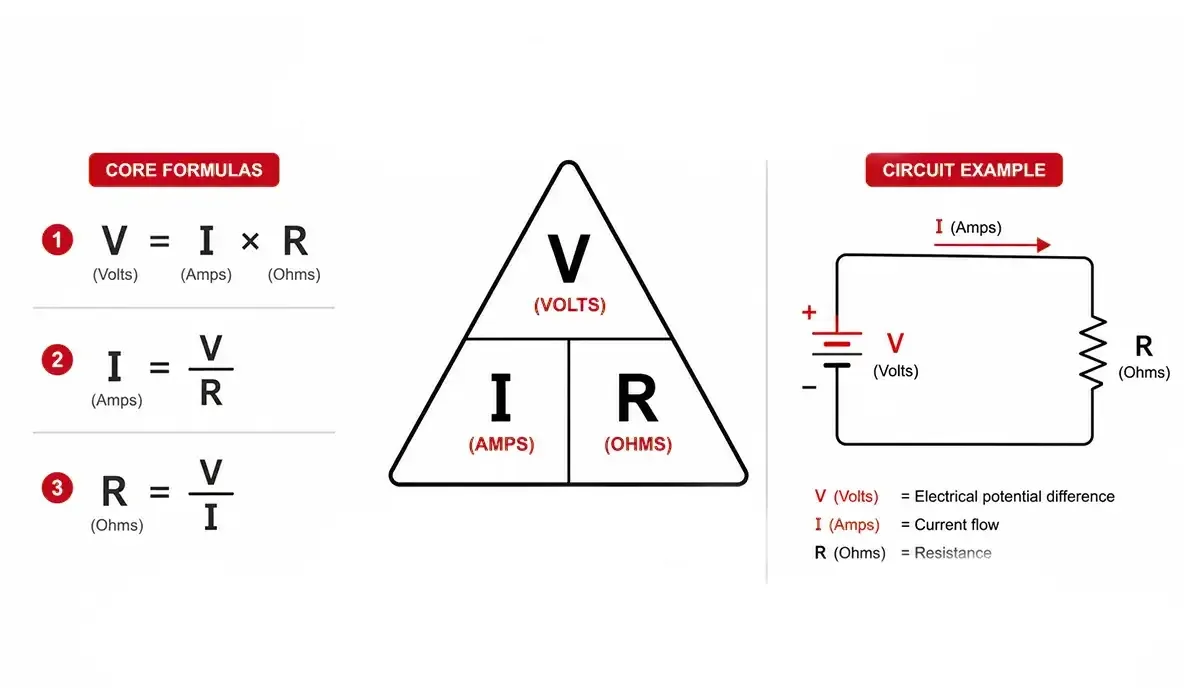
Use the formula V=IR to find the unknown value when you know the other two. Voltage is measured in Volts, current in Amperes, and resistance in Ohms.
The law works perfectly for linear components where resistance stays constant despite changes in voltage. If you double the voltage in a simple resistor circuit, the current will also double. This predictable relationship allows you to calculate the exact load on a wire before you flip the switch.
If a circuit includes non-linear parts like diodes or transistors, the math changes significantly because resistance isn’t fixed. In these cases, Ohm’s law fails to provide a static answer. You must consult the component’s datasheet to find the specific voltage-current curve.
Why Electrical Calculations Matter
This fundamental rule acts as the foundation for almost every basic circuit design because it defines the predictable relationship between three core variables. By knowing how these pieces interact, you can prevent circuit damage caused by excessive current.
If you have a specific voltage source and a device with a known resistance, you can calculate the exact current flowing through the system to ensure it stays within safe limits. This basic electrical theory from the University of Toronto explains how these variables balance each other in stable systems.
The mechanism relies on the fact that for many materials, the current is directly proportional to the applied voltage. When you provide more pressure, more flow occurs through a fixed path. This is why it’s used to size fuses or select the right resistors for a project. It allows you to anticipate behavior without needing to physically test every possible scenario. If the system is linear, the result you calculate will match the real-world measurement.
However, the rule isn’t a universal constant for every piece of electronics. It ignores the complex behaviors of semiconductors, where the resistance changes depending on the temperature or the amount of voltage applied. If you try to apply this simple math to a light-emitting diode or a computer processor, your results will be wrong. These devices don’t follow a straight-line relationship, so you must use advanced models to understand their power draw.
When Standard Calculations Fail

The simple relationship between voltage, current, and resistance breaks down when components behave in non-linear ways. Standard Ohm’s law calculations assume a static environment, but real-world hardware often deviates as operating conditions shift.
If you’re working with incandescent bulbs or heating elements, remember that resistance rises sharply as the material warms. Calculate your current draw based on the operating temperature rather than the cold-state resistance, or you’ll consistently underestimate the power load.
When dealing with semiconductors, the voltage drop isn’t a fixed constant. A silicon diode typically drops a specific amount, but this shifts based on the current passing through it; if your circuit requires precision, have a technician consult the manufacturer’s I-V curve rather than relying on textbook approximations.
Most engineers fail by ignoring back-EMF in inductive loads like motors. This creates voltage spikes that can destroy sensitive logic gates. If you see erratic behavior in a microcontroller, isolate the power supply immediately.
How to Apply Calculations Safely
Identify voltage, current, and resistance. Choose the formula for your missing value, but always verify the component label for its specific thermal or voltage limit first.
Calculate your result using the standard linear formula.
Compare your calculated current against the wire’s maximum rating. If the result exceeds 80% of that capacity, stop immediately to prevent insulation melt.
If you’re unsure of the wire gauge, check the markings printed directly on the jacket. Use a non-contact voltage tester to confirm the circuit is live before applying your math to a physical system. If the tester remains silent, recheck your connections.
Common Mistakes in Circuit Math

Assuming all devices are linear leads to catastrophic failure. If your component is a diode or a transistor, it will draw exponentially more power once it passes its threshold voltage. Always check the datasheet for the appropriate characteristic curve.
Mixing milliamps with Amps is the most common error. If you calculate power using 50mA as 50, your result will be off by a factor of 1,000. Convert all values to base units before starting your math.
Failing to account for the internal resistance of your power source drops the voltage under load. If your battery shows 12V at rest but drops to 10V when active, your circuit will underperform.
Frequently asked questions
Can I use this for my home wall outlets?
If you have concerns about your home power, contact a licensed electrician to inspect your panel and wiring for any potential hazards.
Why does my light bulb get hotter as it runs?
Your bulb gets hotter because the filament resistance increases as it reaches high temperatures, which is a non-linear process. The simple law doesn’t account for this heat-based change in material properties. You can see the specific temperature ratings for your bulb by checking the packaging or the manufacturer’s technical specifications sheet for the product.
How long can I run a circuit at its limit?
You should never run a circuit at its absolute maximum capacity for any length of time. Components degrade faster when pushed to their thermal limits, leading to potential failure or fire risks. Always design your circuits to operate at 80% or less of the maximum rated current to maintain a safe margin for error.
Is it safe to test this on a battery?
It’s safe to test basic math on a battery, but never try to short-circuit the terminals to measure current. Direct shorts can cause batteries to overheat, vent gases, or explode, leading to serious injury. Use a proper load tester if you need to determine the health or capacity of a battery safely.
What happens if the resistance is zero?
If the resistance drops to zero, the current becomes infinite in a theoretical model, which is known as a short circuit. In reality, the wiring will melt or the power source will fail instantly before that happens. Always include a fuse in your circuits to break the connection if the resistance drops unexpectedly.
Does it matter if I use AC or DC?
It matters because this simple formula only applies accurately to direct current (DC) in resistive loads. Alternating current (AC) involves frequency, phase shifts, and impedance, which require much more complex math to calculate correctly. If you’re working with AC, rely on the device’s power rating in Watts rather than trying to calculate it yourself.
How many amps can a wire carry?
The amount of current a wire can carry depends entirely on its gauge and the material it’s made from, such as copper or aluminum. You must check the National Electrical Code or the wire manufacturer’s ampacity chart to find the safe limit for your specific wire size. Never guess the capacity, as the wrong wire will overheat quickly.
Conclusion
Calculations are only as good as the conditions you apply them to. Always verify your component type before performing math, as applying simple rules to complex parts can lead to dangerous errors. If you’re unsure about the safety of your circuit, stop and consult a professional rather than guessing.
