
The molecular structure of glass is characterized by a disordered, non-crystalline arrangement of atoms, technically known as an amorphous solid. Unlike crystalline materials such as quartz or diamond, where atoms align in repeating geometric patterns, the silica molecules in glass are frozen into a random, liquid-like state. This structure occurs because the material is cooled so rapidly from a molten state that the atoms lack sufficient time to organize into a structured lattice, resulting in a robust, rigid, and transparent material.
Key Takeaways
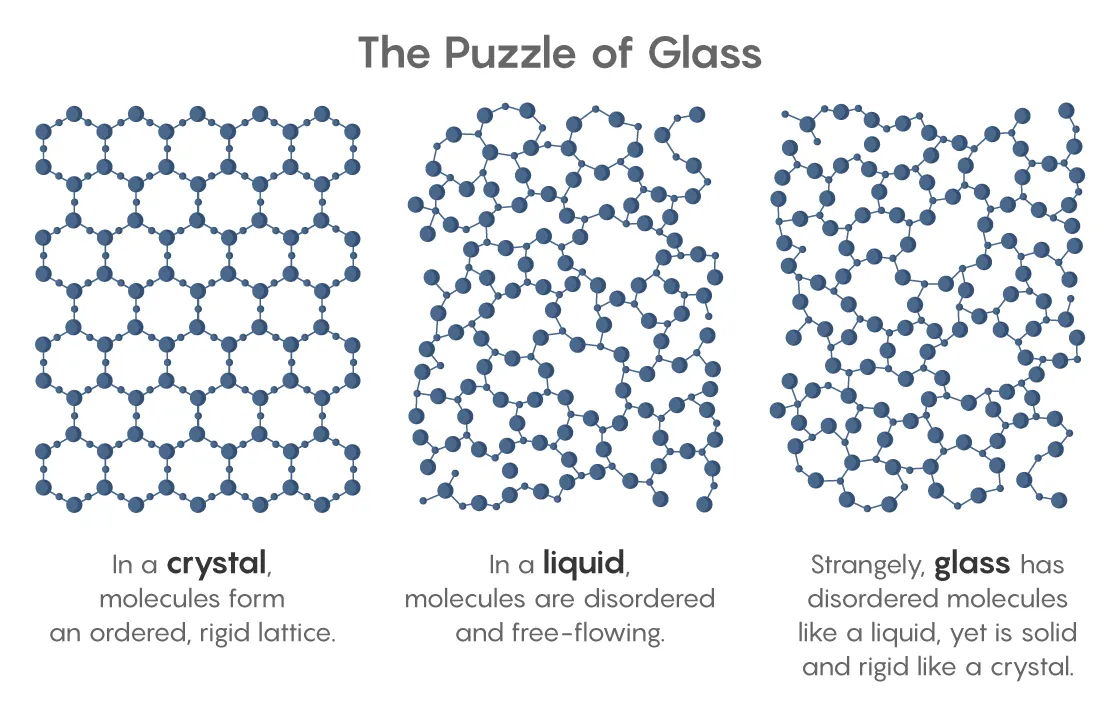
- Glass is an amorphous solid, meaning it lacks a long-range repeating atomic structure.
- The primary component of common commercial glass is silicon dioxide, which forms a tetrahedral network.
- Modifiers like sodium oxide are added to lower the melting temperature and improve workability.
- Rapid cooling, or quenching, is the critical process that prevents crystallization and locks in the disordered state.
- Understanding this structure explains why glass is transparent, brittle, and chemically inert.
What Is the Molecular Structure of Glass?
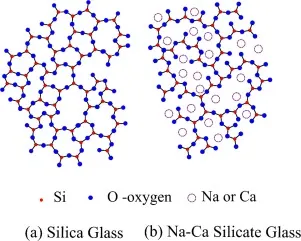
At the microscopic level, common soda-lime glass is a complex, irregular network of silicon and oxygen atoms. The fundamental building block is the silicon-oxygen tetrahedron, where one silicon atom sits at the center, bonded to four oxygen atoms at the corners. In a crystalline quartz structure, these tetrahedra link together in a highly organized, repeating sequence.
In glass, these tetrahedra connect at their corners but in a random, jumbled fashion. This lack of long-range order gives glass its unique physical properties, including its ability to transition from a viscous liquid to a solid without a distinct phase change.
The process of forming this structure is often referred to as “vitrification.” As molten silica cools, the viscosity increases exponentially. Eventually, the movement of atoms becomes so restricted that they’re trapped in their current positions before they can form a crystal. The National Institute of Standards and Technology provides extensive data on how these disordered networks influence the mechanical and thermal performance of various glass compositions.
How Do Modifiers Change the Structure?
Pure silica has a very high melting point, making it difficult to shape into consumer goods. To make glass manufacturing practical, glassmakers introduce “network modifiers” such as sodium oxide or calcium oxide. These modifiers break some of the oxygen bonds within the silica network, creating “non-bridging oxygens.” This disruption effectively lowers the viscosity of the molten glass, allowing it to be shaped at lower temperatures.
| Modifier Type | Effect on Structure | Impact on Properties |
|---|---|---|
| Sodium Oxide | Breaks Si-O-Si bonds | Lowers melting temperature |
| Calcium Oxide | Stabilizes the network | Improves water resistance |
| Aluminum Oxide | Strengthens the lattice | Increases chemical durability |
| Boron Trioxide | Lowers thermal expansion | Increases heat resistance |
Why Is Glass Transparent?
Transparency is a direct result of the lack of a crystalline structure. In crystalline materials, light often reflects or scatters off the boundaries between different crystal grains. Because glass is an amorphous solid, it contains no such grain boundaries to interfere with the passage of light. Furthermore, the electronic energy levels of the silicon-oxygen bonds in standard glass are such that they don’t absorb visible light, allowing photons to pass through the material unimpeded.
Pro Tip: When selecting glass for specific applications, such as high-heat environments or chemical laboratories, consider borosilicate glass, which uses boron to create a tighter, more stable molecular network that resists thermal shock.
Is Glass Actually a Liquid?
A common misconception is that glass is a “supercooled liquid” that flows slowly over time. This is inaccurate. While glass lacks the repeating structure of a crystal, its molecular motion at room temperature is essentially zero. It’s a solid with a disordered atomic arrangement.
The confusion often stems from the observation of ancient window panes that appear thicker at the bottom. This is actually a result of older manufacturing techniques, such as cylinder blowing, which produced uneven thickness, rather than the glass flowing like a liquid.
Comparison of Solids
The following table contrasts the molecular arrangements of different types of solid materials found in everyday life.
| Material Type | Atomic Arrangement | Example |
|---|---|---|
| Crystalline | Repeating, periodic lattice | Table salt, Diamond |
| Amorphous | Random, disordered network | Window glass, Obsidian |
| Polycrystalline | Many small crystal grains | Aluminum foil, Steel |
| Polymeric | Long chain molecules | Plastics, Rubber |
How Does Heat Affect Glass?
When glass is heated, it undergoes a transformation at the “glass transition temperature.” Below this temperature, the atoms are locked in place, and the material behaves as a rigid solid.
Above this temperature, the material becomes soft and moldable as the kinetic energy of the atoms overcomes the forces holding the disordered network in place. This transition isn’t a sharp melting point like that of ice; instead, it’s a gradual softening process, which allows glassblowers to shape the material over a wide temperature range.
Can We Control the Structure?
Engineers can manipulate the molecular structure of glass through various heat-treatment processes. One common method is tempering, which induces internal stress to increase strength. By rapidly cooling the surface of the glass while the interior remains hot, the outer layers shrink and harden first. As the interior cools, it tries to shrink but is held back by the already-hardened surface. This creates a state of compressive stress on the surface, which makes the glass much more resistant to breakage.
Warning: Never attempt to cut or drill tempered glass after it has been manufactured, as the stored internal energy will cause the entire piece to shatter into thousands of small, granular fragments.
What Are the Main Glass Components?
The chemical composition of glass determines its molecular density and stability. While soda-lime glass is the most common, other types exist for specialized needs.
- Soda-Lime Glass: Used for windows and bottles, composed of silica, soda, and lime.
- Borosilicate Glass: Contains boron, used for laboratory glassware and cookware like Pyrex.
- Aluminosilicate Glass: Contains aluminum, used for high-strength displays and smartphone screens.
- Lead Glass: Contains lead oxide, used for fine crystal and radiation shielding.
Is Glass Chemically Inert?
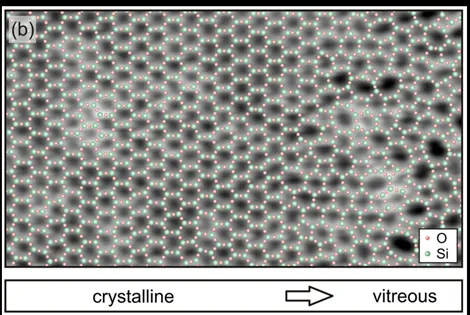
The molecular network of glass is exceptionally stable. The silicon-oxygen bonds are very strong, and because the structure is already “random,” there are few active sites for chemical reactions to occur. This is why glass is the preferred material for storing chemicals, medicine, and food. It doesn’t leach chemicals into the contents, nor does it react with most acids or bases. However, it’s vulnerable to hydrofluoric acid, which can specifically break the Si-O bonds and dissolve the glass structure entirely.
Related guides
- How to Paint a Glass Table Top: A Step by Step Guide
- How to Dispose of Large Glass Table Top Panels Safely
- How to Decorate Glass Table Top Surfaces: 3 Simple Steps
Frequently Asked Questions
Why does glass break so easily?
Glass is brittle because it lacks the ability to deform plastically. In metals, atoms can slide past one another to absorb impact energy. In glass, the rigid, disordered network can’t rearrange itself to dissipate stress. When force is applied, the energy concentrates at microscopic surface flaws, leading to rapid crack propagation and total failure of the material structure.
Does glass change over time?
Glass is thermodynamically unstable compared to its crystalline counterparts, meaning it technically wants to crystallize (a process called devitrification). However, at room temperature, the rate of this process is so slow that it’s effectively zero. Under normal conditions, glass will remain in its amorphous state for thousands of years without any measurable change in its molecular configuration.
Can all glass be recycled?
While the molecular structure allows glass to be melted and reformed indefinitely, not all glass is compatible. Soda-lime glass used for bottles can be melted together, but borosilicate glass has a different melting point and chemical composition. If mixed, it creates defects in the new glass, so recycling centers must separate different glass types based on their specific chemical additives.
How is colored glass made?
Color is introduced by adding specific metal oxides to the molten glass mixture. These metallic ions sit within the disordered silica network and absorb specific wavelengths of light. For example, adding cobalt creates a deep blue color, while adding iron creates a green or brown tint. These additives change the light absorption properties without significantly altering the fundamental amorphous molecular structure.
Is bulletproof glass the same?
Bulletproof glass, or ballistic glass, isn’t a single molecular structure but a laminate. It consists of multiple layers of glass bonded together with intermediate layers of polycarbonate or plastic. The glass provides a hard surface to deform the projectile, while the plastic layers absorb the energy and prevent the glass from shattering into dangerous shards, effectively managing the impact through a composite design.
Conclusion
To further your understanding of how these materials are utilized in modern manufacturing, you should research the specific annealing cycles used in industrial glass production. By studying the cooling curves of various glass types, you can see exactly how temperature control dictates the final density and durability of the glass products you use every day.
