
A transformer changes alternating current voltage up or down without changing the frequency using two coils wrapped around a shared iron core. This complete overview explains the working of these devices, their different types, and their common uses. When current enters the first coil, a shifting magnetic field induces voltage in the second. If the second coil has more turns, voltage rises; fewer turns means it drops.
What a transformer is
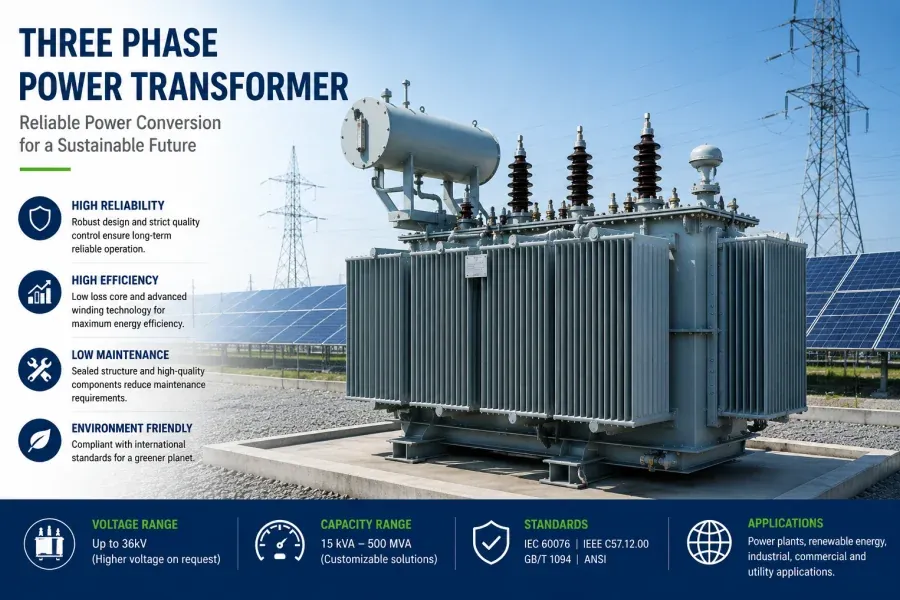
A transformer is an electrical device that transfers energy between two or more circuits through electromagnetic induction. It works only with alternating current, because a steady direct current creates no changing magnetic field and therefore induces nothing. Transformers step voltage up for long-distance power lines or step it down for appliances and electronics. They have no moving parts, which makes them reliable and quiet.
A common misconception is that transformers create energy — they do not; they move it, and a small amount is always lost as heat. The core and windings are sized for a specific voltage and current, so using one outside its rating can cause overheating or failure.
How a transformer works
- Connect the primary winding to an alternating current source.
- The alternating current builds a changing magnetic field in the laminated steel core.
- That field passes through the secondary winding wrapped on the same core.
- The changing field induces an alternating voltage in the secondary winding.
- The output voltage equals the input voltage multiplied by the ratio of secondary turns to primary turns.
- If the secondary has twice as many turns, output voltage doubles; half as many turns halves it.
- Current moves in the opposite direction: stepping voltage up reduces current, and stepping it down raises current.
The single judgement call is matching the turns ratio to the load. Choose the wrong ratio and connected equipment receives the wrong voltage, which can damage motors, electronics, or insulation. If the installation involves high-voltage utility equipment, a licensed electrician should perform the work because mistakes carry a real risk of injury and fire.
Key numbers and settings at a glance
Transformer performance depends on turns ratio, cooling method, and the load it carries.
| Situation | What to use | How long | What to watch for | | Step down 240 V to 12 V | Low-voltage transformer | Continuous while load is connected | Core temperature under load | | Step up for transmission | High-voltage transformer | Continuous | Oil level and cooling fans | | Isolate sensitive equipment | Isolation transformer | Continuous | Grounding and leakage current | | Short-term tool power | Portable site transformer | Hours at a time | Duty-cycle rating and cable size | | Electronic circuit board | Small PCB transformer | Continuous | Mounting heat and vibration |
Ratings vary by manufacturer and model, so check the nameplate on your own unit for its exact voltage, current, and frequency limits.
What separates good results from bad ones
Good installations start with the nameplate. Experienced technicians confirm the primary voltage matches the supply before energising anything, then verify the secondary voltage under load, not just at no load. They check that the core is firmly mounted and that cooling air can flow freely around the unit.
During operation, they watch for unusual humming, discoloration, or oil seepage, any of which suggests overload or insulation trouble. They never exceed the rated ambient temperature, because heat shortens insulation life far faster than electrical loading alone. Ventilation clearances and mounting orientation matter as much as the electrical connections.
Common problems and quick fixes

| What you notice | What it usually means | What to do first | | Loud humming or buzzing | Loose laminations or overload | Reduce load and check mounting | | No output voltage | Blown fuse or open winding | Check supply and fuse with power off | | Overheating | Blocked ventilation or excess load | Clear airflow and reduce load | | Oil leaking from tank | Seal or gasket failure | Isolate unit and call a technician | | Voltage too low or high | Wrong tap setting or turns ratio | Verify tap position against nameplate |
If a fuse blows again immediately after replacement, stop and call an electrician; a repeated fault points to a short or insulation failure that isn’t safe to keep resetting.
The rules that apply
Transformer installations must follow the National Electrical Code, published by the National Fire Protection Association, which covers wiring methods, overcurrent protection, and grounding for transformers of all sizes. Utilities and local authorities often add their own connection requirements for equipment that ties to the grid.
Work on utility-grade or high-voltage transformers requires a licensed electrician or utility contractor because of the risk of arc flash, fire, and lethal shock. If your transformer involves high-voltage levels, you must adhere to the specific clearance distances mandated by Article 450.
Before starting any installation, check the authority having jurisdiction in your area for the permits and inspections that apply. Many installers mistakenly assume that utility-side connections are exempt from local inspection, but failing to secure these permits can lead to a complete service denial. If the transformer is located indoors, you must ensure the room meets specific fire-rating requirements.
Keeping it working afterwards
Dry-type transformers need little maintenance beyond keeping vents clear and checking connections for tightness on a regular schedule. Oil-filled units require periodic oil sampling and inspection of gaskets, gauges, and cooling equipment.
The interval depends on the manufacturer’s rating and the operating environment, so read the nameplate and the maker’s maintenance guide for your specific model. If your unit operates in a high-humidity or dusty environment, inspect the cooling fins and air intake vents every six months rather than annually.
Signs that attention is due include rising oil temperature, discolored oil, visible leaks, or unusual noise. Never open a sealed tank or handle insulating oil without proper training, because contaminated oil and pressurized systems can cause injury and environmental harm. If you notice a steady hum evolving into a sharp metallic rattle, shut down the system immediately. This sound often indicates a core lamination failure, which leads to catastrophic internal arcing if ignored.
When a transformer isn’t the right choice
Some situations call for a different approach. If the load runs on direct current, a transformer can’t work at all. A rectifier and DC-DC converter are needed instead.
For very small voltage adjustments in sensitive electronics, a voltage regulator often gives steadier output than a transformer alone. A linear regulator can hold output within millivolts under shifting loads.
When the goal is to convert frequency as well as voltage, a transformer does nothing for frequency. A frequency converter or inverter is required. Running a 50-hertz motor on 60-hertz power through only a transformer will overheat it.
A common mistake is using a standard transformer to isolate medical equipment from line noise. That requires a shielded isolation transformer with an electrostatic screen between windings. Without that screen, high-frequency noise couples right across the gap.
In each case, the alternative handles something a transformer simply can’t do.
Related guides
- What are the different types of branch connections
- Best Pipe Insulation: How to Choose and Install the Right Type in 2026
Frequently asked questions
Can a transformer work with direct current?
No. A transformer needs alternating current to create the changing magnetic field that induces voltage in the secondary winding.
Why does a transformer get warm?
It loses a small amount of energy as heat in the core and windings; the amount depends on load and efficiency, which varies by unit.
How long does a transformer last?
A well-maintained unit can run for decades; the actual life depends on temperature, loading, and maintenance, which you can check on the nameplate and maker’s guide.
Is it safe to install one yourself?
Only low-voltage, plug-in units are suitable for a non-electrician; anything connected to mains wiring needs a licensed electrician.
What happens if I overload it?
Insulation breaks down faster and the unit can overheat, which may cause failure or fire; reduce the load or use a larger-rated transformer.
Conclusion
A transformer changes voltage through electromagnetic induction, and the right choice depends on matching the turns ratio, cooling, and rating to the job.
