
To check a battery’s charge, set your meter to DC voltage and touch the probes to the terminals. A fresh 1.5V cell reads 1.5V+, while a 12V car battery shows 12.6V when full. You can test a battery with a multimeter in two minutes. This works for household and automotive batteries.
Tools needed to test a battery
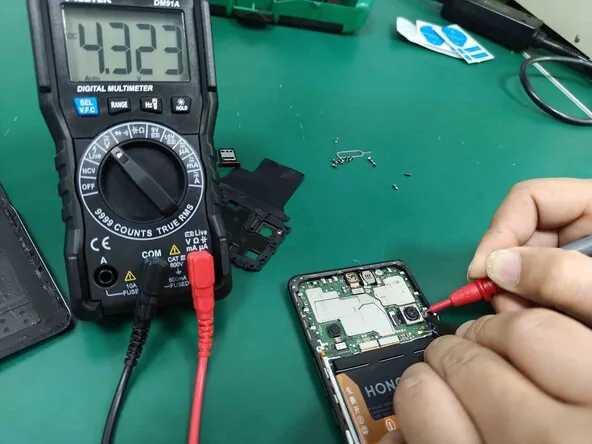
You don’t need much gear to read a battery’s voltage. The process is quick and simple. Gather these items first.
- Digital multimeter with working probes and a fresh 9V internal battery.
- The battery you want to check, wiped clean of dust or corrosion.
- A small notebook or phone to write down each reading.
- Fine sandpaper if the battery terminals look dull or crusty.
- Safety glasses when you’re testing large 12V lead-acid batteries.
A cheap auto-ranging meter is sufficient. Avoid analog meters, as they’re hard to read precisely. If the screen is blank, replace the meter’s internal battery.
Steps to test a battery with a digital multimeter
-
Turn the dial on your multimeter to the DC voltage setting, marked with a V and a straight line. Auto-ranging meters pick the scale for you. On manual ones, select the range just above your battery’s rated voltage — the 20V range for a 12V car battery, or the 2V range for a 1.5V AA cell.
-
Plug the black probe into the port labeled COM and the red probe into the port marked VΩmA. Push them in until they click. Loose probes give jumping numbers that you can’t trust.
-
Touch the red probe tip to the positive terminal and the black probe tip to the negative one. On cylindrical cells like AAs, the raised bump is positive and the flat end is negative. Hold the metal tips steady against the metal contacts.
Careful: Don’t let the bare metal parts of the two probes touch each other while they’re on the terminals. That creates a short circuit, which drains the cell fast and heats the probes.
- Read the number on the display once it stops moving. This usually takes two seconds. A healthy 1.5V alkaline cell shows 1.5V to 1.6V. A fully charged 12V car battery reads 12.6V or slightly more.
Tip: If the screen shows a negative sign, you’ve swapped the probes. It doesn’t hurt anything. Just switch them around so the red touches positive.
-
Compare your reading to the expected full voltage. If a 1.5V cell reads below 1.3V, it’s mostly drained. If a 12V battery drops under 12.0V, it needs charging soon.
-
Write the number down immediately if you’re checking several cells at once. You’ll mix up the good ones and the dead ones without notes.
-
Pull the probes off the terminals when you’re done. Turn the multimeter dial to OFF so you don’t drain its own battery.
If you’re testing a sealed lithium pack from a laptop or power tool, stop here. Opening those packs or probing internal cells risks fire, and a certified technician should handle it. For exact minimum voltages on specialty batteries, check Energizer’s technical specifications for their specific chemistry limits.
Voltage readings by battery type
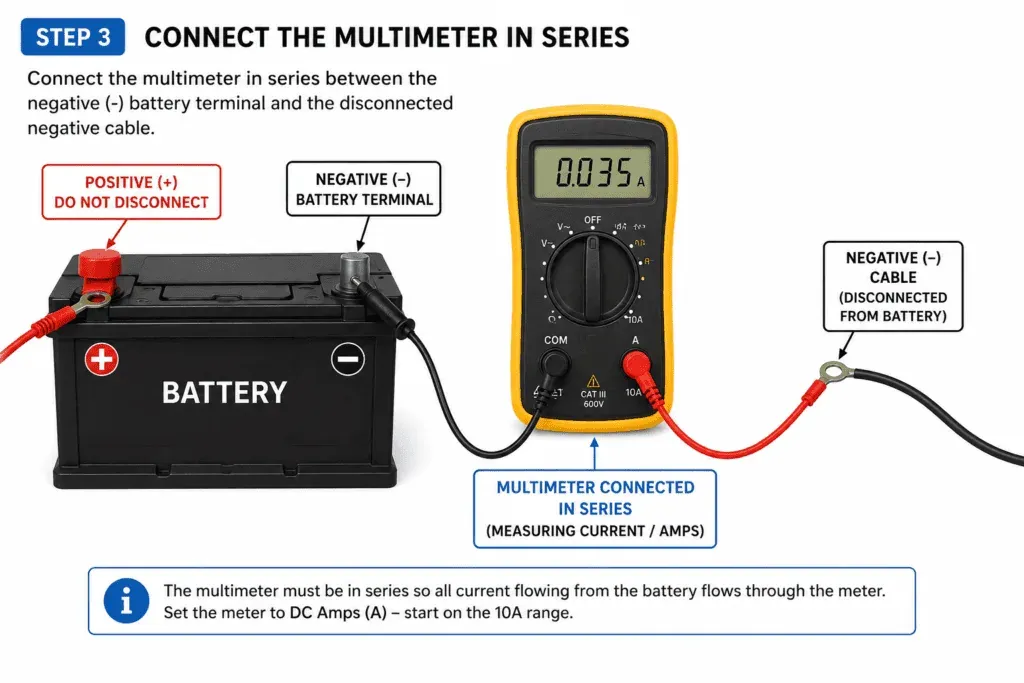
Here are the target voltages for common sizes.
| Battery type | Full voltage reading | What makes it different | Watch for this during the test |
|---|---|---|---|
| AA or AAA alkaline | 1.5V – 1.6V | Small contact points make probe placement tricky | Slipping probes cause wild number jumps |
| 9V alkaline | 9.0V – 9.6V | Both terminals sit close together on top | Probes touching each other causes a short |
| CR2032 coin cell | 3.0V – 3.3V | Very thin edges are hard to grip firmly | Finger oils change the reading slightly |
| 12V car lead-acid | 12.6V – 12.8V | Heavy terminals require firm probe pressure | Loose clips drop the reading falsely low |
| 3.7V lithium-ion cell | 4.1V – 4.2V | Charges higher than its printed name suggests | Never test a swollen or damaged cell |
These figures assume room temperature, around 68°F to 77°F. Cold weather pulls voltage down temporarily, so a battery tested outside in winter might look weaker than it really is. Bring it inside for twenty minutes and test again.
How to read your multimeter results
A strong battery holds its rated voltage even when you connect the probes. A weak one drops quickly or shows a number far below what’s printed on the label.
For a standard 1.5V AA cell, anything over 1.5V is ready to use. Between 1.3V and 1.5V, it’ll run low-drain things like a wall clock but won’t power a camera flash. Below 1.3V, recycle it.
For a 12V car battery, 12.6V means fully charged. At 12.0V, you’re sitting around half capacity, and the engine might crank slowly. Anything under 11.9V usually means the battery can’t start your car reliably.
Cleanup and safety rules
Put your multimeter away with the dial turned to OFF.
The US Environmental Protection Agency asks that you never throw lithium-ion or rechargeable batteries in the regular trash. Drop them at a designated recycling point instead. Alkaline cells can go in household trash in most US states, but local rules differ, so check your city’s waste website.
A resting voltage test only tells you what the battery holds right now. It doesn’t prove the battery can deliver heavy current under load. The exact time a battery lasts depends on the device pulling power from it, and you can read your own device’s draw rate on its specification label.
Other ways to check charge

Using a dedicated battery tester
A standalone battery tester applies a small electrical load while it measures voltage. This reveals if a cell actually has power to give, rather than just showing surface charge. These cost a bit more than a basic meter but take the guesswork out of weak batteries.
Testing under a real load
Leave the battery inside the device it normally powers and measure the voltage there. You’ll see what happens when actual current flows through it. This requires reaching the terminals while the device runs, which isn’t possible on every gadget.
Taking it to an auto parts store
Car batteries need a proper load test that draws hundreds of amps briefly. Most auto parts shops do this free using specialized equipment. Don’t try to build a heavy load yourself, as shorting a large battery generates dangerous heat instantly.
Related guides
- How a Primary Battery Works and When to Use One: A Guide
- TF-100 vs K-2006: Which Pool Test Kit Is Right for You in 2026
- Best Time to Test Pool Water: 5 Essential Testing Tools in 2026
Frequently asked questions
Can I test a battery while it’s still in the device?
Yes, you can measure voltage with the battery seated if you can reach both terminals with your probes. However, the device must be turned off to get a true resting voltage. If it’s running, you’re measuring the voltage under load, which is lower than the resting voltage and doesn’t indicate the battery’s total capacity.
Why does my multimeter reading keep jumping around?
Unstable numbers mean your probe tips aren’t gripping the battery terminals tightly. Oxidation or dirt on the metal contacts causes this poor connection. Clean the terminals with a dry cloth or gently rub them with fine sandpaper. Once the bare metal touches cleanly, the display will settle within two seconds.
How long does a voltage test take?
A single battery takes about ten seconds from the moment you turn on the multimeter to the moment you read the screen. Holding the probes steady for three seconds gives the meter time to average the signal. Testing a whole drawer of mixed cells usually takes under five minutes total.
Is it safe to test a leaking battery?
No, don’t put multimeter probes on a battery that’s leaking fluid or white powder. The leaked chemicals are corrosive and can damage your probes or irritate your skin. Put on gloves, place the battery in a plastic bag, and dispose of it according to your local waste authority’s guidelines.
What happens if I touch the probes together on the battery?
Touching both probes together while they contact the battery terminals creates a short circuit. The battery dumps its energy rapidly through the thin meter wires, heating them up. This drains the battery quickly and can blow the internal fuse inside your multimeter. Keep the metal shafts apart.
How often should I check my car battery voltage?
Check it twice a year, ideally before summer and winter hit. Extreme temperatures stress lead-acid batteries the most. If your reading drops below 12.4V between checks, put it on a smart charger overnight. Waiting until the car struggles to start means the battery plates may already be damaged.
Can a multimeter tell me how many hours a battery will last?
No, a voltage reading only indicates the battery’s current charge, not its remaining lifespan. Runtime depends entirely on your device’s power consumption. To estimate total hours, divide the milliamp-hour rating printed on the battery label by the current draw of your specific device.
Conclusion
If the readout stays low, it’s time to recycle the old unit properly rather than tossing it in the trash. You shouldn’t keep dead batteries around, as they can leak and damage your devices. Check your local community guidelines to find a nearby drop-off center where they’ll handle it safely for you.
