
As an Amazon Associate, we earn from qualifying purchases. This post contains affiliate links – if you buy through them, we may earn a commission at no extra cost to you.
Choosing the right camping lighter depends on the type of trips you take and what conditions you might face. Some lighters work in rain and wind, others are simple and basic, and a few do more than just make fire. We looked at 94 options on Amazon, comparing how they’re built, what fuels them, and what real use asks of you. The top picks split on toughness, ease, and what happens when things get wet or windy.
Best overall: Waterproof Butane Torch Lighter – It resists wind and water with a strong jet flame, making it ready for tough outdoor jobs like lighting grills or campfires in bad weather.
Best for long-term reliability: Zippo Classic – Made from metal with a lifetime guarantee, it’s built to last years and works again after every refill, even after impact or exposure to wind.
Best for quick, no-fuss use: Coghlan’s Disposable Gas Lighter – With one hand operation and an adjustable flame, it lights fast and needs no charging or fuel buying ahead.
This guide is for campers who want honest tradeoffs — not hype — so you can pick what fits your pack, your style, and your worst-day-in-the-woods plan.
How We Picked
We reviewed 94 Amazon listings for camping lighters, focusing only on clear facts each seller provided. To make the list, a product had to state its build materials, fuel type, and key features like wind resistance or rechargeability. We also checked for safety details, portability, and whether it needed extra parts like fuel or chargers.
Products were ruled out if they lacked basic use info or made claims without support — like saying “indestructible” with no material proof. We didn’t judge by brand name alone or unverified promises like “lasts forever.” Only lighters that clearly said how they work, what they need, and where they perform made the cut.
Each pick here stands for a real choice: durability over convenience, simplicity over tech, or multi-use over single task. What matters most is whether the lighter will work when wet, how often it fails, and what you must carry with it.
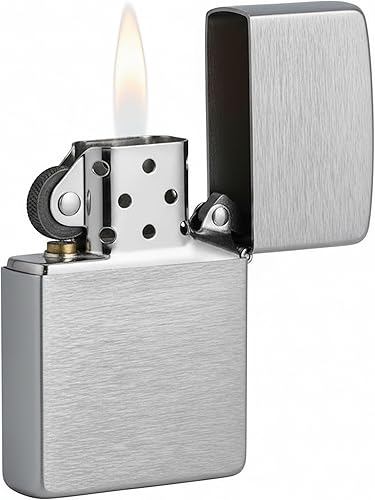
1. Zippo Classic Brushed Chrome Pocket Lighter
Best for: Campers who want a lifelong tool
The Zippo Classic feels solid in your hand thanks to its brushed chrome metal body. It’s small enough to fit in a pocket but heavy enough to know it’s built tough. The flip-top lid snaps shut with a satisfying click, which many people like — it gives confidence the flame won’t go out easily.
Its windproof design has been tested in real conditions for decades. While it needs fluid and flints bought separately, refilling is simple once you learn it. And because Zippo offers a lifetime fix-it-free guarantee, you don’t toss it when it fails — you send it in.
You must buy genuine Zippo fuel and parts for reliable performance.
Pros
- Built to last with metal body
- Lifetime repair guarantee
- Works in wind with proper fuel
Cons
- Needs separate fuel and flints
2. SOTO Pocket Torch Lighters

Best for: Outdoor cooks and serious campers
This torch packs a powerful flame that hits 1300℃ (about 2300°F), hot enough to light damp wood or charcoal fast. It has a telescoping burner head for extended reach during use. That makes it great for backyard BBQs or backcountry meals.
Electronic ignition means no rubbing a wheel — just press a button and you get flame. It runs on common butane, refillable with a standard adapter. The grip is comfortable, and the child-resistant lock adds safety around kids.
The SOTO Pocket Torch is designed for optimal performance below 5,000 feet elevation. Also, since it’s shipped empty, you can’t test it until you buy fuel.
Still, for low-altitude camping and cooking, it’s one of the most capable tools. Just keep it away from extreme heights.
Pros
- High-temperature flame for fast lighting
- Extended burner for safe reach
- Easy electronic start and refill
Cons
- Loses power above 5,000 ft
- Sold without fuel — can’t use right away
3. MEIRUBY Electric Lighter Candle Lighter Rechargeable USB Lighter Arc Lighters

Best for: Daily users wanting eco-friendly fire
This electric arc lighter uses no gas — just a USB charge. The MEIRUBY electric lighter can be used 600 times on a single charge. It’s splashproof and windproof thanks to plasma arcs that don’t blow out, so it works even in light rain.
Its slender shape slips into a pocket or purse easily. Lighting candles or campfires takes one button press. The battery level shows in real time with LED lights, so you know when to recharge.
But it’s not built for heavy outdoor use. There’s no flashlight or lanyard, and the case feels more plastic than rugged. The listing does not state impact resistance on hard surfaces. And while it says it replaces 300 lighters, that number comes from the seller — not a lab test.
So it’s best for casual use, not survival trips. Great for home, okay for short hikes.
Pros
- Wind and splash resistant
- Shows battery level clearly
Cons
- Plastic body not for rough handling
- No extra tools like whistle or light
4. SUPRUS Electric Lighter Arc Windproof Flameless USB Rechargeable Lighter

Best for: Compact carry with safety focus
This lighter is small and sleek, colored champagne gold with a smooth finish. It weighs little and fits in tight pockets, making it easy to bring anywhere. The dual safety switch means kids can’t turn it on by accident — you must unlock first, then press to spark.
Like other electric models, it uses plasma arcs that resist wind. Rain or gusts won’t stop it from lighting candles, stoves, or campfires. A full charge takes about two hours and lasts for 150–300 uses.
It also shows charge status with four LEDs — all lit means full. And it comes in a gift box with cable and manual, so it’s ready to give or use.
But the build is lightweight, not heavy-duty. It lacks a flashlight or emergency tools. So while safe and portable, it’s not the one to rely on in true survival situations.
Pros
- Compact and easy to carry
- Double safety switch for kids
- Clear battery indicator
Cons
- Not built for hard impacts
- No added survival features
5. Survival Frog Tough Electric Lighter 2.0

Best for: Hikers needing a survival-ready tool
This orange lighter is made for tough use. It’s waterproof and works in storms or downpours. Push a button and the twin plasma arcs fire up — no fear of wind blowing them out. It charges via USB in about two hours and gives around 300 lights per charge.
What sets it apart is what else it does. There’s a built-in flashlight with three modes, handy at night or in emergencies. A whistle is built in too, loud enough to signal help. And it comes with a paracord lanyard you can use in survival tasks.
Made from zinc alloy and strong plastic, it feels dense and durable. At just 2.1 oz, it won’t weigh down your pack. All this makes it ideal for real outdoor risks.
But the battery is smaller — 220 mAh — so it doesn’t last as long between charges as some others. It’s designed for users who recharge frequently and value compact size over extended use.
If you want one device that lights fires, gives light, and helps call for help, this is it.
Pros
- Waterproof and windproof
- Flashlight, whistle, and lanyard included
- Tough build for outdoor abuse
Cons
- Smaller battery than bulkier models
- May need frequent recharging on long trips
6. Scotte Plasma Windproof arc Lighter Electric Lighter and LED Flashlight

Best for: Those who want two tools in one
This black lighter does double duty: one end is a twin-arc electric lighter, the other a bright LED flashlight. That means you don’t need to carry both items. The lighter starts fast with a button and resists wind thanks to plasma tech.
The flashlight has two modes — steady beam and flashing signal — useful at night or in emergencies. A full charge takes about two hours and powers 150–300 lights or several hours of beam.
It comes with a 5-in-1 magnesium fire starter that adds backup fire-making capability. This kit works even when batteries die, making it a smart backup.
Together, they form a complete fire-and-light system. However, the main lighter still depends on charge. And the fire starter, while helpful, is small — not for prolonged survival.
Still, for preparedness, few kits combine so many essential tools in a single compact design.
Pros
- Lighter and flashlight in one
- Comes with full fire-starting kit
- Auto-shutoff for safety after 7 seconds
Cons
- Main lighter needs charging
- Fire starter compact, not full-size
7. BIC Multi-Purpose Classic Edition Lighters

Best for: Families needing spares
This pack gives four long-handled lighters in one box. Each has a metal wand that allows safe flame access — ideal for lighting grills, fireplaces, or candles without risk. They’re simple and easy to replace, so losing one isn’t a big deal.
BIC says each lighter goes through over 50 quality checks. They’re child-resistant, meaning a push-and-slide motion stops kids from turning them on by accident. That makes them safer around the house.
Since they’re disposable, you don’t refill or recharge. When one runs out, you toss it and grab another. That’s good for short trips or power outages when immediate ignition is essential.
But they’re not built to last. Once the fuel is gone, it’s gone. And they don’t work well in strong wind or rain. So they’re best as backups, not your only option.
For everyday jobs where fire is quick and simple, these get the job done.
Pros
- Four lighters in a pack
- Long wand protects fingers
- Child-resistant design
Cons
- Not reusable — throw away when empty
- Weak in wind and wet
8. Waterproof Butane Torch Lighter

Best for: Reliable outdoor lighting
This black torch lighter is built to handle the elements. A rubber seal makes it waterproof, and a safety lock keeps it from turning on in your bag. The high-pressure jet flame hits 2850°F — hot enough to light anything from campfires to fireworks.
It’s refillable with butane, so you don’t throw it away. A fuel gauge lets you see how much gas is left by holding it to light. Flame height adjusts without tools, giving control for delicate or heavy jobs.
Made from engineering plastic and zinc alloy, it survives drops and bumps. A lanyard helps you carry it on a belt or pack. For campers who face wind, rain, or cold, this is a solid daily driver.
The seller offers a 1-month no-questions-asked refund service.
But it ships without gas, so you can’t test it until you buy fuel.
Pros
- Waterproof and windproof
- Strong flame up to 2850°F
- Durable build with lanyard
Cons
- Shipped empty — fuel sold separately
- Needs butane supply on hand
9. Exotac nanoSPARK Ultra-Compact Fire Starter with One-Handed Operation High-Spark Flint

Best for: One-handed fire starting
This tiny fire starter is unlike any other. It works with one hand — crucial if you’re injured or wearing gloves. The flint wheel sparks easily, even when wet, and the body seals tight against rain.
Inside, a small chamber holds tinder or spare flints. That means you carry fire-making supplies together. It’s ultra-compact, smaller than most lighters, so it fits in tight spaces.
Because of the lack of specs, it’s hard to recommend for everyone. But for backpackers who prioritize lightweight gear and easy operation under strain, it could be worth exploring.
Pros
- Operates with one hand
- Stores tinder and flints inside
- Sealed against water
Cons
- Few details in listing
- Unknown durability without testing
10. Coghlan’s Disposable Gas Lighter

Best for: First-time campers
This lighter is simple and ready to use. Turn the knob and press the button — flame appears. The adjustable height lets you set a small spark or big jet, depending on the job. That makes it flexible for candles, stoves, or campfires.
It’s windproof and butane-powered, so it lights reliably in most conditions. The child-resistant feature adds safety at home or in camp. And it’s compact, light, and easy to pack.
No charging or refilling needed — just use it until it runs out. Then toss it. That makes it perfect for short trips or as a spare.
But since it’s disposable, it’s not eco-friendly. And once empty, you can’t fix it. Still, for beginners who want zero learning curve, it’s one of the easiest choices.
Pros
- Simple twist-and-light action
- Adjustable flame control
- Lightweight and portable
Cons
- Can’t be refilled — must replace
- Not sustainable long-term
How to Choose in Sixty Seconds
What’s the real difference between electric and fuel lighters?
Electric lighters use a battery and plasma arc to create fire — no flame, no fuel. They’re windproof and rechargeable, so they work in rain and don’t run out mid-trip unless drained. But they need charging, and cold weather can reduce battery life. Fuel lighters (butane or fluid) give instant, steady flame and work longer between refills. They’re better for heavy use but can fail in wind unless designed to resist it. Your choice depends on access to power and how often you’ll use it.
Which camping lighter should I avoid?
Avoid any lighter that doesn’t clearly state its fuel type, materials, or safety features. If it claims “indestructible” or “works forever” without proof, skip it. Also, avoid high-altitude use with models like the SOTO Pocket Torch — they lose power above 5,000 feet. And don’t trust disposables with no child lock or quality checks. Simplicity is fine, but safety and clarity matter most.
Do I need a lighter with extra tools?
Only if you camp in risky conditions. A built-in flashlight, whistle, or fire starter helps in emergencies. Models like the Survival Frog or Scotte add real value when things go wrong. But for backyard fires or short hikes, those extras aren’t needed. Stick to simple, reliable tools. More functions mean more points of failure — so match the tool to your trip risk.
Related guides
Frequently Asked Questions
What do I need to use with my camping lighter?
Most lighters need something extra. Zippo models require fluid and flints bought separately. Butane torches need gas canisters. Electric ones need a USB cable and power source. Even disposables eventually run out. Always check what the listing says it includes — many arrive empty. And confirm fuel compatibility before buying extras. For example, SOTO works with normal butane or mixed canisters, but not propane-only.
What maintenance do camping lighters need?
Refillable lighters need regular care. Zippo types need fresh wicks and flints every few months with heavy use. Butane torches should have clean nozzles and stored upright. Electric models last longer if charged before fully draining. Keep all lighters dry and away from dust. Store them in a case or pouch. And never leave them in hot cars — heat builds pressure in fuel tanks and damages batteries.
What usually breaks first on a camping lighter?
On fuel lighters, the ignition wheel or valve fails first — especially when exposed to moisture. In electric models, the battery wears out after repeated charging. Buttons and switches can stick or stop responding. Cheaper plastics crack under stress. Metal-bodied lighters like Zippo survive longest, but their internal parts still wear. Regular cleaning and proper storage slow these issues.
Is a disposable lighter good enough for camping?
Yes, for short trips or as a backup. BIC or Coghlan’s disposables light grills, stoves, and candles fast. They require no setup and are easy to find. But they don’t last. In wind or rain, they may fail. And carrying several adds waste. For weekend camping, they’re fine. For longer or remote trips, a reusable model is smarter. You’ll save money and reduce trash. Use disposables as spares — not your only plan.
Conclusion
Waterproof Butane Torch Lighter is our top pick for most campers. It handles wind, water, and daily wear. Zippo Classic is best for those who want a tool that lasts years with care. Before you go, check your gear — make sure you have fuel, a way to charge, or backups ready.