
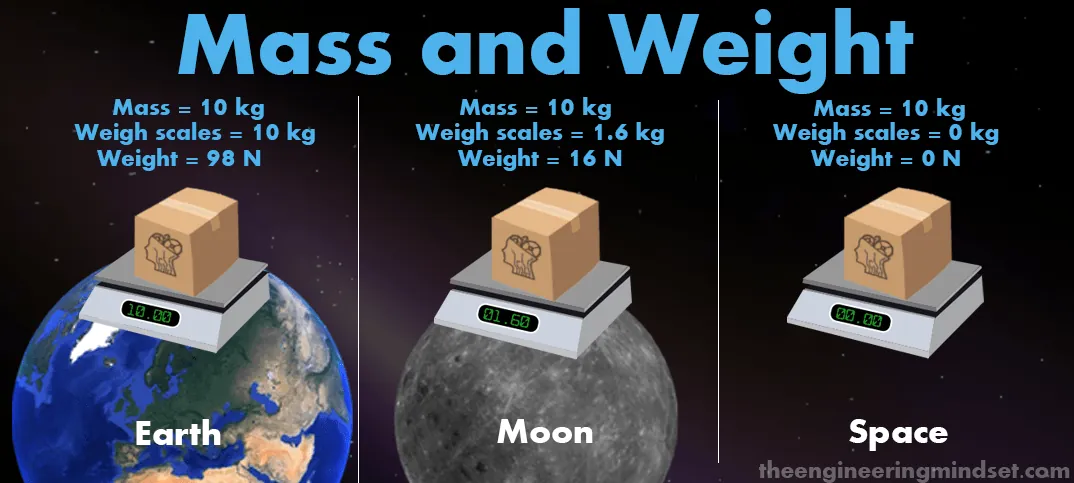
Mass is the amount of matter inside an object, while weight is the gravitational force pulling that matter down. The core idea behind mass and weight what they’re and their differences comes down to one thing: location. Your mass stays exactly the same everywhere in the universe, but your weight changes depending on how strong local gravity is. On Earth, a 10-kilogram object weighs about 98 newtons; on the Moon, it still has 10 kilograms of mass but only pulls with roughly 16 newtons of force.
Mass vs weight quick facts
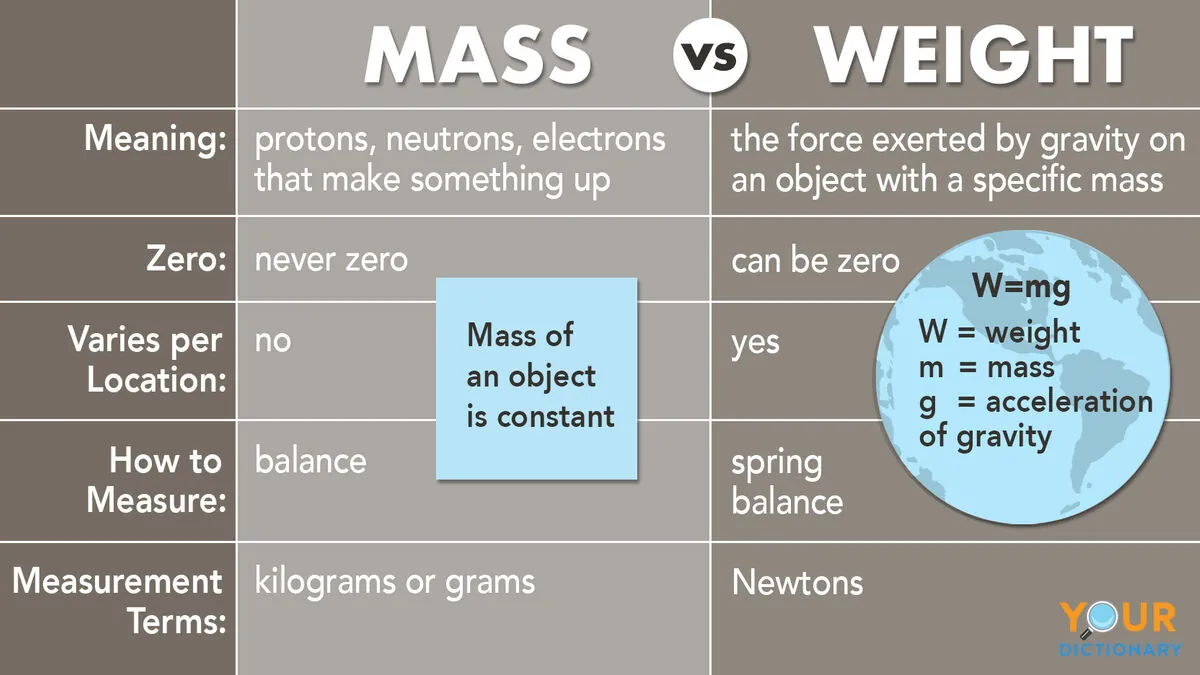
- Mass measures matter in kilograms (kg) and never changes when you move to another planet or station.
- Weight measures gravitational pull in newtons (N) and drops to about one-sixth on the Moon compared to Earth.
- You calculate weight by multiplying mass in kg by local gravity in meters per second squared (m/s²).
- A standard bathroom scale actually reads the downward force, then divides by 9.8 m/s² to display kg.
- In deep space far from large bodies, your weight approaches zero while your mass remains completely unchanged.
- Engineers use mass for inertia calculations but switch to weight when designing structures that must support loads.
Why gravity separates the two
Mass belongs to the object itself. It’s the total count of atoms packed together, and nothing outside the object alters that count. You can’t change it by moving, falling, or floating. Weight, however, isn’t a property of the object at all. It’s a relationship between the object and whatever massive body sits nearby.
Earth pulls everything toward its center. That pull accelerates objects at 9.8 m/s² near the surface. Multiply your mass by that acceleration, and you get your weight in newtons. The formula is W = mg, where W is weight, m is mass, and g is local gravitational acceleration.
If you travel to a location with weaker gravity, the downward force decreases while your mass remains constant. Because you still possess the same number of atoms, your mass doesn’t change even though you press down with less force. NASA explains this distinction in its mass versus weight guide.
This matters beyond space travel. If you’re sizing a motor to lift a load, you need the weight at your specific location. If you’re calculating how hard it’s to push that same load sideways on a frictionless track, you only care about mass.
Using weight for an inertia problem gives you the wrong answer every time, because resistance to acceleration depends purely on how much matter you’re trying to move, not how hard gravity pulls it down. Pick the right measurement for the job.
When weight changes but mass doesn’t

The simple rule works perfectly on Earth’s surface, but different environments shift the numbers.
| Situation | What changes | What to do instead |
|---|---|---|
| Standing on the Moon | Gravity drops to 1.6 m/s² | Multiply mass by 1.6 |
| Orbiting in the ISS | Freefall cancels felt weight | Use mass only for physics |
| High mountain peak | Gravity slightly weaker than sea level | Expect fractionally lower readings |
| Deep underwater | Buoyancy pushes up against gravity | Measure apparent weight, not true weight |
| Jupiter’s surface | Gravity reaches about 24.8 m/s² | Multiply mass by 24.8 |
| Elevator accelerating upward | Floor pushes harder than gravity alone | Add elevator’s acceleration to g |
How to calculate weight from mass
You don’t need special equipment to find weight if you already know the mass. Just follow these steps with a calculator.
- Find the object’s mass in kilograms. Read it from a balance scale or check the manufacturer’s label, since balances compare masses directly without relying on gravity.
- Identify the local gravitational acceleration. Use 9.8 m/s² for Earth’s surface, 1.6 m/s² for the Moon, or look up the exact value for your specific location.
- Multiply the mass by the gravitational acceleration. For a 5 kg bag on Earth, compute 5 × 9.8 to get your result in newtons.
- Check your units. The answer must be in newtons (N). If you accidentally left it in kilograms, you’ve recorded mass again instead of calculating the actual force.
- Adjust for altitude if precision matters. At higher elevations, gravity weakens slightly, so subtract roughly 0.003 m/s² for every kilometer above sea level before multiplying.
- Verify by comparing to a spring scale reading. A spring scale measures force directly in newtons, so its number should match your calculated result within the device’s margin of error.
Errors that mix them up
- Reading a spring scale as pure mass. Spring scales measure force, so taking them to a different planet gives you a different number for the same object. You’ll order the wrong amount of material if you treat that shifting reading as fixed mass.
- Using pounds for both interchangeably. “Pound-mass” and “pound-force” are entirely different units sharing the same word. Mixing them in engineering math causes structural failures because the numbers differ by a factor of 32.2.
- Assuming zero gravity means zero mass. Objects in orbit still resist being pushed or stopped exactly as much as they do on the ground. Astronauts who forget this send heavy tools flying through stations because the mass still requires real force to accelerate.
- Weighing things near strong magnets. Magnetic attraction adds extra downward force to a scale’s reading. You’ll record a falsely high weight and calculate the wrong mass if you don’t remove the magnetic interference first.
Frequently asked questions
Can something have mass but no weight?
Yes, it happens constantly in orbit. An astronaut aboard the International Space Station has the exact same mass they had on Earth, but they experience continuous freefall. Because nothing pushes back against them, a scale under their feet reads zero. Their weight vanishes while their mass stays locked in place.
Why does my weight change on different planets?
Weight equals mass multiplied by local gravity, and every planet has a different mass and radius. Mars produces about 3.7 m/s² of surface gravity, while Earth generates 9.8 m/s². Your body contains the same atoms everywhere, but the weaker planetary pull on Mars reduces the downward force you feel.
How long does mass stay constant?
Mass remains constant permanently unless you physically add or remove matter from the object. Heating, cooling, moving, or changing altitude doesn’t alter the atom count. Even traveling near light speed increases relativistic momentum, but the rest mass printed on a particle’s specification sheet never shifts over time.
Is it safe to use a kitchen scale for weight?
Kitchen scales display grams or ounces, which are mass units calibrated for Earth’s 9.8 m/s² gravity. They work fine for cooking here because the conversion factor stays constant across your countertop. Take that same scale to the Moon, and it will show one-sixth of the real mass, ruining any recipe.
What happens if you confuse mass and weight in engineering?
Structures fail when designers substitute one for the other. If you size a bridge cable using mass instead of the actual gravitational force pulling down, you’ll underestimate the load by a factor of 9.8. Cables snap under forces nobody planned for because the math used the wrong unit entirely.
Does air affect weight measurements?
Air creates buoyancy, pushing upward against gravity just like water does. A very light, large object like a balloon displaces enough air to reduce its apparent weight significantly. Precision laboratories correct for this by calculating the displaced air’s mass and adding it back to the scale reading.
How many newtons equal one kilogram of mass?
On Earth’s surface, one kilogram of mass produces 9.8 newtons of weight. That figure assumes standard sea-level gravity. If you’re working at high altitude or near the poles where gravity strengthens slightly, the exact number shifts, so always multiply by your location’s specific gravitational acceleration rather than assuming 9.8 universally.
Do digital scales measure mass or weight?
Digital bathroom scales calculate your weight by measuring the downward force exerted on their sensors. They internally divide this force by 9.8 m/s² to display a value in kilograms. This converted measurement remains accurate only while you’re on Earth, where gravity stays relatively constant.
Conclusion
Understanding these concepts helps you see the world differently, whether you’re looking at the stars or just weighing your groceries. Next time you step on a scale, you’ll realize it’s actually measuring the pull of the planet beneath your feet. It’s a simple shift in perspective that’s worth keeping in mind.
