
An inductor is a passive electronic component that stores energy in a magnetic field when electric current flows through it. This guide explains how inductors work, how to pick one, and what to watch for when you use one in a circuit.
A complete look at the inductor
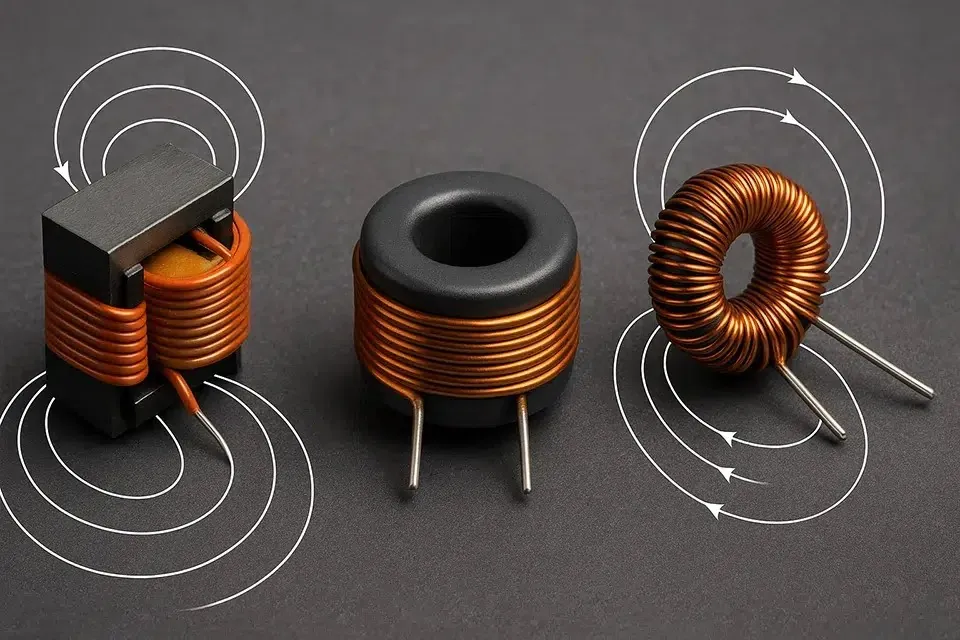
An inductor is a coil of wire, usually wrapped around a core of air, iron, or ferrite. It resists changes in current: when current tries to rise, the inductor builds a magnetic field and pushes back; when current tries to fall, the collapsing field keeps current moving for a moment.
That behavior makes inductors useful in power supplies, radio tuning circuits, and filters that block unwanted frequencies. A common misconception is that an inductor stores energy like a battery; it stores it temporarily in a magnetic field, not as chemical charge.
If you need to filter high-frequency noise, choose a ferrite core for its high permeability. If you’re building a radio circuit where precision matters, stick to air-core inductors to avoid core saturation.
The energy it holds depends on its inductance, measured in henries, and the current flowing through it. Beginners often mistake high inductance for high current capacity, but a coil with too thin a wire will melt under heavy loads.
How inductors work in a circuit
- Identify what the circuit needs: filtering, energy storage, or timing.
- Choose an inductance value in microhenries or millihenries based on the circuit design.
- Check the current rating so the wire doesn’t overheat under load.
- Pick a core material: air for high frequencies, iron or ferrite for power circuits.
- Mount the inductor with space around it so heat can escape.
- Connect it in series to block high frequencies or in parallel to smooth voltage.
The single judgement call is saturation current: if the circuit pushes more current than the inductor is rated for, the core saturates and the part stops behaving like an inductor, which can damage downstream components. If you’re designing a power supply that handles significant current, have the design reviewed by someone with electronics training.
Key numbers and settings at a glance
These figures cover the most common variations you’ll face when choosing an inductor.
| Situation | What to use | How long | What to watch for |
|---|---|---|---|
| High-frequency radio circuit | Air-core inductor | Continuous use | Low inductance value |
| Power supply filtering | Iron or ferrite core | Continuous use | Saturation current |
| Smoothing DC voltage | Large-value inductor | Continuous use | Physical size and heat |
| Signal blocking | Series inductor | As long as signal runs | DC resistance |
| Tuning a radio frequency | Variable inductor | While adjusting | Core material losses |
Check the manufacturer’s datasheet for the exact saturation current, DC resistance, and inductance tolerance for the part you’re considering, because these numbers vary by model and aren’t universal.
What separates good results from bad ones
Experienced designers check the DC resistance before choosing a part, because high resistance wastes power as heat. They also verify the saturation current at the highest load the circuit will see, not just at normal operation. Partway through a build, they confirm the inductor doesn’t run hot to the touch after sustained use. They leave sensitive analog traces away from the inductor, since its magnetic field can induce noise in nearby wires.
Many beginners mistake the rated current for the saturation current, leading to sudden, catastrophic core saturation under transient spikes.
Common problems and quick fixes

| What you notice | What it usually means | What to do first |
|---|---|---|
| Circuit overheats | Inductor saturated or too small | Reduce load or use a higher-current part |
| High-frequency noise passes through | Inductance too low for the frequency | Choose a larger value or different core |
| Voltage doesn’t smooth | Wrong placement or value | Confirm series versus parallel use |
| Inductor hums or vibrates | Core loose or overloaded | Secure the core or lower the current |
If the part is physically damaged or the circuit keeps failing after these checks, stop and consult a qualified electronics technician rather than replacing parts blindly.
The rules that apply
Inductors must meet safety and electromagnetic standards when they’re built into products sold in the United States. The Federal Communications Commission sets strict limits on electromagnetic interference that electronic devices can emit. You must test your final assembly before marketing it to ensure it stays below these thresholds.
Underwriters Laboratories publishes essential safety standards for components used in power supplies and similar high-voltage equipment. If you’re building a product for sale, have it evaluated by a certified testing lab to confirm compliance. Selling non-compliant electronics invites severe legal penalties and potential product recalls.
Distinguish between consumer and industrial use early. If your device connects to a public power grid, it faces rigorous UL 60950-1 scrutiny. If it remains contained within a closed industrial loop, you may qualify for different exemptions. Always check your specific certification class before finalizing your board layout.
Keeping it working afterwards
Inductors are passive parts with no moving elements, so they don’t wear out on their own. Keep them dry, free of dust, and within their rated temperature range. If the circuit is opened for service, check that the connections are tight and that the core isn’t cracked or loose.
Vibration often causes micro-fractures in ferrite cores. If you notice a sudden drop in inductance or increased heat, inspect the core for hairline cracks under a magnifying glass. A cracked core loses its magnetic permeability and will cause the circuit to oscillate or overheat.
Replace the inductor only with a part that matches the original inductance, current rating, and core type. Substituting a different value shifts the resonant frequency of your filter or power stage.
When an inductor is the wrong choice
For frequencies exceeding the self-resonant point, an inductor’s parasitic capacitance dominates, turning your filter into a high-frequency bypass. If your signal frequency sits within 20% of the manufacturer’s self-resonant frequency, switch to a ferrite bead to maintain impedance.
Space constraints often tempt designers to swap inductors for resistors. Calculate the power loss as I squared R to ensure your board can handle the localized heat.
When your application requires rapid energy bursts, inductors fail because they resist current changes. If your load demands a transition time under 50 nanoseconds, use a capacitor.
Related guides
- 10 Best Woods for Kitchen Countertops: Expert Selection in 2026
- Best Toilet Bolt Caps and Hardware Kits: Selection Guide in 2026
- Best Range Hood for Small Kitchens: Expert Selection Guide in 2026
Frequently asked questions
What does an inductor do?
It stores energy in a magnetic field and resists changes in current flow.
Can an inductor store energy like a battery?
No. It stores energy only while current flows, and releases it when the field collapses.
How long does an inductor last?
It has no fixed service life; it lasts as long as it stays within its current and temperature limits.
Is it safe to touch an inductor during operation?
No. It can become hot enough to burn skin under load; let it cool first.
What happens if the current is too high?
The core saturates and the inductor stops working, which can damage other parts.
How do I choose the right value?
Match the inductance and current rating to your circuit design, then check the datasheet.
Conclusion
An inductor is a simple part, but choosing the right one depends on your circuit’s current, frequency, and space limits. Check the manufacturer’s datasheet for the exact figures your design needs.
