
Drag in aerodynamics is the mechanical force generated by a solid object moving through a fluid, such as air, which acts in opposition to the direction of motion. This resistive force is a fundamental concept in physics that dictates how efficiently airplanes, cars, and cyclists move through the atmosphere. Essentially, as an object pushes through air molecules, it must displace them, resulting in an energy transfer that slows the object down or requires more power to maintain velocity.
Key Takeaways

- Minimize frontal surface area to reduce the primary component of resistive force.
- Use smooth surface finishes to prevent the transition from laminar to turbulent flow.
- Implement aerodynamic fairings on vehicles to help air reattach smoothly at the rear.
- Understand that drag increases exponentially with velocity, not linearly.
- Prioritize streamlining to lower the coefficient of drag on high-speed equipment.
What is drag and what causes it?
In the study of fluid dynamics, drag is the cumulative effect of air resistance acting upon an object. It’s caused primarily by two physical phenomena: the difference in pressure between the front and back of the object and the friction between the air molecules and the object’s surface.
When air hits the leading edge of a vehicle, it creates a high-pressure zone. As the air flows around to the rear, it often detaches, creating a low-pressure wake that “pulls” the object backward.
The total resistive force is mathematically expressed using the drag equation, which accounts for air density, the object’s velocity, its frontal area, and its shape-dependent coefficient. The NASA Glenn Research Center explains that the coefficient of drag is a dimensionless number that reflects how aerodynamic a specific shape is. A sleek, teardrop-shaped object will have a much lower coefficient than a flat, square plate, even if their frontal areas are identical.
The Role of Skin Friction
Skin friction is a specific type of drag caused by the viscosity of the air. As air flows over a surface, the molecules immediately adjacent to the skin stick to it due to friction, creating a boundary layer. This layer exerts a shear stress on the object.
The smoother the surface, the thinner this boundary layer remains, which helps in maintaining laminar flow. When surfaces are rough, they trigger turbulent flow, which increases the energy loss and adds to the overall resistive force.
| Surface Condition | Flow Characteristics | Impact on Efficiency |
|---|---|---|
| Polished Metal | Laminar | High |
| Painted Composite | Laminar/Transitional | Moderate |
| Matte/Textured Plastic | Turbulent | Low |
| Exposed Rivets | Highly Turbulent | Very Low |
Pressure Drag and Separation
Pressure drag, often called form drag, is the most significant component for most vehicles moving at moderate to high speeds. It’s caused by the separation of the airflow from the surface of the object.
When the air can’t follow the contour of the body—typically at the rear—it detaches, creating a large, low-pressure wake behind the object. This pressure deficit creates a net force pushing the object backward. To combat this, engineers design vehicles with “tapered tails” to allow the air to rejoin gradually.
How does velocity affect drag?

The relationship between speed and air resistance isn’t a simple one-to-one ratio; it’s a squared relationship. If you double your speed, the drag force increases by a factor of four. This is why fuel economy drops drastically in automobiles once they exceed highway speeds. At low speeds, rolling resistance or mechanical friction might be the dominant force, but as velocity increases, aerodynamic drag quickly becomes the primary obstacle to performance.
Categorizing the Types of Drag
To manage air resistance, engineers categorize the force into distinct types. Understanding these allows for targeted optimization, such as choosing specific materials or altering the structural geometry.
- Parasitic Drag: The sum of all drag forces acting on the object, including skin friction and form drag.
- Induced Drag: A byproduct of lift generation, common in aircraft wings where pressure differences create vortices at the wingtips.
- Wave Drag: Occurs specifically at transonic and supersonic speeds when shock waves form around the object.
- Interference Drag: Caused by the interaction of airflows between two different parts of an object, such as where a wing meets a fuselage.
Pro Tip: When modifying a vehicle or piece of equipment for speed, focus on the rear section first. Closing the wake with a taper is often more effective than sharpening the front nose.
Minimizing Resistance in Design
Designers use several proven methods to reduce the total drag force. The most effective approach involves streamlining the body to keep the boundary layer attached for as long as possible. This involves removing sharp corners and ensuring that the transition between different surfaces is gradual. Using wind tunnels or computational fluid dynamics software, engineers test various iterations to find the optimal shape for a given application.
Common Design Features
- Fairings: Used on motorcycles and bicycles to enclose mechanical components.
- Diffusers: Placed under race cars to accelerate air and reduce pressure.
- Winglets: Small vertical extensions on wingtips to mitigate induced drag.
- Underbody Trays: Smooth panels that prevent air from getting trapped in the chassis.
Drag in Different Environments
The density of the fluid significantly influences the magnitude of the force. Air is much less dense than water, yet at high speeds, its effects are profound. In denser air—such as on a cold day or at sea level—the drag force is higher than it would be in thin, hot air at high altitudes. This is why aircraft engines are often more efficient at high altitudes, where the lower density reduces the resistance encountered by the airframe.
| Environment | Density Relative to Sea Level | Impact on Drag |
|---|---|---|
| Sea Level | 100% | Highest |
| 5,000 ft Altitude | 84% | Moderate |
| 10,000 ft Altitude | 70% | Lower |
| 20,000 ft Altitude | 45% | Lowest |
Why is streamlining so important?
Streamlining is the process of shaping an object to reduce its profile and allow air to pass around it with minimal disturbance. A perfectly streamlined body prevents the air from separating, thereby eliminating the low-pressure wake that causes the most significant drag. While it’s impossible to eliminate all resistance, effective streamlining allows for significant gains in speed and efficiency without requiring additional power output.
Warning: Never attempt to modify the exterior of a road-legal vehicle with homemade aerodynamic devices, as these can negatively affect stability, steering, and safety at highway speeds.
Comparing Aerodynamic Efficiency
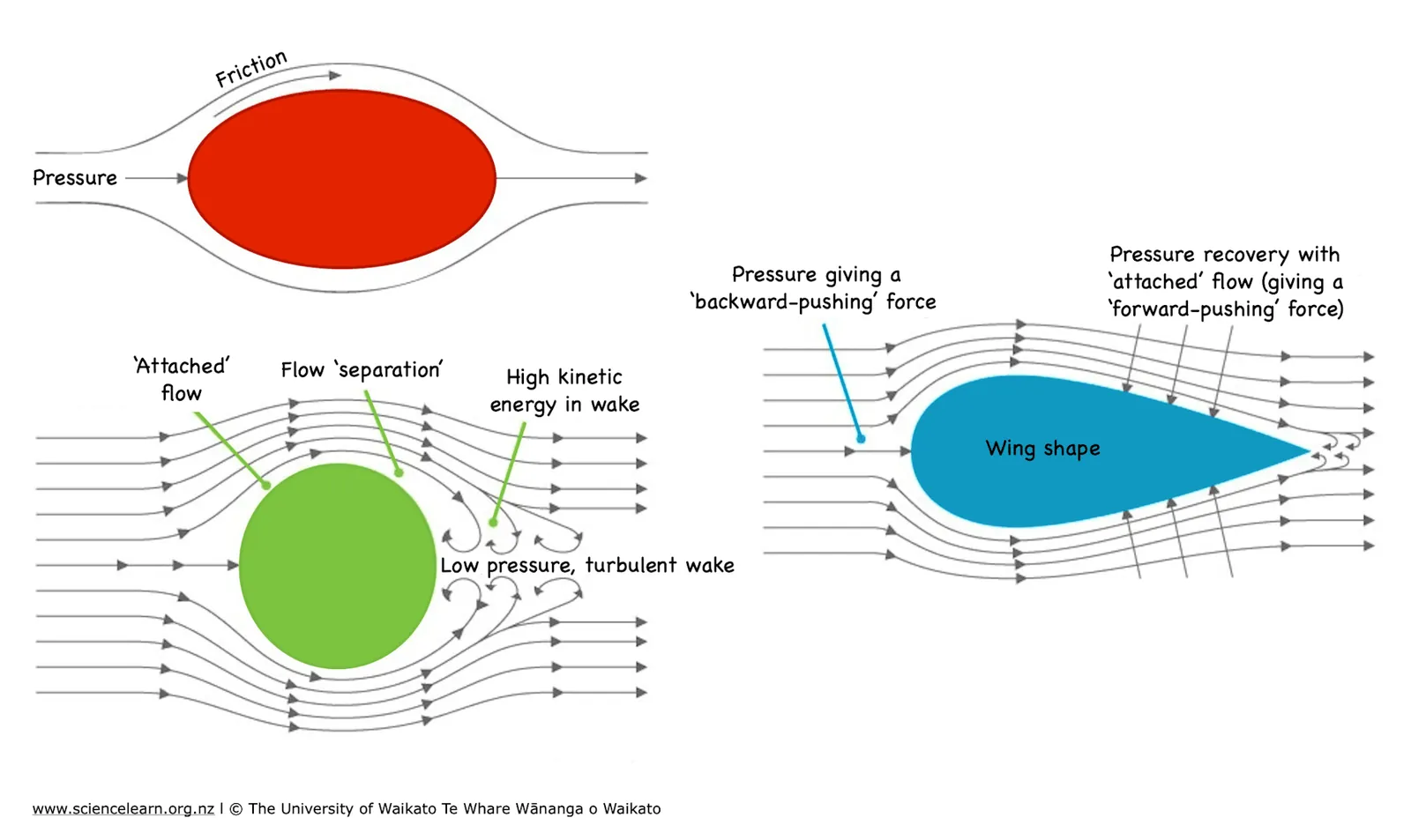
Not all shapes are created equal. The following table provides a general comparison of how different geometric profiles handle airflow. Note that these are approximations based on standard testing conditions.
| Shape | Drag Coefficient | Relative Efficiency |
|---|---|---|
| Flat Plate (Frontal) | 1.28 | Very Poor |
| Cube | 1.05 | Poor |
| Sphere | 0.47 | Moderate |
| Teardrop (Long) | 0.04 | Excellent |
| Streamlined Body | 0.02 | Superior |
Related guides
- Why Is My Pool Cloudy? 8 Common Causes and Quick Fixes in 2026
- Aqua Genie Skimmer Problems: 3 Common Causes and Fixes in 2026
Frequently Asked Questions
Does waxing a car reduce drag?
Yes, applying a high-quality wax to a vehicle can reduce skin friction by smoothing out microscopic imperfections in the clear coat. While the reduction in total drag is minimal at typical city speeds, it can provide a measurable improvement in efficiency at highway velocities, where parasitic drag is more pronounced. Keeping a surface clean and smooth is a simple way to optimize airflow.
Can I reduce drag on my bicycle?
You can significantly reduce drag by adopting a lower, more aerodynamic body position, which reduces your frontal surface area. Additionally, wearing tight-fitting cycling apparel prevents fabric from flapping, which creates turbulent flow. Using deep-section wheels and aero-profile handlebars can also help, as these components are specifically designed to slice through the air more efficiently than standard round-tube structures.
Is drag always a bad thing?
No, drag is essential in many applications. Parachutes rely entirely on high drag to slow down falling objects safely. Similarly, air brakes on aircraft are designed to increase drag intentionally to help the pilot decelerate during landing or descent. In these cases, the force is a tool for control rather than an obstacle to performance.
How does air density change drag?
Drag is directly proportional to air density. If the air is thicker, there are more molecules striking the object per second, which increases both pressure drag and skin friction. This is why vehicles generally perform better on hot days or at higher altitudes, where the air is less dense, resulting in less resistance against the moving object.
What is the difference between lift and drag?
Lift is the force generated perpendicular to the direction of motion, typically used to support an object in the air. Drag is the force generated parallel to the direction of motion, acting as a resistive force. While both are products of air interaction, lift is the goal of wing design, whereas drag is the byproduct that engineers work to minimize.
Conclusion
To continue improving your understanding of these forces, look up the specific drag coefficient for your vehicle model in its official owner’s manual or technical specifications sheet. By identifying the baseline efficiency of your equipment, you can better understand how small adjustments to your driving habits or vehicle maintenance can lead to measurable improvements in fuel economy and overall performance over time.
