
Delamination in composites is usually caused by weak bonding between layers or high stress concentrations. This separation happens when the internal forces exceed the strength of the resin matrix holding the fibers together. You can usually identify this issue through a simple tap test, where a dull, hollow sound indicates a lack of structural integrity beneath the surface compared to the sharp ring of solid material.
Primary causes of composite delamination

| Cause | How common | How to confirm it | Fix it yourself? |
|---|---|---|---|
| Impact damage | Very common | Visual cracks or dents | No |
| Manufacturing error | Common | Ultrasound inspection | No |
| Thermal stress | Frequent | Visible edge peeling | No |
| Moisture intake | Occasional | Surface swelling | No |
| Fatigue loading | Occasional | Vibrational changes | No |
| Chemical exposure | Rare | Material softening | No |
Impact damage on composite surfaces
High-energy impacts are the primary driver of internal layer separation in composite materials. When a hard object strikes the surface, the energy travels inward, causing the brittle resin to fracture between the plies. This often creates “barely visible impact damage,” where the surface looks fine, but the internal layers have already detached.
To confirm this, use a coin to perform a tap test across the affected area. Move the coin systematically in a grid pattern and listen for a sudden change in pitch. A solid, healthy laminate produces a sharp, high-pitched “click.” A delaminated area will sound “thuddy” or hollow. If you find such a spot, the structure is compromised and can’t support its original load.
Repairing this usually requires professional composite technicians. The process involves grinding away the damaged layers and laying down new, resin-impregnated fiber patches in a controlled environment. If you notice this on a structural part, such as an aircraft component or a load-bearing beam, don’t attempt a DIY fix. You must consult the relevant FAA Advisory Circulars regarding composite repair to understand the safety standards required for restoring structural integrity.
Manufacturing defects during the cure process
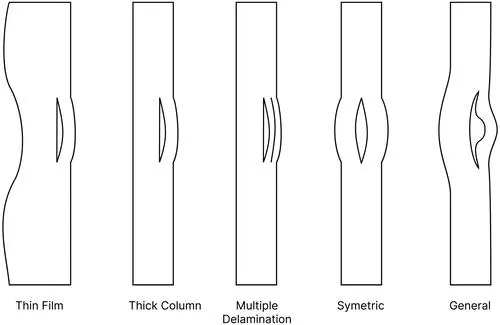
Manufacturing errors occur when the curing process fails to create a uniform bond between the layers. If the resin doesn’t flow correctly or if the pressure applied during the cure is uneven, small voids or “dry spots” remain trapped between the plies. These tiny air pockets act as stress concentrators that eventually grow into full-scale delamination under normal service loads.
You can distinguish this from impact damage by checking the location. Manufacturing defects often appear near corners, thick sections, or areas where the geometry of the mold was complex. Unlike impact damage, which is usually localized to a specific point of contact, manufacturing faults often run along the fiber orientation or follow the shape of the mold.
If you suspect a manufacturing fault, look for inconsistencies in the surface finish or resin richness. A part with proper cure should have a uniform appearance. If the area feels soft or shows signs of resin starvation, the material likely lacked sufficient pressure during the initial build.
In these cases, the part is often considered defective from the start. You should return it to the manufacturer rather than attempting to bond it yourself, as the internal weakness is likely systemic throughout the piece.
Thermal stress and expansion cycles
Thermal stress causes delamination when different materials within the composite expand or contract at different rates. Because fibers and resins have unique coefficients of thermal expansion, rapid temperature changes create internal shearing forces. These forces pull the layers apart, especially if the operating temperature exceeds the glass transition temperature of the resin matrix.
You can tell this apart from other causes by looking for edge peeling or cracks that coincide with extreme heat exposure. If the delamination starts at the edges of a part and moves inward, thermal cycling is the likely culprit. This is common in parts exposed to direct sunlight or those used near engines where the ambient temperature fluctuates wildly.
This process is slow and cumulative. While a single cycle might not cause a failure, hundreds of cycles eventually wear down the bond. If you see signs of edge separation, the resin has likely degraded or become brittle.
Once the resin loses its elasticity, it can no longer absorb the movement of the fibers. At this stage, the material has reached its service limit, and applying more resin to the edges won’t stop the internal separation from spreading deeper into the core.
Rare triggers for material failure
- Moisture absorption: Water molecules penetrate the resin and force the layers apart through swelling, usually identified by bubbles or blisters on the surface.
- Fatigue loading: Constant, repeated vibration or bending causes the microscopic cracks between layers to link up, often diagnosed by a change in the part’s resonance.
- Chemical attack: Solvents or harsh chemicals dissolve the resin binder, leading to a distinct “weeping” or sticky feel at the seams of the composite.
- Ultraviolet degradation: Long-term sun exposure breaks down the surface resin, which eventually allows moisture to enter and trigger deeper layer separation.
If you encounter these issues, professional assessment is required. These conditions often mean the chemical composition of the part has changed, and patching the surface won’t resolve the underlying structural decay.
What a fix usually involves

Fixing delamination demands specialized tools and a controlled environment. A basic repair requires vacuum bags, heat blankets, and specialized epoxy resins that match the original material’s properties. These items are much more expensive than standard hardware store adhesives, and the labor involved is comparable to high-end automotive bodywork. You can’t simply glue the layers back together, as the structural load paths must be restored through precise fiber alignment.
The cost depends entirely on the size of the area and the criticality of the part. A small, non-structural cosmetic repair might be affordable for a hobbyist, but a structural fix for a high-performance part requires professional certification. Always ask a technician for a quote based on the specific load requirements of your part, as guessing the strength needed for a repair can lead to catastrophic failure during use.
Related guides
- Why Is My Pool Cloudy? 8 Common Causes and Quick Fixes in 2026
- Aqua Genie Skimmer Problems: 3 Common Causes and Fixes in 2026
- Why Do People Wrap Baked Potatoes in Foil: The Real Reason in 2026
Frequently Asked Questions
Can I use super glue to fix a delaminated composite?
No, you should never use super glue for structural repairs. It lacks the necessary shear strength and is too brittle to handle the stresses that caused the delamination in the first place. Always use the specific epoxy resin system recommended by the original manufacturer to ensure the repair bond is as strong as the base material.
Is it safe to fly or drive with delaminated parts?
No, it isn’t safe to use a part showing signs of delamination. The separation reduces the structural stiffness and strength of the material, which can lead to sudden, brittle failure under load. If you find delamination on a critical component, you must stop using the item immediately until a professional confirms it’s safe.
How long does a composite repair take?
A proper repair usually takes 24 to 48 hours to complete. This time frame includes the preparation of the surface, the application of the vacuum bag, and the full curing cycle required for the resin to achieve its maximum strength. Rushing the cure time will result in a weak bond that’s likely to fail again.
Why does delamination start at the edges?
Delamination often starts at the edges because these areas are exposed to the environment and lack the support of the surrounding material. Stress concentrations are highest at the boundaries of the laminate, making the resin-to-fiber bond at these points the most vulnerable to moisture, thermal expansion, and mechanical impact.
Does the thickness of the composite affect the repair?
Yes, the thickness determines the complexity of the repair process. Thick laminates require more layers of fiber and longer cure times to ensure the heat and pressure reach the center of the part. If you don’t account for the total thickness, the internal layers won’t bond correctly, leaving a hidden void inside the material.
Conclusion
Proper maintenance of composite structures relies on early detection. If you perform regular inspections and catch small issues before they spread, you can often save a component before it becomes a total loss. Always prioritize safety by consulting professionals when you’re unsure about the extent of the damage.
