
Elastomers are rubber-like polymers that return to their original shape after you stretch them, and they’re defined by their ability to deform under stress and recover once that force is removed. These materials include both natural and synthetic types, which are used across industries based on their specific chemical resistance, temperature tolerance, and mechanical strength.
Essential types of industrial elastomers
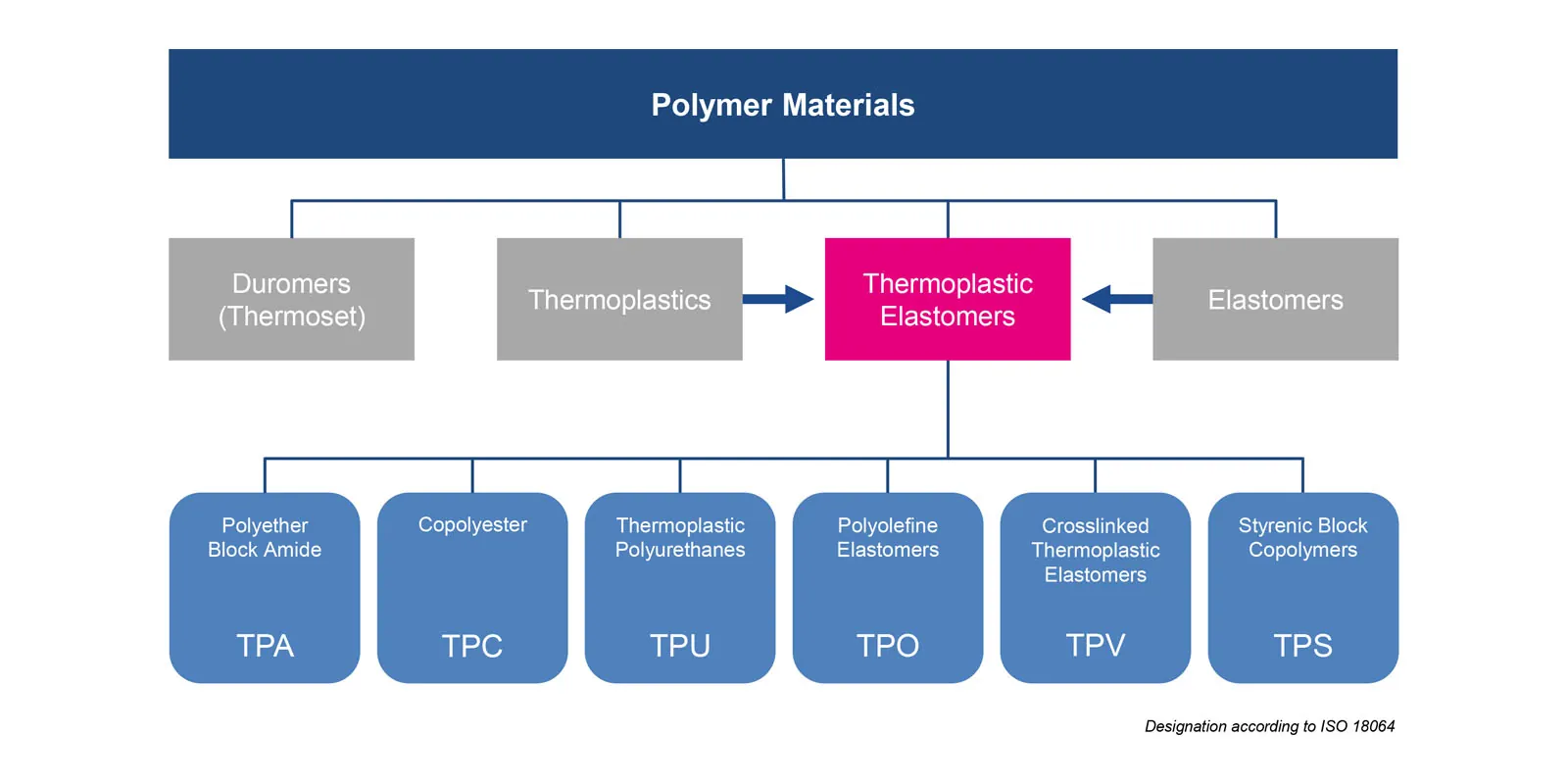
You can group these materials by their chemical makeup and how they respond to environmental conditions. Select based on the specific failure mode you fear most: if your part faces constant UV exposure, prioritize EPDM over Neoprene to prevent surface cracking.
- Natural rubber: Derived from tree sap, it offers high tensile strength and tear resistance for tires and seals. Avoid using it in direct sunlight, as it degrades rapidly under UV radiation.
- Silicone rubber: This material stays flexible in extreme heat or cold, making it ideal for medical and food-grade components. It lacks mechanical toughness, so skip it for high-friction applications.
- Nitrile rubber: Known as BUNA-N, it resists oils and fuels. Use it for fuel hoses, but keep it away from ozone, which causes it to perish quickly.
- EPDM: This synthetic rubber withstands sunlight, ozone, and weathering. It’s the standard for outdoor window seals.
- Fluoroelastomers: These provide superior resistance against aggressive solvents. They’re heavy and expensive, so reserve them for aerospace or chemical processing where failure carries a high cost.
- Neoprene: A versatile material that balances oil resistance with weather durability. It’s the best choice for general-purpose belts and protective covers.
Why elastomers behave like rubber
The unique behavior of these materials comes from their molecular structure, which consists of long, tangled polymer chains held together by cross-links. When you apply force, these chains stretch out like coiled springs, but the cross-links prevent them from sliding past one another permanently. Once you release the force, the chains snap back to their original, disordered state.
This process is known as entropy-driven elasticity. The material is most stable when the chains are tangled, so it naturally seeks to return to that state after deformation. If you add too many cross-links, the material becomes stiff and brittle, resembling hard plastic rather than rubber. If you add too few, the material will flow like a liquid when heated or stretched, losing its ability to recover.
The American Society for Testing and Materials provides standardized testing methods to measure these properties, such as tensile strength and compression set. You should check the technical data sheets provided by your specific manufacturer to see how a batch of rubber will perform under your required load. Because rubber is a natural or synthetic blend, the exact heat threshold varies by the specific chemical additives used in the mixture.
When elastomer performance changes
The simple rule of recovery isn’t always true if you subject the material to conditions beyond its design limit. High heat, constant chemical exposure, or extreme cold will change how an elastomer reacts.
If your seal feels tacky or leaves a residue on your fingers, the polymer chains have likely begun to degrade. This indicates the material has crossed its thermal limit, permanently losing its cross-linked structure. At this point, the part will never return to its original shape, regardless of how much pressure you remove.
| Situation | What changes | What to do instead |
|---|---|---|
| Extreme heat | Polymer chains break | Use silicone or fluoroelastomers |
| Constant oil contact | Material swells/softens | Use nitrile or fluoroelastomers |
| Outdoor sun exposure | UV light cracks surface | Use EPDM rubber |
| Extreme cold | Material turns brittle | Use specialized low-temp silicone |
| High physical impact | Material tears easily | Use natural or neoprene rubber |
Check for permanent deformation by measuring the compression set. Don’t attempt to reuse these components in high-pressure cycles, as they will inevitably leak.
How to choose elastomer materials, types, and applications
Identify the highest temperature your part will reach during normal operation to determine if you need a high-heat material like silicone.
Check for chemical exposure, as oil or fuel will destroy standard natural rubber within days, requiring a nitrile or fluoroelastomer instead. If you see swelling or a tacky surface after initial contact, the material is incompatible.
Measure the required hardness using a Shore A durometer scale, where a lower number indicates a softer, more flexible rubber part. Use 40A for seals requiring high conformability, but step up to 80A if the part must resist extrusion under high pressure.
Verify the compression set, which tells you how much the material will permanently flatten if kept under pressure for a long time. A high compression set leads to premature leaks.
Consult the manufacturer’s material specification sheet to confirm the elastomer meets the necessary industry standards for your specific application. Always verify the specific batch certifications rather than relying on general marketing data.
Mistakes that ruin elastomer parts

Ignoring chemical compatibility remains the most common oversight. If your part swells by more than 10% in volume, the polymer matrix is already compromised. Always check the specific fluid against the material’s compatibility chart before installation.
Over-stretching during assembly causes permanent damage. Never exceed 50% of the material’s elongation limit during the install process. If you notice white stress marks or micro-tears after the part is seated, discard it immediately. Those invisible fractures will propagate rapidly once the system reaches operating pressure.
Choosing based on price alone often invites failure in outdoor environments. Budget elastomers frequently lack the necessary carbon black or UV stabilizers. If your part will be exposed to direct sunlight for more than six months, specify a compound rated for outdoor weather resistance.
Finally, avoid running parts near their maximum heat limit. Prolonged exposure causes compression set, where the rubber loses its ability to return to its original shape.
Related guides
Frequently asked questions
Can elastomers be recycled like plastic?
Most cured elastomers can’t be melted down and reformed because their chemical cross-links are permanent. You can grind them into a powder to use as a filler in other products, but you can’t turn a used rubber gasket back into a raw, moldable material like you can with thermoplastic resins.
How long do elastomer seals last?
The lifespan of a seal varies based on the environment and the amount of stress it faces. You can check the expected service life by looking at the shelf-life and aging data on the manufacturer’s technical sheet for the specific rubber compound you’re using.
Is it safe to use any elastomer for food?
Only specific grades of elastomers are safe for food contact, and they must meet regulatory standards for non-toxicity. You must look for materials marked as FDA-compliant, as standard industrial rubbers often contain chemicals that can leach into food products during processing or storage.
What happens if I use the wrong rubber?
Using the wrong rubber leads to hardening, swelling, or cracking, which causes leaks or mechanical failure. If the material isn’t compatible with your chemicals, the part will lose its structural integrity, often within a few days of exposure to the incompatible fluid or high temperature.
Does the hardness of the rubber matter?
Hardness is critical because it determines how well the material seals against a surface and how much force is needed to deform it. If you choose a material that’s too hard, it won’t create a tight seal; if it’s too soft, it may extrude or tear under pressure.
How do I store rubber parts?
Store your parts in a cool, dark, and dry place to prevent degradation from light and ozone. You should keep them in sealed bags to avoid contact with air, as oxygen and ozone will slowly break down the polymer chains, making the rubber brittle even before you use it.
Conclusion
Selecting the right material requires balancing your environmental needs with the physical properties of the polymer. By checking the chemical resistance and temperature tolerance of each type, you ensure that your components will perform reliably throughout their intended service life.
