
Electricity is a flow of tiny charged particles called electrons, and it is generated when power plants spin magnets inside coils of wire to push those electrons into motion. This moving charge carries energy to lights, motors, and devices. Plugging something in closes a path so the flow can do work, then returns to the source. It works much like water pushed through a pipe by a pump, except the thing moving is charge instead of water.
How electricity gets generated
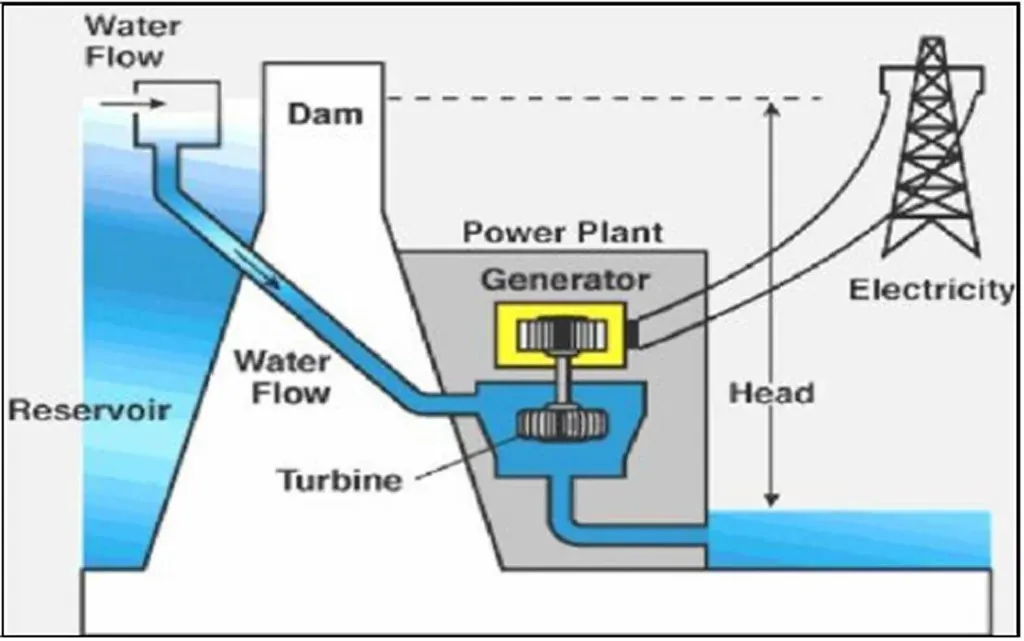
Power stations turn different energy sources into the same thing: a flow of electric charge through wires. The most common method spins a turbine, which turns a generator built from magnets and coils of wire. Fuel or falling water pushes the turbine, the spinning magnets push electrons through the coils, and the grid carries that flow to homes and businesses.
Coal and natural gas burn to make steam that turns the turbine. Nuclear plants split atoms to create that heat. Wind and water push the blades directly. Solar panels work differently — sunlight knocks electrons loose inside silicon cells without any spinning parts.
| Part or input | What it does | What you notice when it goes wrong |
|---|---|---|
| Fuel or water | Turns the turbine | No power or weak output |
| Turbine | Spins the generator shaft | Vibration, noise, or no rotation |
| Generator | Turns motion into electric flow | Lights flicker or stay off |
| Transformers | Raise or lower voltage for the grid | Outages in one area |
| Power lines | Carry electricity to users | Dim lights or total loss |
From source to your outlet
- A power plant burns fuel, splits atoms, or uses wind and water to spin a turbine.
- The turbine turns a shaft inside a generator filled with magnets and wire coils.
- Spinning magnets push electrons through the coils, creating electric current.
- A step-up transformer raises the voltage so the flow can travel long distances with little loss.
- High-voltage lines carry the electricity across cities and regions.
- A step-down transformer near neighborhoods lowers the voltage to safe levels for homes.
- Wires inside your walls deliver the flow to outlets and switches.
Each step takes a fraction of a second, and the whole cycle repeats continuously while the plant runs. A claim about how much electricity a plant makes depends on its size and fuel — a large coal plant can produce several hundred times more than a small solar farm, and output changes with the weather for wind and solar. Check the nameplate on any generator or the capacity listed by its operator for the real figure.
Why the flow stops when something breaks
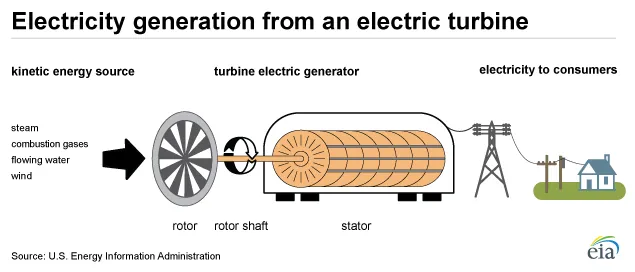
A single failed part can cut power across a whole street because every stage depends on the one before it. If a transformer blows, voltage can’t drop to safe levels and the line stays dead until it’s replaced. If a turbine stops spinning, the generator has nothing to push electrons with, so current falls to zero everywhere downstream.
A fallen tree on a line creates an open path, and electricity can’t jump gaps the way water can push through a wet spot. That’s why one storm can leave thousands without power even when every plant is still running. The grid is built with backups and alternate routes, but those only work if the break is small enough to route around.
A large substation failure or a major line down means crews must find the exact break, isolate it, and repair it before power returns. You can check your own breaker panel first — a tripped switch looks different from a grid outage, and resetting it takes seconds.
What you control and what stays fixed
Things you control
- Which appliances you run at the same time
- When you run large loads such as dryers and air conditioners
- Whether you unplug devices that draw power while off
- The temperature you set on heating and cooling equipment
Running a microwave, toaster, and kettle together can trip a standard 15-amp kitchen circuit. Running only one or two at a time keeps the load within the breaker’s rating.
Devices with remote controls or digital clocks pull standby current around the clock. A power strip with a physical switch cuts that drain completely.
Fixed by design
- The voltage your utility delivers to your meter
- The capacity of the wires inside your walls
- The fuel mix your local power plant uses
Adding new circuits or changing your service panel requires a licensed electrician. That work touches live wiring and mistakes can start fires or void insurance. Never open a breaker box beyond flipping a switch yourself.
Older homes often have main panels that may require upgrading to support modern households with electric vehicles, a job for a qualified technician.
Habits that follow from how it works
Run large appliances one at a time instead of together. A microwave and a toaster running at once will hit that limit.
Unplug chargers and electronics when they aren’t in use. Many draw small amounts of power even while switched off. If the transformer block feels warm to the touch, it’s still burning electricity.
Set your thermostat a few degrees lower in winter and higher in summer. Heating and cooling move the most energy through your wires.
Check that outdoor cords and plugs are rated for the load they carry. Look for the gauge number printed along the jacket. A 16-gauge cord works for string lights but will overheat under a space heater. Undersized wire heats up under heavy current.
Replace frayed cords right away. Damaged insulation lets current escape where it should not. People often wrap these spots in electrical tape and forget them. Electrical tape provides temporary insulation but isn’t a permanent repair for damaged cords.
These habits trace directly to the way electricity flows. It follows the path you give it. It only takes one weak spot to stop the whole chain.
Frequently asked questions
Can I make my own electricity at home?
Yes, with solar panels or a small wind turbine connected to your wiring through an inverter. How much you get depends on your roof, your local sun or wind, and the system size you install — check your utility’s interconnection rules and a certified installer’s quote for real figures.
Why do lights flicker when the air conditioner starts?
A large motor pulls a sudden burst of current when it starts, which briefly drops voltage on the same circuit. If lights on other circuits also dim, the issue may be at the panel or the utility transformer and an electrician should check it.
How long does electricity take to reach my home?
It travels at nearly the speed of light through the wires, so the delay from plant to outlet is a fraction of a second — what changes is how much power is available, not how fast the flow arrives.
Is it safe to touch a wire if the switch is off?
No — a switch only breaks the path on one side, and wires can still carry live current from the panel or from another source. Treat every wire as live until a licensed electrician tests it.
What happens if I plug too much into one outlet?
The circuit breaker or fuse trips to stop the flow before wires overheat, which cuts power to everything on that circuit. Repeatedly resetting a tripped breaker instead of unplugging something can damage wiring over time.
Does it matter where my electricity comes from?
It matters for cost and emissions, not for how your devices work — electricity from coal, wind, or solar behaves the same inside your wires. Your utility bill or its website shows the fuel mix for your area.
Conclusion
Electricity moves because something pushes electrons through a closed path, and every device you plug in is just one more point on that path. The amount you can draw depends on your wiring, your utility, and what is running at the same time — read your breaker panel and your bill to see the numbers for your own home.
