
Units of measurement in electrical engineering give every quantity a fixed size so engineers can compare circuits, size wires, and set protection devices without guessing. The quantities fall into base units, derived units, and multiples formed with prefixes. The one thing that separates them is whether they stand alone or are built from other units.
The ampere is defined by the fixed numerical value of the elementary charge, e, when expressed in the unit C, which is equal to A·s. Derived units, such as the watt, rely on these base units to describe complex interactions like power consumption.
If you’re calculating heat dissipation, always convert your input to base units first. This avoids the common mistake of mixing milliwatts with kilowatts, which often leads to undersized wiring and dangerous thermal failures. When in doubt, return to the SI standard.
Common electrical units
| Unit | Best for | Example |
|---|---|---|
| Ampere | Electric current | A 15-amp circuit breaker |
| Volt | Electrical potential | A 120-volt outlet |
| Ohm | Electrical resistance | A 100-ohm resistor |
| Watt | Electrical power | A 60-watt light bulb |
| Farad | Capacitance | A 100-microfarad capacitor |
| Henry | Inductance | A 10-millihenry coil |
| Hertz | Frequency | 60-hertz alternating current |
Ampere
The ampere measures electric current, the flow of charge past a point each second. It suits anyone sizing wires, breakers, or motor loads.
Think of the ampere as the volume of water moving through a pipe. If you ignore the amp rating of a wire, you risk overheating the insulation, which leads to permanent damage or fire. Always match the breaker to the smallest wire in the circuit. If you have 14-gauge wire, you must use a 15-amp breaker. Using a 20-amp breaker on that wire is a dangerous mistake that causes the wire to melt before the breaker trips.
Check the nameplate on any motor or tool to find its full-load current. If the device requires a high current, you need a circuit capable of handling the load to account for startup surges, which should be assessed by a technician.
Volt
The volt measures electrical potential difference, the push that moves charge through a circuit. Unlike the ampere, it describes pressure rather than flow. It suits anyone checking battery charge, outlet voltage, or equipment ratings.
- It states the potential between two points.
- It appears on power supplies and nameplates.
- It guides wire insulation and device selection.
- It combines with current to find power.
Example: a standard US wall outlet supplies power that should only be tested by a technician.
Ohm
The ohm measures electrical resistance, how much a material opposes current flow. It’s the unit that lets you predict current from voltage using Ohm’s law. It suits anyone choosing resistors or checking conductor size.
- It sets resistance values in circuits.
- It shows conductor and wire resistance.
- It appears on resistor color codes.
- It relates voltage and current directly.
Example: a 100-ohm resistor limits current in a low-power circuit.
Watt
The watt measures electrical power, the rate at which energy is used or produced. Unlike the volt and ampere, it’s a derived unit built from both. It suits anyone sizing generators, inverters, or energy use.
- It states real power consumed by a load.
- It rates appliances, motors, and heaters.
- It sizes wires and protection for load.
- It appears on lighting and equipment labels.
Example: a 1,500-watt space heater draws a specific current that should only be tested by a technician.
Farad
The farad measures capacitance, the ability to store charge. It’s a massive unit; most practical components are rated in microfarads or picofarads. If you see a capacitor labeled in whole farads, it’s likely a supercapacitor designed for energy storage rather than signal filtering.
Use the farad to size components for power supplies, timing circuits, or motor starters. A 100-microfarad capacitor effectively smooths voltage ripples in a power supply, but that same value would be far too large for high-frequency radio tuning.
Novices often mistake voltage ratings for capacitance, choosing a higher voltage part that physically fails to fit the circuit board. Always match the farad rating to your energy needs first, then select a voltage rating at least 20% higher than your expected peak to prevent dielectric breakdown.
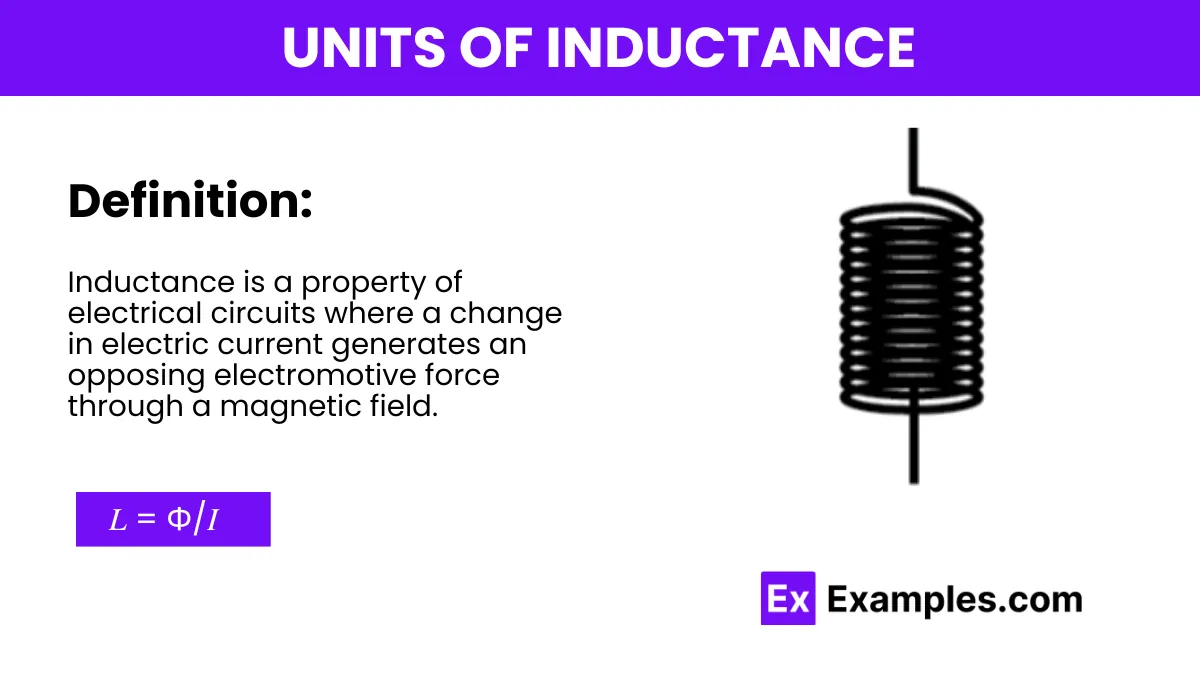
Henry
The henry measures inductance, the property of a coil that opposes changes in current. It’s the unit people most often get wrong because it only appears where coils or magnetic fields exist. It suits anyone designing transformers, motors, or radio circuits.
- It sizes inductors and coils.
- It rates transformers and chokes.
- It sets inductive reactance in AC circuits.
- It appears on motor and ballast ratings.
Example: a 10-millihenry inductor filters ripple in a DC supply.
Other electrical units
-
Coulomb — quantity of electric charge. Use this when calculating battery capacity or total charge transfer. One coulomb equals the charge transported by a constant current of one ampere in one second.
-
Siemens — electrical conductance. This measures how easily current flows through a component. It’s the reciprocal of resistance, so if you have a device with a specific resistance, its conductance should be assessed by a technician.
-
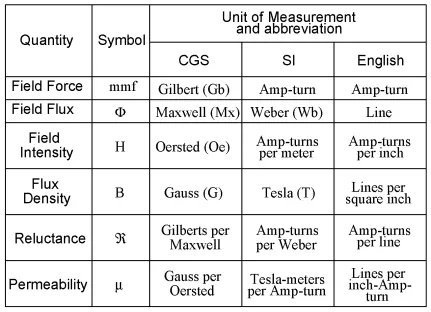
Weber — magnetic flux. Essential for transformer and motor design. A weber is the magnetic flux that, when changing at a rate of one weber per second, induces an electromotive force of one volt in a circuit of one turn.
-
Tesla — magnetic flux density. Critical for magnet and inductor work. Most industrial magnets operate between 0.5 and 2 teslas.
-
Volt-ampere — apparent power in AC circuits. Use this to size transformers and UPS units. Unlike watts, which measure real power, volt-amperes account for the phase shift between voltage and current.
How to choose the right unit
Match the unit to the quantity you’re measuring, not to the equipment you own. Current calls for the ampere; potential difference calls for the volt; opposition to current calls for the ohm; and power calls for the watt. Storage calls for the farad, and coils call for the henry.
What you already have — a multimeter, a clamp meter, or a power analyzer — decides which reading you can take, but it doesn’t change the unit the quantity uses. You can combine units in calculations, such as volts times amperes to get watts, but you never replace one with another.
Frequently asked questions
What is the base unit of electric current?
The ampere is the SI base unit for electric current. It’s one of seven base units in the International System of Units.
How do volts and amperes relate to watts?
Watts equal volts times amperes for direct current. This assumes resistive loads or unity power factor; for alternating current, power factor changes the result.
What unit measures resistance?
The ohm measures electrical resistance. The relationship between resistance, current, and voltage should only be tested by a technician.
Is a farad a large unit?
One farad is very large for most circuits. Practical capacitors are usually rated in microfarads, nanofarads, or picofarads.
What does hertz measure?
Hertz measures frequency, or cycles per second. North American power systems run at 60 hertz, while many other regions use 50 hertz.
Can I measure inductance with a standard multimeter?
Many standard multimeters can’t measure henrys directly. You need an inductance meter or an LCR meter for that reading.
Pick the unit that matches your quantity
Start by naming the quantity you need—current, voltage, resistance, power, capacitance, or inductance—then use the unit that measures it. Match your multimeter’s dial to the specific unit printed on the component label. If you’re measuring a standard household battery, set your dial to the 20V DC range to capture the 1.5V or 9V output accurately.
Expect your reading to fall inside the range printed on the equipment nameplate. If the display shows a “1” or “OL,” your range is too low; move the dial up one notch. A common mistake is leaving the leads in the high-current port while measuring voltage, which blows the internal fuse. If the circuit is live or the values exceed your device’s maximum rating, stop and call a professional.
