
Knowing how alternating and direct current differ is necessary for electronics work, home wiring, or understanding how power reaches your devices. Although both move electrical charge through a circuit, they function in distinct ways that determine their specific uses. This guide explains the mechanics, applications, and safety requirements of both systems to help you manage your electrical projects.
Key Takeaways
- Alternating current reverses direction periodically, making it ideal for long-distance power transmission from utility grids to homes.
- Direct current flows steadily in one direction, which is required by batteries, solar panels, and nearly all modern digital electronics.
- You can’t plug a DC device directly into an AC wall outlet without a rectifier or power adapter to convert the electricity safely.
- AC power is measured in hertz (Hz), representing how many times per second the current changes direction—typically 60 Hz in the US.
- Converting AC to DC requires specific components like diodes and capacitors, while converting DC to AC requires an electronic inverter.
- Always check the voltage and current type printed on a device’s label before connecting it to any power source to prevent immediate damage.
What Is Alternating Current?
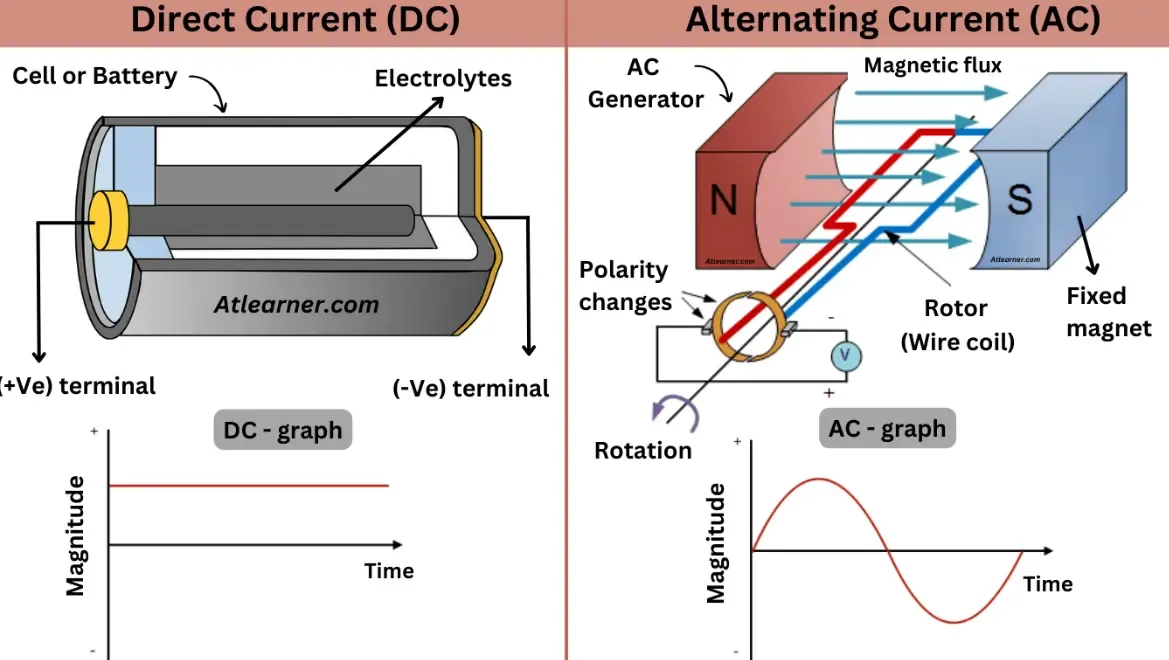
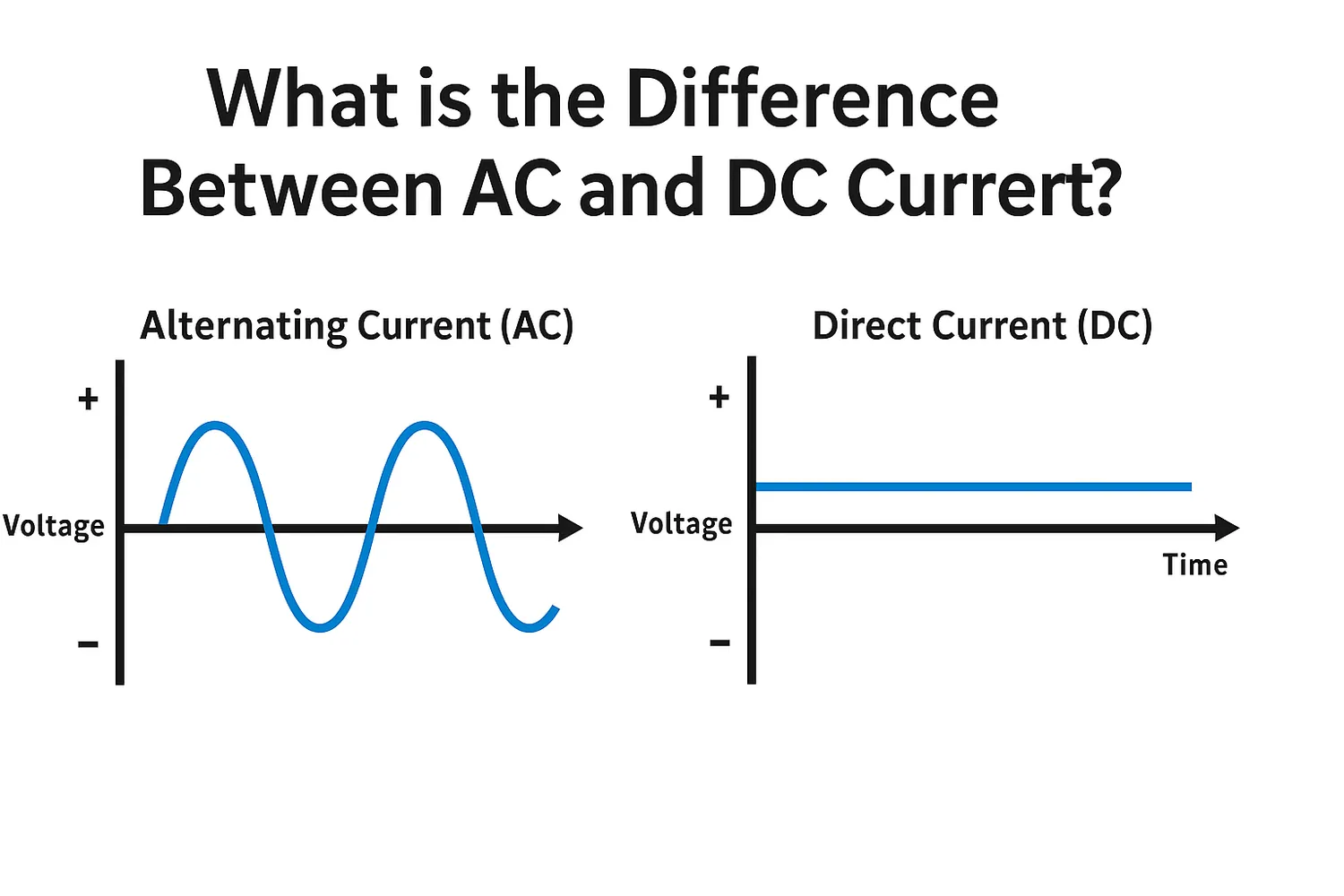
Alternating current, commonly referred to as AC, is an electrical flow that continuously reverses its direction. Instead of moving in a straight line from negative to positive, the electrons oscillate back and forth within the conductor. This oscillation creates a wave-like pattern, most often a sine wave, when graphed over time.
The speed at which this reversal happens is called the frequency, measured in hertz. In North America, the standard utility grid operates at 60 Hz, meaning the current completes sixty full cycles every second. In much of Europe and Asia, the standard is 50 Hz.
Why AC Dominates Power Grids
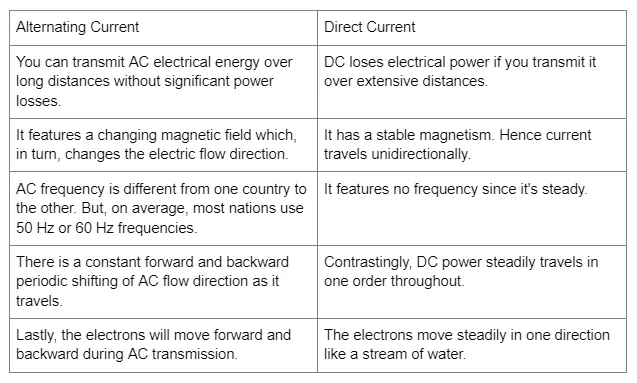
AC became the standard for power distribution because it can be easily stepped up to high voltages using transformers. High-voltage transmission reduces energy loss over long distances. Once the power reaches a neighborhood, another transformer steps the voltage back down to safe levels for household use. Major utilities like Duke Energy and Pacific Gas and Electric rely entirely on this alternating system to deliver power efficiently across thousands of miles.
What Is Direct Current?
Direct current, or DC, provides a constant, unidirectional flow of electrical charge. Electrons move steadily from the negative terminal to the positive terminal without reversing. This creates a flat, stable line when graphed over time, rather than the oscillating wave seen in AC systems.
DC is the native language of batteries and electrochemical cells. When you insert a Duracell AA battery into a flashlight or connect a lead-acid battery to a car starter, you’re utilizing direct current. The voltage remains relatively constant until the chemical energy inside the cell is depleted.
Common Sources of DC Power
Beyond disposable and rechargeable batteries, DC power is generated by several other technologies. Solar panels produce direct current when photons strike their photovoltaic cells. Fuel cells generate DC through chemical reactions involving hydrogen and oxygen. Additionally, USB ports on computers and wall chargers output low-voltage DC to safely power smartphones, tablets, and peripherals.
How AC and DC Current Differ
To clearly understand the difference between AC and DC current, it helps to compare their core characteristics side by side. Each property dictates how the electricity behaves and where it can be applied effectively.
| Feature | Alternating Current (AC) | Direct Current (DC) |
|---|---|---|
| Direction of Flow | Reverses periodically | Flows in one direction only |
| Voltage Behavior | Rises and falls in waves | Remains constant over time |
| Frequency | 50 Hz or 60 Hz typically | Zero hertz (no frequency) |
| Power Factor | Varies between zero and one | Always exactly one |
| Storage Capability | Can’t be stored in batteries | Easily stored in batteries |
The most critical distinction lies in transmission efficiency. AC can travel hundreds of miles with minimal loss, while DC suffers significant voltage drop over long distances unless converted to extremely high voltages using specialized equipment.
Where Do We Use AC Power?
Because of its ability to change voltage levels effortlessly via transformers, AC powers almost everything plugged directly into a wall outlet. Heavy machinery, industrial motors, and household appliances rely on this alternating supply.
Household Appliances
Large appliances such as Whirlpool refrigerators, LG washing machines, and GE air conditioners run on AC power. Their internal electric motors are specifically designed to operate on the alternating cycles provided by the grid. Attempting to run these heavy-duty motors on DC would require massive, expensive converters and result in poor performance.
Industrial Applications
Factories utilize three-phase AC power to run large conveyor belts, CNC machines, and industrial pumps. Three-phase power delivers a more consistent stream of energy compared to single-phase residential power, allowing heavy equipment to start under load without stalling.
Where Do We Use DC Power?
Digital electronics and portable devices strictly require direct current. Microchips, transistors, and logic gates need a steady, unwavering voltage to process data accurately. Any fluctuation or reversal in polarity would corrupt calculations and destroy sensitive components.
Consumer Electronics
Every smartphone, laptop, and smartwatch runs on DC. Devices like the Apple iPhone or Samsung Galaxy use internal lithium-ion batteries that store and discharge direct current. Even though you plug them into an AC wall outlet, the charging brick acts as a converter, transforming the alternating grid power into the smooth DC the phone requires.
Automotive Systems
Modern vehicles, including those made by Ford and Toyota, use a 12-volt DC electrical system. The alternator generates AC power while the engine runs, but built-in diodes immediately rectify it into DC to charge the battery and power the headlights, infotainment screen, and engine control modules.
Can You Convert Between Them?
Yes, converting between AC and DC is a routine engineering task accomplished using specific electronic circuits. Understanding these conversions is vital for designing power supplies or integrating renewable energy systems.
Warning: Never attempt to build your own power conversion circuits for high-voltage mains electricity without proper training. Mishandling AC mains voltage can cause fatal electric shocks or start electrical fires.
Converting AC to DC
To change alternating current into direct current, engineers use a device called a rectifier. A basic rectifier uses diodes—components that only allow current to flow in one direction—to chop off the negative half of the AC wave. Adding a capacitor smooths out the resulting bumps, creating a steady DC voltage suitable for electronics.
Converting DC to AC
Changing direct current back into alternating current requires an inverter. Inverters use fast-switching transistors to rapidly flip the DC polarity, simulating an alternating wave. This technology is crucial for solar energy systems.
For example, a SolarEdge inverter takes the DC produced by rooftop panels and converts it into AC so the home can use it or send it back to the utility grid. According to the U.S. Department of Energy, inverters are essential components that ensure solar-generated electricity matches the grid’s requirements.
Which Type Is More Dangerous?
Both AC and DC can be lethal, but they affect the human body differently. Safety standards treat them with equal respect, yet understanding their distinct hazards helps in risk assessment.
| Hazard Type | AC Risk Profile | DC Risk Profile |
|---|---|---|
| Muscle Reaction | Causes continuous tetanic contractions | Causes a single violent convulsion |
| Let-Go Threshold | Lower; harder to release the wire | Higher; easier to pull away initially |
| Heart Fibrillation | Highly likely at 50/60 Hz | Less likely, but causes severe burns |
| Arc Flash Risk | Extinguishes naturally at zero-crossings | Sustains continuous, hard-to-break arcs |
Alternating current is generally considered more dangerous at common household voltages because its frequency interferes directly with the heart’s natural pacemaker cells, easily triggering ventricular fibrillation. Furthermore, the continuous muscle contractions caused by AC can freeze a person’s hand onto the live conductor, preventing them from letting go.
However, direct current carries its own severe risks. Because DC doesn’t cross zero volts like AC does, an electrical arc caused by DC is much harder to extinguish. High-voltage DC systems, such as those found in electric vehicle battery packs or solar arrays, can sustain dangerous arcs that melt metal and ignite surrounding materials.
How to Identify AC vs DC
Identifying the type of current in a given circuit or device is straightforward if you know where to look. Manufacturers use standardized symbols and labels to communicate this information clearly.
Reading Device Labels
Look at the power specification sticker on any electronic device. If you see a wavy line symbol (~) or the letters “AC,” the device expects alternating current. If you see a solid line over a dashed line symbol (⎓) or the letters “DC,” it requires direct current. Many modern power adapters list both: “Input: 120V AC” and “Output: 5V DC.”
Pro Tip: When troubleshooting a dead device, always verify whether your multimeter is set to the correct mode. Measuring a DC battery while your meter is set to AC will yield a reading of zero, leading you to falsely believe the battery is completely empty.
Using a Multimeter
A digital multimeter from brands like Fluke or Klein Tools allows you to measure both types of current. Turn the dial to the “V” with a straight line for DC voltage, or the “V” with a wavy line for AC voltage. Always start with the highest range setting if you’re unsure of the expected voltage to protect the meter’s internal fuse.
Related guides
- Mustard Algae or Sand: How to Know the Difference in 2026
- What Is Eddy Current Loss and How to Reduce It Effectively
- How Current Foldback Protects Power Supplies: A Clear Guide
Frequently Asked Questions
Why did AC win the war of currents?
AC won the historical War of Currents in the late 1880s primarily because transformers allowed its voltage to be easily increased for efficient long-distance transmission and decreased for safe home use. Thomas Edison championed DC, but George Westinghouse and Nikola Tesla demonstrated that AC was far more practical and economical for building a national power grid.
Do phones use AC or DC power?
Smartphones operate exclusively on DC power supplied by their internal lithium-ion batteries. When you plug your phone into a wall outlet, the charging block acts as a power adapter. It converts the 120V AC from your wall into the low-voltage DC, typically 5V to 20V, that your phone needs.
Are car batteries AC or DC?
All automotive batteries, whether traditional lead-acid or modern lithium-ion packs in electric vehicles, store and supply DC power. The vehicle’s electrical architecture, including lights, sensors, and computers, is designed to run on this steady 12-volt or higher direct current supply.
Can I plug a DC motor into AC?
No, plugging a standard DC motor directly into an AC outlet will likely damage or destroy it. The constantly reversing current prevents the motor from spinning correctly and causes excessive heat buildup. You must use a rectifier or a dedicated DC power supply to run a DC motor from an AC source.
Which is cheaper to generate, AC or DC?
Historically, AC has been cheaper to generate and distribute on a massive scale due to simple alternator designs and inexpensive transformers. However, advancements in power electronics have made generating DC highly cost-effective for localized applications, particularly with solar panels and wind turbines equipped with modern solid-state rectifiers.
Conclusion
Now that you understand how these two electrical systems operate, inspect the power labels on your household electronics today. Identifying whether your devices require alternating or direct current ensures you select the correct replacement adapters and maintain safe, reliable connections throughout your home.
