
An optical particle counter works by shining a laser into moving air and measuring the light that bounces off each speck. You put dirty air in, a sensor catches the scattered flashes, and the machine gives you a count of particles sorted by size. It’s like standing in a dark room with a flashlight; you don’t see the dust until the beam hits it, and bigger pieces flash brighter than tiny ones.
Parts inside an optical particle counter
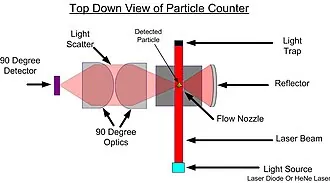
An optical particle counter works by using five specific pieces that function together.
| Part or input | What it does | What you notice when it goes wrong |
|---|---|---|
| Vacuum pump | Pulls air through the sensor chamber | Flow rate drops, counts fall artificially low |
| Laser diode | Lights up passing particles | No flashes appear, screen reads zero constantly |
| Optical chamber | Keeps outside light away from sensor | Random high readings even in clean rooms |
| Photodetector | Catches scattered light flashes | Counts jump wildly or stay flat at zero |
| Signal processor | Turns flashes into particle sizes | Size bins show wrong numbers for known dust |
| Sample inlet | Guides air smoothly into the chamber | Large particles get stuck before reaching laser |
Steps as air moves through the counter
-
The vacuum pump starts, drawing air through the sample inlet at a fixed flow rate. For standard portable units, this is usually 0.1 cubic feet per minute (2.83 liters per minute). This assumes the factory nozzle is attached; if you use a longer tube, the pump has to pull harder, and large particles may stick to the walls before reaching the sensor.
-
Air enters the dark optical chamber, where walls block all outside light. This keeps the photodetector from seeing anything except the laser. This step takes less than a second as the air stream passes straight through the narrow sensing zone.
-
A laser diode fires a tight beam across the air path. Every particle crossing this beam scatters light sideways toward the detector. The laser stays on continuously while the pump runs, which drains the battery over one to eight hours depending on the model you hold.
-
The photodetector catches each flash of scattered light. Bigger particles scatter more light, creating a taller electrical pulse. If two particles cross together, the detector sees one big flash instead of two small ones, which changes your count.
-
The signal processor measures the height of every electrical pulse. It compares each pulse against set voltage limits to guess the particle’s size. This happens thousands of times per second while the machine is sampling.
-
The processor sorts each counted particle into size bins, like 0.3 or 0.5 micrometers. You choose these bins on the screen before starting. The display updates live, showing totals for each size range as the sample runs.
-
After the set sample time ends, usually one minute for cleanroom checks, the pump stops. The screen holds the final count per volume. You can save this data or clear it for the next spot.
Why scattered light causes wrong readings
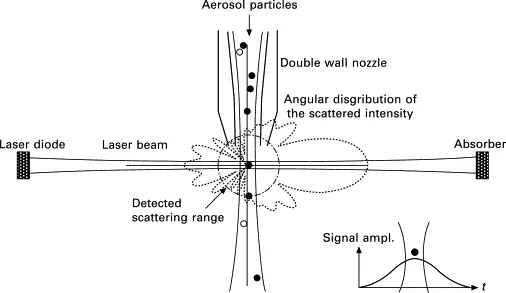
A bright flash doesn’t always mean a single large particle. When two small specks cross the laser beam at the exact same moment, the photodetector adds their light together. The signal processor sees one tall pulse and logs a single large particle instead of two small ones. This coincidence error grows quickly as the air gets dirtier.
If you’re checking a very dusty space, like a construction site, coincidence error causes the counter to register multiple small particles as a single large particle, leading to inaccurate size distribution data. ISO 21501-4 sets the maximum concentration limits for these instruments, and you can read the exact thresholds in ISO 21501-4 calibration requirements. Pushing past those limits makes the math useless.
The shape of the particle changes the flash too. A round droplet scatters light differently than a flat skin flake of the exact same weight. The processor assumes everything is a perfect sphere, so odd shapes land in the wrong size bin.
Water vapor causes another problem. In humid air, tiny salt crystals absorb moisture and swell up. The counter reads them as larger particles than they actually are when dry. If you move the device from a cold hallway into a warm room without letting it adjust, condensation forms inside the chamber and triggers false high counts.
You also trade speed for accuracy here. A faster pump clears the chamber quickly but gives the detector less time to measure each flash. Slower pumps catch details better but take longer to sample a full cubic foot. Pick the fast setting for quick safety checks, and switch to the slow, precise flow only when you need certified cleanroom data.
What you control and what is fixed
Things you can change
- Set the sample duration, usually between 10 seconds and 10 minutes, depending on how much air you need to test.
- Choose which size bins to display on the screen, typically ranging from 0.3 to 10 micrometers.
- Swap the inlet tubing length, though adding more than three feet causes heavy particles to drop out before reaching the sensor.
- Clear the background count by running the machine with a HEPA filter on the inlet before starting real tests.
Things built into the machine
- The laser wavelength is soldered onto the board and can’t be changed without replacing the whole module.
- The detector’s lowest voltage threshold fixes the smallest particle it can ever see, regardless of software settings.
- The chamber geometry determines how much outside light leaks in during normal use.
- Opening the sealed optical chamber to clean the lens voids the calibration certificate. If the laser alignment drifts or the mirror fogs over, a certified metrology lab must reset it using traceable reference beads. Don’t try adjusting the mirrors yourself, because misaligning the beam by a fraction of a millimeter ruins every reading the machine produces afterward.
Habits that keep readings accurate
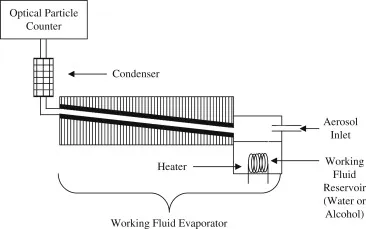
Always run the counter with a HEPA filter cap on the inlet for 30 seconds before testing. This establishes a true zero baseline so you aren’t counting leftover dust from the last room. Skip this, and your first minute of data carries phantom particles.
Hold the device at breathing height, about three to four feet off the floor, unless your protocol says otherwise. Dust settles fast, so pointing the inlet at the carpet gives numbers that don’t match what people actually breathe.
Keep the sample inlet facing downward or sideways, never straight up. Gravity pulls heavy particles down, and an upward-facing tube catches falling debris that wouldn’t normally float into the sensor.
Let the machine warm up for five minutes after turning it on. The laser diode’s output shifts slightly as it heats up, and the processor needs a stable light source to sort sizes correctly.
Don’t wave the counter around while it samples. Moving fast forces extra air into the inlet, breaking the pump’s calibrated flow rate. Stand still and let the pump do the pulling.
Frequently asked questions
How long does a particle count take?
One minute is standard for a 0.1 cubic feet per minute flow rate when testing a cleanroom. That gives you enough air to compare against ISO class limits. If you’re just checking a home vent, 10 seconds tells you if dust is blowing out.
Can it tell what the dust is made of?
No, it only measures the brightness of the light flash to guess the size. It can’t separate pollen from smoke or skin flakes from concrete dust. You’d need a microscope or chemical filter analysis to identify the material itself.
Why does my counter read zero outside?
It probably isn’t broken, but the lowest size bin might be set too high. Outdoor air has millions of particles smaller than 0.3 micrometers. If your screen only shows 1.0 micrometer and above, it won’t register the fine haze you’re breathing.
Is it safe to use near chemicals?
Only if the manual specifically rates the pump for explosive or corrosive vapors. Standard counters pull air directly over hot electronics and a laser. Solvent fumes can ignite inside the chamber or permanently cloud the optical glass.
What happens if the battery dies mid-sample?
The pump stops instantly, and the processor saves whatever counts it logged up to that second. But the volume calculation will be wrong because the machine didn’t pull air for the full planned time. Always start with a full charge.
Does humidity change the particle count?
Yes, high humidity makes certain particles absorb water and swell up. A 0.2-micrometer salt crystal can grow past 0.5 micrometers in damp air. The counter reads the wet size, not the dry size, which inflates your large-particle totals.
How often should it be calibrated?
Once a year is the standard rule for cleanroom compliance work. The calibration lab uses known polystyrene spheres to check if the voltage thresholds still match the printed size bins. Check your specific manufacturer’s manual, as some demand a six-month cycle for pharmaceutical environments.
Can I attach a longer hose to reach tight spots?
You can, but particles heavier than 5 micrometers will crash into the hose walls and never reach the sensor. Keep any added tubing under three feet long and as wide as the original inlet. Narrow, long tubes ruin the count for larger dust.
Conclusion
Every counter has a hard floor where its laser simply can’t make small things flash brightly enough to see. Your machine’s minimum detectable size is printed right on its specification sheet or calibration sticker, and no software update will push it lower.
