
You will find Amazon affiliate links in this article. As an Amazon Associate we earn from qualifying purchases, and buying through one never raises your price.
You need to balance heating power with safety features and noise levels to ensure you stay comfortable without worry. This guide explains what to look for so you can choose a heater that fits your specific room size and daily habits. For most people, the DREO Portable Electric Heater is the top choice because it combines high-performance heating with smart temperature controls.
What Actually Matters
Heating Capacity
A heater’s wattage determines how much air it can warm, but bigger isn’t always better. Small spaces like desks only need 500W to feel comfortable, while larger rooms require 1500W to move enough air. Check the wattage against your room size to avoid wasting energy.
Safety Features
Modern heaters include essential protections like tip-over switches and overheat sensors. These features are vital for unattended use. Always look for certifications from independent organizations that confirm the unit meets established safety standards.
Noise Levels
If you plan to use a heater in a bedroom or office, the decibel level matters. Models using brushless motors or specialized fan designs are often marketed as quieter than traditional units. A whisper-quiet heater should operate around 30-40dB, which is subtle enough to ignore while you work or sleep. Check the product description for noise ratings before buying if you’re sensitive to background hums or fan buzzing.
Portability and Controls
Think about where you’ll place the heater. Units with built-in handles are easier to move between rooms, while remote controls allow you to adjust settings without getting up. Some models offer simple manual dials, which are very reliable, while others use digital touchscreens for precise temperature settings. Choose based on whether you prefer “set-it-and-forget-it” convenience or manual control over your warmth.
1. DREO Portable Electric Heater
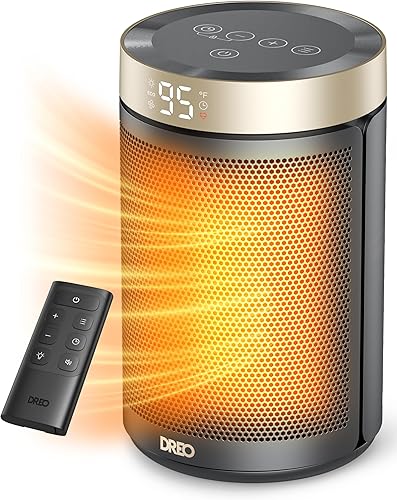
Best for: People wanting precise temperature control and quiet operation.
This heater uses an advanced PTC system to push warm air further than standard models. It features a digital thermostat that allows you to set the exact temperature you prefer, which helps maintain comfort without constant cycling. The brushless motor keeps noise as low as 34dB, making it an excellent choice for a quiet bedroom environment.
It’s a feature-rich device, so it might be overkill for someone who just needs a basic, one-button heat source for a garage or basement. The included remote and child lock add convenience, but they also mean there are more digital settings to manage compared to a manual unit.
Pros
- Precise thermostat with 1-degree increments
- Very quiet 34dB operation
- Includes remote and child lock
- ETL certified safety features
Cons
- More complex settings than manual heaters
2. Lasko 9″ Tabletop Ceramic Space Heater with Thermostat
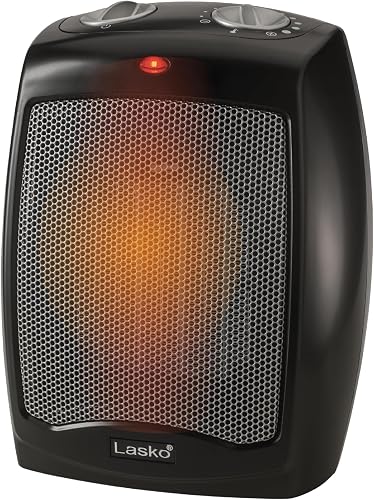
Best for: Simple, reliable warmth on a desk or table.
This compact unit is designed for direct, personal warmth. It uses manual controls on top of the unit, which makes it very straightforward to use if you don’t want to deal with remotes or digital displays. The cool-touch housing is a smart addition for those with curious pets or children nearby.
This heater is best for small, contained spaces. If you’re trying to warm a large room, the output may feel limited compared to tower-style heaters. It’s a no-nonsense tool built for durability rather than advanced smart features.
Pros
- Simple manual controls
- Compact tabletop size
- Cool-touch exterior
- ETL certified
Cons
- Limited reach for large rooms
3. Vornado VH202 (2026) Personal Space Heater
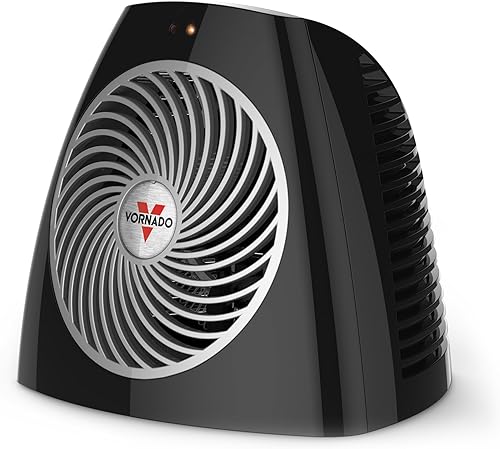
Best for: Focused air circulation in small work areas.
Vornado uses a unique “Vortex” circulation design to move air more efficiently without relying on intense, concentrated heat. This creates a more even warmth in your immediate personal space. It’s built to be compact, so it fits easily under a desk or on a crowded shelf.
This is a personal heater, not a room heater. If you want to warm up an entire living area, this unit won’t provide enough output. It’s strictly for someone who wants to keep their hands or feet warm while sitting at a desk.
Pros
- Efficient air circulation technology
- Small, compact footprint
- Quiet operation
- 3-year replacement guarantee
Cons
- Not designed for large rooms
4. Amazon Basics Ceramic Space Heater

Best for: Safety-conscious users needing a compact, portable solution.
This heater focuses on the essentials: fast heating and strong safety protocols. It includes tip-over and overheat protection as standard, providing a reliable way to add warmth to an office or bedroom. It’s lightweight, making it easy to carry from room to room as the day progresses.
This unit isn’t meant for humid environments like bathrooms or laundry rooms. If your space has moisture, you’ll need to look for a different heating solution, as this model is strictly for dry indoor areas.
Pros
- Fast ceramic heating
- Lightweight and portable
- Built-in safety sensors
- Quiet 43dB operation
Cons
- Can’t be used in bathrooms
5. JIBUFI Oscillating Space Heater
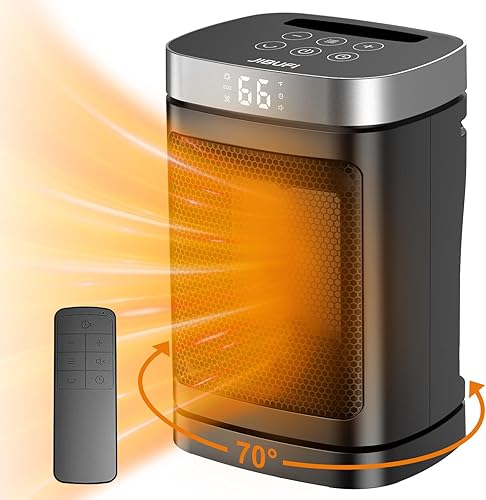
Best for: Heating larger areas with wide-angle coverage.
The 70-degree oscillation allows this heater to distribute warmth across a wider area than fixed heaters. It includes an ECO mode that helps manage energy use by adjusting the output to reach your target temperature. This makes it a good choice for someone who wants to balance power with efficiency.
Because it oscillates, it requires a bit more clearance on your desk or floor compared to stationary models. It’s a powerful 1500W unit, so it’s best for those who need to warm up a small room rather than just a single spot.
Pros
- Wide 70-degree oscillation
- Energy-saving ECO mode
- Includes remote control
- ETL certified safety
Cons
- Requires more clearance space
6. PTC Ceramic Remote Heater
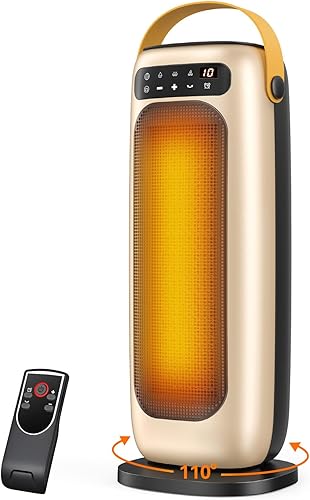
Best for: Users who want maximum control and oscillation.
This model stands out with a 110-degree oscillation system, which is great for moving air around a medium-sized room. The LED touchscreen and remote control make it very easy to adjust settings from across the room. It also features a 10-hour timer, which is helpful if you want the heat to turn off automatically after you fall asleep.
The unit is more feature-heavy than a basic heater, so it isn’t the right choice for someone who prefers simple, mechanical buttons. It must be plugged directly into a wall outlet, so you can’t use it with an extension cord.
Pros
- Wide 110-degree oscillation
- Convenient remote control
- 10-hour auto-off timer
- Quiet 40dB operation
Cons
- Can’t be used with extension cords
7. QOWETU 24 inches X-Large 1500W Electric Space Heaters

Best for: Large rooms requiring consistent heat.
This taller, 24-inch design allows for more substantial airflow. It includes a smart thermostat that automatically adjusts the heat output to maintain a steady temperature, which prevents the “hot and cold” cycling common in simpler heaters. The 12-hour timer is a great addition for long-term comfort.
Because of its size, this is less portable than the mini-heaters on this list. It’s designed to sit on the floor and warm a room, so it would be a poor fit for someone looking for a small desk-top heater.
Pros
- Smart thermostat for steady heat
- 12-hour auto-off timer
- Includes remote
- ETL certified
Cons
- Larger size is less portable
8. 2-in-1 Fan and Heater

Best for: Year-round comfort in office environments.
This device functions as both a heater for winter and a cooling fan for summer. The 45-degree tilt allows you to aim the air exactly where you need it, whether you’re sitting on the floor or at a desk. It’s a smart way to clear desk clutter by combining two appliances into one.
While it’s versatile, it isn’t as powerful as a dedicated, high-wattage room heater. This model is designed specifically for focused, personal warmth rather than heating an entire living space.
Pros
- Dual fan and heater function
- Adjustable 45-degree tilt
- Compact and slim profile
- Built-in safety sensors
Cons
- Lower power output than room heaters
9. Amazon Basics Ceramic Space Heater

Best for: Tight spaces like desks or nightstands.
This heater weighs only 1.4 lbs. It’s perfect for someone who works at a desk and needs a little extra warmth without the heater taking over their workspace. It’s very simple to move and set up wherever you have a power outlet.
At 500W, this is a low-power heater. Don’t expect it to warm up a living room or a basement. It’s strictly a personal heater for small, confined areas.
Pros
- Extremely compact design
- Very lightweight
- Quiet 48dB operation
- Tip-over protection
Cons
- Low 500W heat output
10. Lerat Mini Space Heater

Best for: Minimalist setups and personal workspace heating.
This mini heater is designed to be whisper-quiet at 30dB, making it ideal for a quiet office or a library setting. It uses a one-button control, which is the definition of simplicity. Its small size ensures it doesn’t crowd your desk or nightstand.
Because it’s a 500W unit, it isn’t meant to heat large volumes of air. It’s best used for warming your hands or feet in a small space. It also requires a direct wall connection to avoid overloading power strips.
Pros
- Extremely quiet 30dB operation
- Operation is streamlined into a single, intuitive control.
- Compact, minimalist design
- V0-class flame-retardant materials
Cons
- Limited to small personal spaces
Who Should Buy Which
If you need to heat a medium-sized room, the DREO Portable Electric Heater or the PTC Ceramic Remote Heater are your best options due to their oscillation and smart controls. For the person working at a desk who wants to clear space, the Lerat Mini Space Heater or the Amazon Basics Mini Heater provide focused warmth without the bulk. If you want a device that works all year, the 2-in-1 Fan and Heater is the right choice. Finally, if you’re replacing a heater that let you down and you want something reliable for a tabletop, the Lasko 9-inch Ceramic Heater is a solid, simple performer.
Mistakes That Catch Buyers Out
- Choosing a large, oscillating heater when you only need a small unit to warm your feet under a desk.
- Assuming a heater can be used in a bathroom when the listing explicitly warns against high-moisture environments.
- Using an extension cord with a 1500W heater, which can be a significant fire hazard regardless of the heater’s safety certifications.
- Judging a heater solely on its size rather than checking the wattage to ensure it matches the room size.
Closing
For most people, the DREO Portable Electric Heater is the most versatile choice due to its precise temperature control and quiet motor. Before you order, make sure you measure your space to choose between a 500W personal unit and a 1500W room heater to get the best performance.
Frequently Asked Questions
Can I leave my space heater on while I sleep?
Many modern heaters have safety timers and overheat sensors, but it’s often recommended to use a unit with an auto-off timer. Always ensure the heater is placed on a flat, stable surface at least three feet away from bedding, curtains, or other flammable objects to minimize risks while you rest.
Do I need to plug my heater into a wall outlet?
Yes, most manufacturers strongly recommend plugging 1500W heaters directly into a wall outlet. Power strips and extension cords are often not rated for the high current these heaters draw, which can lead to overheating at the connection point and potential fire risks in your home.
Does a higher wattage mean the heater is better?
Higher wattage means the heater can produce more heat and warm up a larger volume of air faster. However, if you only need to heat a tiny space like a desk, a 1500W heater may be excessive. A 500W heater is often more efficient and perfectly adequate for small, personal areas.
Final Thoughts
Staying warm shouldn’t break your budget, and finding the right model makes all the difference during chilly months. Once you’ve picked your favorite, don’t forget to test it in a clear area away from curtains or furniture. You’ll be much more comfortable knowing your space is cozy and safe all winter long.