
The definition of electric current is the flow of electric charge, typically carried by moving electrons through a conductor like copper wire. It is measured in amperes and serves as the fundamental force powering everything from household appliances to industrial machinery. Understanding how this flow behaves helps you work safely with electrical systems, choose the right equipment, and troubleshoot common wiring problems without risking injury or damage.
Key Takeaways
- Electric current requires a closed loop to flow; an open circuit stops the movement of charge carriers immediately.
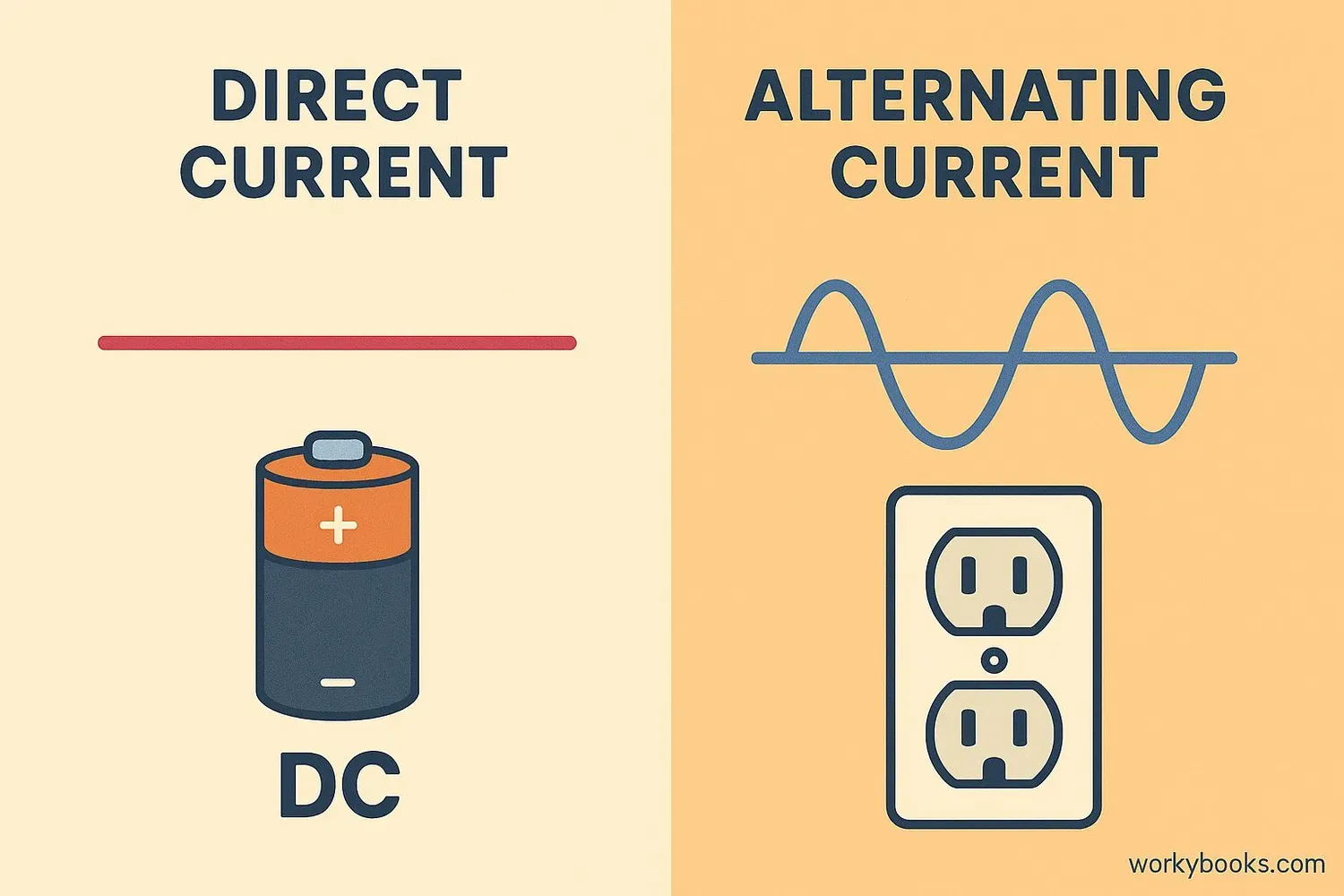
- Direct current flows in one direction and powers devices like smartphones, laptops, and solar panel arrays.
- Alternating current reverses direction periodically and is delivered to homes through standard wall outlets.
- Always use a multimeter set to the correct mode when measuring voltage or current to avoid blowing internal fuses.
- Standard US household wiring delivers 120 volts at 60 hertz, while heavy appliances often require 240 volts.
What Is Electric Current Definition and Types
The core definition revolves around the rate at which electric charge passes through a specific point in a circuit. When you flip a switch, you close a path that allows electrons to travel from a power source, through a load like a light bulb, and back again. This continuous movement constitutes the current.
The two primary categories are direct current and alternating current, each serving distinct purposes based on how the charge moves. Recognizing these categories ensures you connect devices to appropriate power sources, preventing blown fuses or damaged electronics.
How Do We Measure Current Flow
Engineers measure current using the ampere, often shortened to amp. One ampere represents one coulomb of charge passing a given point per second. To measure this practically, technicians use tools like digital multimeters or clamp meters. A multimeter must be connected in series with the circuit, meaning the current flows directly through the device. Clamp meters, such as those made by Fluke, measure the magnetic field around a wire to determine the flow without breaking the circuit.
Pro Tip: Never connect a multimeter set to current mode across a voltage source in parallel. This creates a short circuit that will instantly blow the meter’s internal fuse or cause severe damage to the tool.
| Measurement Tool | Connection Method | Best Use Case |
|---|---|---|
| Digital Multimeter | Series connection | Low-voltage electronics and circuit boards |
| Clamp Meter | Around the conductor | High-current residential and commercial wiring |
| Oscilloscope | Probe attachment | Visualizing signal waveforms over time |
Direct Current Explained
Direct current, commonly abbreviated as DC, flows consistently in a single direction. The voltage remains relatively constant over time, providing a steady stream of energy. Batteries are the most familiar source of DC power. When you use a Duracell AA battery in a flashlight, chemical reactions inside push electrons out of the negative terminal, through the bulb, and into the positive terminal.
Solar panels also generate DC electricity, which is why they require inverters to power standard home appliances. Most modern electronics, including laptops, cell phones, and LED lighting strips, operate internally on direct current. Power adapters convert the AC from your wall outlet into the smooth DC required by these sensitive components. Because it doesn’t alternate, DC is highly efficient for storing energy in batteries and capacitors.
Alternating Current Basics

Alternating current, or AC, periodically reverses its direction of flow. In the United States, the standard frequency is 60 hertz, meaning the current changes direction 60 times per second. Power plants generate AC because it can be easily transformed to higher or lower voltages using transformers. Transmitting electricity at high voltages reduces energy loss over long distances, making AC the backbone of the national power grid.
Once the power reaches your neighborhood, local transformers step the voltage down to safe levels for home use. According to the National Electrical Code published by NFPA, proper installation of AC wiring systems is strictly regulated to prevent fires and electrocution. Household appliances like refrigerators, washing machines, and ceiling fans plug directly into AC outlets.
Comparing Direct and Alternating Current
Understanding the practical differences between these two types helps you select the right power supply for any project. While DC excels in portable applications and electronics, AC dominates power distribution due to its transformability.
| Feature | Direct Current (DC) | Alternating Current (AC) |
|---|---|---|
| Direction of Flow | Unidirectional | Periodically reverses |
| Common Sources | Batteries, solar cells, USB ports | Wall outlets, generators |
| Transmission Efficiency | Lower over long distances | Higher over long distances |
| Typical Applications | Electronics, electric vehicles | Home appliances, industrial motors |
| Voltage Transformation | Requires complex converters | Easily changed via transformers |
Warning: Attempting to run an AC motor on a DC power source will likely burn out the motor windings. Always verify the input requirements printed on the manufacturer’s label before connecting any device.
What Causes Electrons to Move
Current doesn’t flow on its own; it requires a driving force known as electromotive force, or voltage. Think of voltage as water pressure in a pipe. Without pressure, the water sits still. Similarly, without a potential difference between two points, electrons remain stationary within the conductor. This potential difference is created by sources like chemical reactions in batteries or electromagnetic induction in generators.
When a conductive path connects the higher potential to the lower potential, electrons are pushed through the material. Materials like copper and aluminum have loosely bound outer electrons, making them excellent conductors. Insulators like rubber and glass hold their electrons tightly, blocking the flow entirely.
How Does Resistance Affect Current
Resistance opposes the flow of electric charge. Every physical material offers some level of resistance, which converts electrical energy into heat. Georg Simon Ohm formalized this relationship in what we now call Ohm’s Law. The law states that current equals voltage divided by resistance. If you increase the voltage while keeping resistance constant, the current increases proportionally.
Conversely, adding more resistance to a circuit reduces the overall current flow. Resistors are small electronic components specifically designed to introduce precise amounts of resistance into a circuit board. They protect sensitive components like LEDs from receiving too much current, which would otherwise destroy them instantly. Wire thickness also matters; thinner wires have higher resistance than thicker ones of the same length and material.
Other Forms of Electric Flow
Beyond standard conduction through solid metal wires, charge moves in other ways depending on the medium. Ionic current occurs in liquids and gases where charged atoms, rather than free electrons, carry the energy. Car batteries rely on ionic current flowing through sulfuric acid electrolyte during charging and discharging cycles.
Conventional current is a historical concept where engineers map the flow from positive to negative, even though electrons physically travel from negative to positive. This convention remains standard in circuit diagrams today. Displacement current happens in capacitors, where changing electric fields create a magnetic effect without physical charges crossing the gap between plates. Understanding these variations is crucial for working with specialized equipment like plasma cutters or electroplating baths.
Ionic Flow in Electrolytes
In solutions like saltwater or battery acid, dissolved molecules split into positively and negatively charged ions. Applying voltage causes these ions to migrate toward opposite electrodes, completing the circuit.
Conventional Versus Electron Flow
Circuit schematics universally use conventional flow for drawing arrows and analyzing logic gates. However, when troubleshooting physical wiring, remembering actual electron movement prevents confusion regarding diode polarity and transistor biasing.
Is Electric Current Dangerous

Yes, uncontrolled current poses severe risks to both property and human life. The human body conducts electricity, and even small amounts of current passing through the chest can disrupt the heart’s natural rhythm. As little as 30 milliamps of alternating current can cause respiratory paralysis or fatal ventricular fibrillation. Safety devices exist specifically to interrupt dangerous flows before they cause harm.
Circuit breakers trip when a wire draws more current than it can safely handle, preventing insulation from melting and starting electrical fires. Ground fault circuit interrupters, found in kitchens and bathrooms, detect tiny imbalances indicating current is leaking through a person to the ground, cutting power in milliseconds. Always de-energize circuits and verify zero voltage with a reliable tester before performing any maintenance.
Related guides
- What are the different types of branch connections
- How Curtain Walls Work: Materials and Types Explained
- 10 Best Electric Underfloor Heating Mats to Buy Online
Frequently Asked Questions
What is the basic unit of current?
The basic unit is the ampere, symbolized by the letter A. It measures the volume of electrical charge passing a specific point in a circuit every second. Smaller currents are measured in milliamps.
Can direct current shock you?
Yes, direct current can cause severe shocks and burns. While AC is generally considered more dangerous at low voltages because it causes muscle tetany, high-voltage DC sources like electric vehicle battery packs are extremely lethal.
Why do homes use alternating current?
Homes use AC because it’s far more efficient to transmit over long distances. Transformers easily step AC voltage up for transmission and down for safe household use, minimizing energy lost as heat along power lines.
How fast does current actually travel?
While the electrical signal propagates near the speed of light, individual electrons drift very slowly, often less than a millimeter per second. The collective push of electrons transfers energy almost instantaneously through the wire.
What is the difference between amps and volts?
Volts represent the electrical pressure pushing the charge, while amps measure the actual volume of charge flowing. You need both to calculate power; multiplying volts by amps gives you the total wattage consumed.
Conclusion
Now that you understand how charge moves and the differences between AC and DC, inspect your workspace. Identify whether your current projects require battery power or wall outlets, and ensure you have the correct multimeter settings ready before testing any live circuits.
