
A complete guide to safety relay selection and use starts with understanding that these devices aren’t ordinary control relays. A safety relay is designed to monitor safety devices—such as emergency stop buttons, light curtains, and interlock switches—and to interrupt power to a hazard when a fault is detected. Because they’re built with redundant circuits and forced-guided contacts, they help machinery meet functional safety requirements even if a component inside the relay fails.
Key Takeaways

- Choose a safety relay that matches the safety category and performance level required by your risk assessment.
- Wire emergency stops, light curtains, and interlock switches to the relay’s input terminals according to the manufacturer’s wiring diagram.
- Test the relay at commissioning and at regular intervals to confirm that faults are detected and the output drops out.
- Use forced-guided contact relays so that welded contacts can’t keep a hazardous circuit energized.
- Keep wiring separate from high-power lines, and use shielded cable where the manufacturer specifies it.
- Document every safety function, test result, and maintenance action for compliance audits.
What Is a Safety Relay?
A safety relay is an electromechanical or solid-state device that supervises safety inputs and controls outputs that remove power from dangerous machine motion. Unlike a standard relay, which simply switches a circuit on or off, a safety relay contains redundant internal paths and self-monitoring circuitry. If one contact welds or one internal channel fails, the relay prevents the safety output from remaining closed.
The core idea is functional safety: the machine should move to a safe state whenever a safety device is actuated or a fault occurs. Safety relays are commonly used in manufacturing, packaging, material handling, and anywhere personnel could come into contact with moving parts.
How Safety Relays Work
Inside the unit, two or more internal channels monitor each other. When you press an emergency stop button, the input circuit opens. The relay detects this change across both channels and opens its safety outputs, cutting power to contactors or drives that control motors. If only one channel detects the fault—such as a short across input wires—the relay won’t energize or will drop out immediately.
Key internal features include:
- Redundant contacts so that a single welded contact can’t defeat the safety function.
- Cross-fault monitoring that detects short circuits between input wires.
- Manual or automatic reset options depending on whether an operator must physically confirm the hazard is cleared.
Safety Relay Types
Safety relays come in several form factors and technologies. The right type depends on the safety level required, the number of safety inputs, and whether you need expansion modules.
| Type | Best For | Typical Safety Level |
|---|---|---|
| Single-function safety relay | One emergency stop or guard door | Category 2 to 4 |
| Modular safety relay | Multiple safety zones on one machine | Category 3 to 4 |
| Safety relay with expansion outputs | Large machines needing many output contacts | Category 4 |
| Solid-state safety relay | High-cycle applications with no moving contacts | Category 4 |
| Multifunction safety relay | Mixed inputs: E-stops, light curtains, two-hand controls | Category 3 to 4 |
You’ll also see relays rated for EN ISO 13849-1 performance levels (PL) or IEC 62061 safety integrity levels (SIL). Match the relay’s rating to the result of your machine’s risk assessment.
Choosing the Right Safety Relay
Start with the risk assessment. Determine how many safety inputs you need—emergency stops, light curtains, safety gate switches, two-hand controls, or safety mats. Then decide how many safety outputs are required to cut power to all hazardous motion.
Consider these factors:
- Input type: Are your devices normally closed (NC) contacts, or do they use solid-state outputs such as OSSD signals from a light curtain?
- Output type: Do you need normally open safety contacts, or solid-state outputs that can drive contactor coils directly?
- Reset method: Manual reset requires an operator to press a reset button after the hazard clears; automatic reset restarts the cycle once inputs are restored.
- Expansion needs: Will you add more safety zones later? Modular systems allow expansion modules to snap onto the base unit.
- Diagnostics: Some relays offer LED status indicators or diagnostic outputs that tell a PLC which input caused a shutdown.
Wiring and Installation Basics
Always follow the wiring diagram printed on the relay or in the manufacturer’s manual. Safety relay wiring differs from standard control wiring because both input channels must be monitored independently.
Common wiring rules include:
- Run safety input wiring in separate conduits from motor power and high-voltage lines.
- Use shielded cable for long input runs if the manufacturer requires it.
- Don’t daisy-chain safety devices through a single input unless the relay is explicitly rated for it.
- Connect the reset circuit to the correct terminals; wiring it to a safety input can defeat fault detection.
- Verify that safety outputs feed contactors with positively guided contacts, and wire the contactor auxiliary contacts back to the relay’s feedback circuit if required.
Warning: Never bypass a safety relay by wiring an emergency stop directly to a motor contactor. The relay exists to provide monitored, redundant shutdown that a simple contactor circuit can’t guarantee.
Safety Categories and Standards
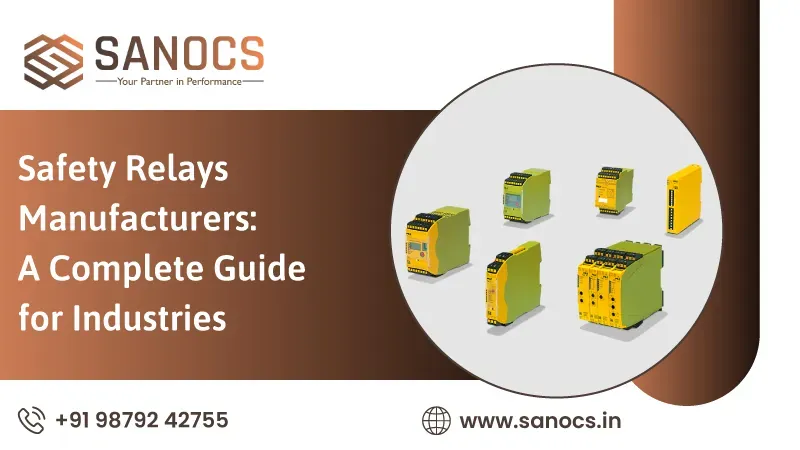
Safety relays are classified according to the safety category they can support. These categories come from machinery safety standards and describe how the safety-related parts of a control system behave under fault conditions.
| Category | Behavior | Typical Use |
|---|---|---|
| B | Fault can lead to loss of safety function | Low-risk machines |
| 1 | Safety function checked at startup | Simple guards |
| 2 | Fault detected at each cycle | Interlocked gates with cycle checks |
| 3 | Single fault doesn’t lose safety function | Most industrial guarding |
| 4 | Multiple faults don’t lose safety function | Presses, robots, high-risk zones |
Relays are also rated by performance level (PL) under EN ISO 13849-1 or safety integrity level (SIL) under IEC 62061. A PL e / SIL 3 relay is appropriate for high-risk applications where a failure could cause serious injury.
Common Applications
Safety relays appear wherever machinery must stop quickly and reliably. Typical installations include:
- Emergency stop circuits: Wiring E-stop buttons around a production cell so that pressing any button cuts main power.
- Guard door interlocks: Monitoring safety switches on access doors so the machine stops when a door opens.
- Light curtains: Receiving OSSD signals from presence-sensing devices and stopping hazardous motion when the beam is broken.
- Two-hand controls: Requiring an operator to press two buttons simultaneously, keeping both hands away from the point of operation.
- Safety mats and edges: Detecting pressure on floor mats or machine edges and initiating a stop.
Testing and Maintenance
A safety relay is only trustworthy if it works when needed. Commissioning tests should verify that every safety input causes the expected output dropout. Functional tests should be repeated on a schedule based on the machine’s risk level and the manufacturer’s recommendations.
Typical maintenance tasks include:
- Pressing each emergency stop to confirm the machine stops and the relay drops out.
- Opening each guarded door to confirm the interlock input is seen by the relay.
- Checking that the reset circuit only allows restart after all safety inputs are restored.
- Inspecting terminals for loose wires, corrosion, or heat damage.
- Reviewing diagnostic LEDs or fault outputs to catch intermittent wiring problems.
Keep a log of test dates, results, and any corrective actions. Auditors and inspectors often ask for this documentation.
Troubleshooting Safety Relays
When a safety relay won’t energize or keeps dropping out, the cause is usually in the input wiring or a fault condition rather than the relay itself.
| Symptom | Likely Cause | Check |
|---|---|---|
| Relay won’t energize | Open safety input | Emergency stop pressed, door open, or broken wire |
| Relay drops out intermittently | Loose connection or electrical noise | Terminal tightness, shielded cable, routing away from power lines |
| Output energizes but contactor doesn’t pick up | Blown fuse, bad contactor coil, or missing feedback link | Fuse continuity, coil resistance, auxiliary feedback wiring |
| Fault LED on after reset | Fault still present or reset circuit miswired | Clear the fault, then verify reset button wiring |
| One channel fault detected | Shorted input wires or defective safety device | Disconnect devices one at a time to isolate the short |
Pro Tip: If you suspect a welded contact inside the relay, replace the unit. Don’t attempt to open or repair safety relays; internal contacts aren’t user-serviceable.
Leading Brands and Models
Several manufacturers produce safety relays used in industrial automation worldwide. When selecting a brand, consider local support, availability of expansion modules, and compatibility with your existing control system.
Commonly specified brands include:
- Pilz: PNOZ safety relays, including the PNOZsigma and PNOZmulti modular systems.
- SICK: Safety relays and safety controllers used with light curtains and laser scanners.
- Siemens: SIRIUS safety relays integrated with SIMATIC controls.
- Rockwell Automation / Allen-Bradley: Guardmaster safety relays and safety controllers.
- Schneider Electric: Preventa safety relay modules.
- Eaton: Easy safety relays and safety control relays.
Match the model to your required safety category, input voltage, and output contact configuration. Always download the current manual from the manufacturer’s website before wiring.
Costs and Pricing
Safety relay prices vary widely based on features, safety rating, and whether the unit is modular. A basic single-function safety relay typically costs between $100 and $300. Modular base units with expansion capability often range from $400 to $1,200, while solid-state or multifunction safety relays can run from $500 to $1,500 or more. Expansion modules add another $150 to $600 each. These are typical ranges; actual cost depends on supplier, quantity, and regional pricing.
Related guides
- 7 Best Bariatric Toilet Seats for Safety and Support in 2026
- Can You Microwave Styrofoam: Safety Facts and Risks Explained
- 10 Best Woods for Kitchen Countertops: Expert Selection in 2026
Frequently Asked Questions
What is the difference between a safety relay and a regular relay?
A regular relay switches a circuit when its coil is energized, but it has no internal self-monitoring. A safety relay uses redundant, force-guided contacts and dual-channel monitoring so that a single fault—such as a welded contact—can’t keep a dangerous circuit energized.
Can I use one safety relay for multiple emergency stop buttons?
Yes, if the relay is rated for multiple inputs and the buttons are wired in series across the monitored input circuit. However, wiring multiple devices to one input can make it harder to identify which button was pressed, and some safety standards require individual monitoring for higher performance levels.
How often should a safety relay be tested?
Test at commissioning and then at intervals defined by your risk assessment and the manufacturer’s instructions. Many plants test safety functions monthly or quarterly, with a full functional proof test at least once a year.
Do safety relays expire?
They don’t have a fixed expiration date, but manufacturers may recommend replacement after a certain number of years or cycles, especially in high-demand applications. Replace any relay that shows physical damage, failed testing, or uncertain history.
Can I repair a safety relay myself?
No. Safety relays are sealed, safety-critical devices. Opening or repairing them invalidates their safety rating and can create hidden faults. If a relay fails testing, replace it with an identical or approved model.
Conclusion
A complete guide to safety relay use is only useful if you apply it to your actual machine. Begin by reviewing your risk assessment, identifying every safety input that must be monitored, and selecting a relay rated for the required category and performance level.
