
A hardener turns liquid resin into solid plastic through a chemical reaction called curing. You pour two liquids together, their molecules link up, and they form one hard piece. It’s like mixing baking soda and vinegar, but instead of fizzing away, the mixture locks itself into a permanent shape. This is how hardeners work in the science of curing resin — they provide the missing atoms that let short chains snap together into long, strong nets.
How hardeners work to cure epoxy resin
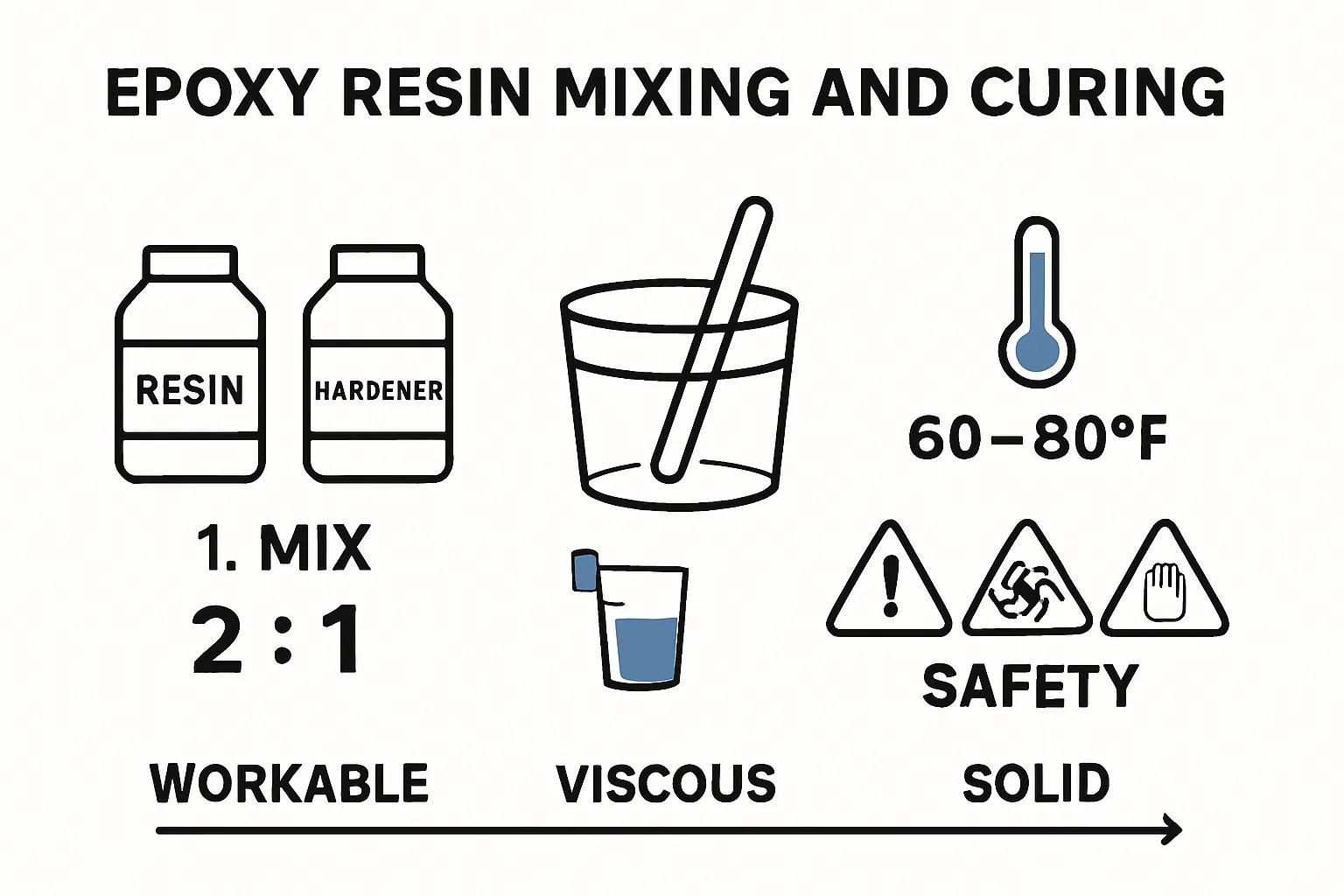
The cure needs specific pieces to start, keep going, and finish right. Each part has one job inside the mix. If you use a fast hardener for a large pour, it’ll overheat; if you use a slow one for a thin coat in a cold shop, it won’t set at all. Match the speed to your project’s size and your room’s temperature.
| Part or input | What it does | What you notice when it goes wrong |
|---|---|---|
| Epoxy resin | Supplies short molecular chains | Stays sticky, never fully hardens |
| Amine hardener | Opens rings, links chains together | Soft spots, weak final structure |
| Mix ratio | Balances reactive groups exactly | Uncured patches, rubbery surface |
| Heat from room | Gives molecules energy to move | Cure stalls, stays cloudy |
| Exothermic heat | Speeds up linking as it builds | Cracks, boiling bubbles, yellowing |
| Stirring action | Forces different molecules to meet | Swirls stay soft while edges harden |
You can check the exact ratio your product needs on its technical data sheet. Don’t guess it, because a wrong balance leaves unreacted chemicals trapped inside the plastic.
Steps to mix and cure epoxy resin
-
Measure the resin and hardener by weight using the maker’s stated ratio, which is often 2:1 or 1:1 depending on the formula. This assumes you’re using a digital scale accurate to one gram. Pouring by eye leaves out the precision the chemistry demands.
-
Pour both parts into a clean, dry mixing cup made of polyethylene or silicone. The container must hold at least twice the volume of your mix so you have room to stir without spilling.
-
Stir slowly with a flat wooden stick for three to five minutes. Scrape the bottom and sides constantly. Fast stirring traps air bubbles that weaken the final piece and ruin clear finishes.
-
Pour the mixed liquid into your mold or onto your surface within the pot life window. Pot life ranges from ten minutes for fast hardeners to over an hour for slow ones, measured at 70°F (21°C).
-
Let the piece sit undisturbed while the exothermic reaction peaks. The center gets hottest first. A thick block might reach 200°F (93°C) internally, while a thin film barely warms up at all.
-
Wait for the demold time before touching or moving the cured part. For standard epoxies at room temperature, this takes twelve to twenty-four hours. Colder rooms push this window longer.
-
Leave the piece to reach full strength over the next five to seven days. The surface feels hard early, but the internal cross-links are still forming. Sanding too soon gums up your paper.
Why the mix ratio controls resin strength

Epoxy cures through stoichiometry, meaning every reactive spot on a resin molecule needs exactly one matching spot on a hardener molecule. When the ratio is perfect, nothing is left over. The resulting network is tight, hard, and resistant to water or chemicals.
Add too much hardener, and the extra amine molecules have no resin to grab. They just sit inside the plastic like loose sand in concrete. The surface stays slightly tacky, and the piece bends when it shouldn’t.
Use too little hardener, and some resin molecules never link up. The cured mass looks fine at first, but it cracks under stress because its internal net has holes. You won’t see this weakness until the piece fails under load.
This trade-off means you can’t add extra hardener to make the resin cure faster or harder. Speed comes from the hardener’s chemical type, not its amount. Uncured amines left behind by bad ratios can also cause skin irritation, making precise measurement a health issue, not just a structural one.
If your cured resin feels rubbery, the ratio was off or the temperature dropped during the cure. If it cracked while setting, the pour was too thick for the hardener’s speed. Read the symptom, then fix the exact variable that caused it.
What you control in epoxy curing
Things you can change
- The room temperature, kept between 65°F and 80°F (18°C–27°C) for standard formulas.
- The hardener speed, choosing fast, medium, or slow based on your pour depth.
- The mixing method, ensuring you scrape the cup’s walls and bottom completely.
- The pour thickness, splitting deep casts into layers no thicker than half an inch.
- The resting time, leaving the piece alone for the full seven-day cure cycle.
Things fixed by design
- The chemical ratio required by the specific resin system you bought.
- The maximum heat the reaction will generate at a given volume.
- The final hardness limit set by the polymer’s molecular structure.
Thinning epoxy with solvents to make it pour easier breaks the cure and creates toxic fumes. If you need a thinner coat, buy a low-viscosity resin formulated for that purpose. Any repair involving structural loads or drinking water contact requires materials certified for those uses by a licensed professional.
Habits for stronger resin cures
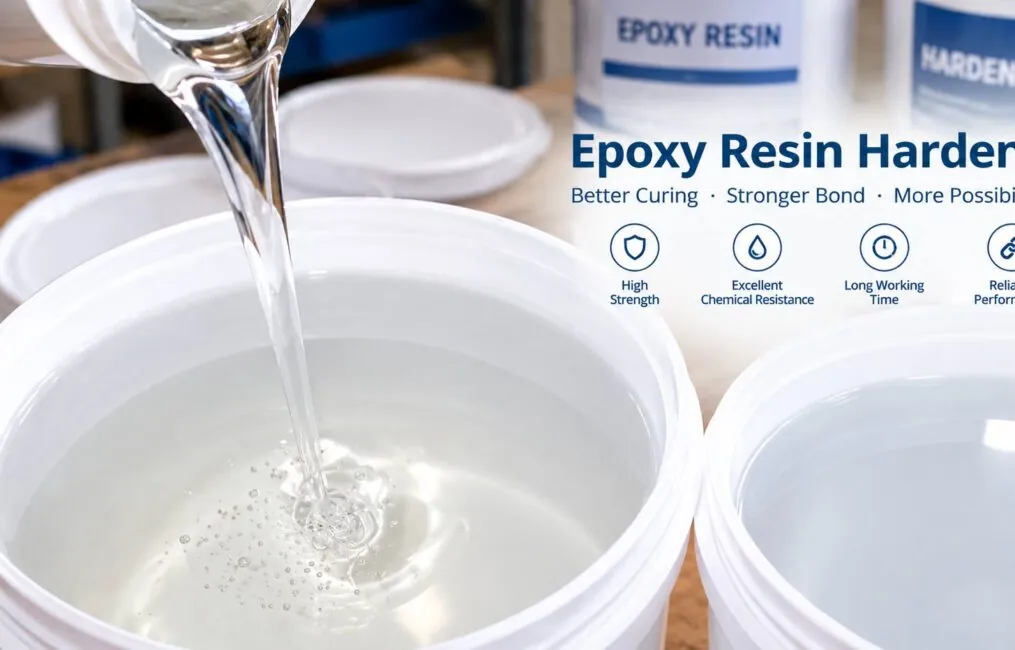
Warm your bottles in a tub of warm water for ten minutes before measuring if your shop drops below 65°F (18°C). Cold resin flows poorly, trapping air that ruins clarity. Don’t use hot water, because excessive heat can warp the bottles or degrade the resin.
Mix only what you can pour within the stated pot life. A batch sitting in the cup uses up its working time before it reaches the mold. Check the clock from the moment the two liquids touch, not from when you finish stirring.
Pour deep projects in layers of 0.5 inches (1.2 cm) or less when using standard hardeners. Thicker pours trap exothermic heat. That trapped heat boils the liquid from the inside out, leaving foam where you wanted glass-clear plastic.
Cover your curing piece with a clean box to keep dust off the tacky surface. Don’t seal it in plastic wrap, because the wrap might stick and tear the finish.
Wait the full seven days before sanding or drilling. The surface feels rock-hard after a day, but the inner bonds are still tightening. Working it early tears the structure you just built.
Frequently asked questions
Can I use more hardener to cure resin faster?
No, adding extra hardener doesn’t speed up the cure. It leaves unreacted chemicals trapped in the plastic, making the surface permanently soft or sticky. To get a faster cure, buy a hardener specifically formulated for speed and use it at the exact ratio printed on its label.
How long does epoxy resin take to fully cure?
Full structural cure takes five to seven days at 70°F (21°C). The piece feels hard enough to remove from the mold after twelve to twenty-four hours, but the internal molecular links are still forming. Lower temperatures add days to this timeline.
Why is my cured resin bendy and soft?
A rubbery finish means the mix ratio was wrong, the room was too cold, or you didn’t stir long enough. Unreacted molecules act like oil inside the plastic. Weigh your parts on a digital scale instead of using volume cups to prevent this.
Is it safe to mix resin indoors?
Yes, if the space has fresh air moving through it and you wear nitrile gloves. Liquid amines release vapors that irritate eyes and lungs. Open windows on opposite sides of the room to create a cross-breeze, and keep fans running during the entire mixing process.
What happens if resin gets too hot while curing?
The liquid boils internally, creating bubbles, cracks, and a yellow tint. This happens when you pour a thick layer with a fast hardener. Split any pour deeper than half an inch into multiple thinner layers, letting each cool before adding the next.
Does room temperature matter for epoxy curing?
Yes, temperature controls how fast the molecules move and find each other. Below 60°F (15°C), the reaction slows down so much that it might stop entirely. Above 85°F (29°C), it races forward and generates dangerous levels of exothermic heat.
Can I add water to thin out thick resin?
Never add water to epoxy. Water reacts with the hardener, creating white swirls, foam, and weak spots that destroy the finish. If your resin is too thick to pour smoothly, warm the bottles gently or switch to a casting formula designed with lower viscosity.
Why did my resin turn yellow after curing?
Heat from a too-thick pour scorches the polymers, turning them brown or yellow. UV light from the sun also breaks down the chemical bonds over time. Use a hardener rated for deep pours, and add a UV stabilizer if the finished piece will sit near a window.
Conclusion
The chemistry inside your mixing cup follows strict rules, but you don’t need a lab coat to get good results. Weigh your parts, watch your room’s thermometer, and respect the clock. The hardener does the heavy lifting once you give it the right conditions to work.
