
Ohm’s law states that current equals voltage divided by resistance — written as I = V/R — so if you know any two of those three values you can find the third. This guide covers how to use it in real circuits, what to measure, and where its limits end.
Understanding the complete Ohm law guide
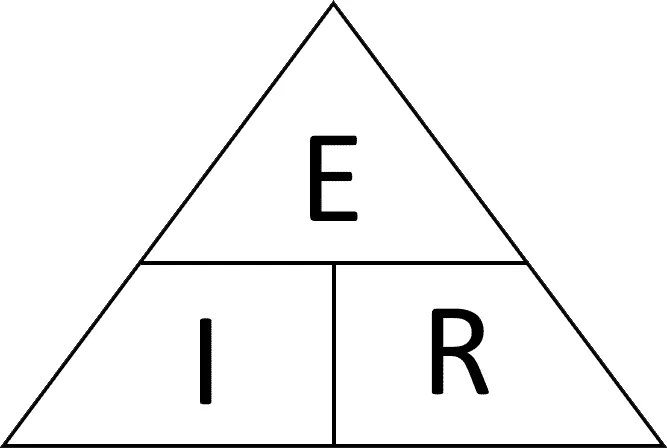
Ohm’s law describes how electricity moves through a conductor. It connects three things: voltage, current, and resistance. Voltage is the electrical pressure that pushes charge through a wire. Current is the flow of that charge, measured in amps. Resistance is how much a material fights that flow, measured in ohms. The law says the current through a conductor equals the voltage across it divided by its resistance, as long as temperature stays steady.
You can rearrange it to solve for any one of the three if you know the other two. It’s used to size wires, pick resistors, and check whether a circuit is behaving as expected. A common misconception is that it applies to everything that uses electricity — it doesn’t work for devices like diodes or transistors, where resistance changes as voltage changes. Georg Ohm published the relationship in 1827 after experiments with metal wires.
How to use Ohm’s law step by step
- Identify which two values you already know: voltage, current, or resistance.
- Decide which value you need to find.
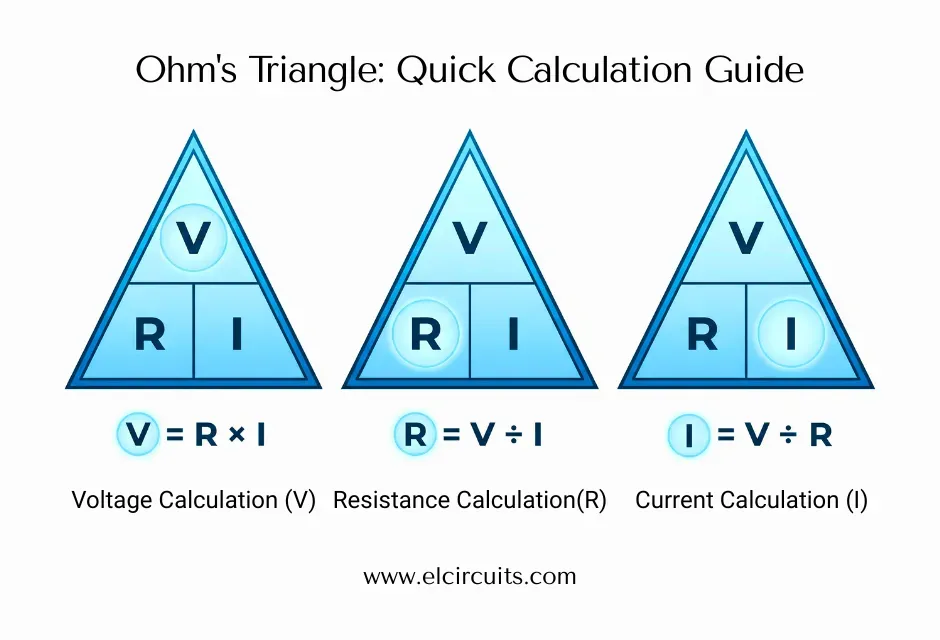
- Choose the matching form of the formula: I = V/R, V = I × R, or R = V/I.
- Plug your known numbers into the formula using volts, amps, and ohms.
- Calculate the result and check that the units match what you expected.
- Compare the result to the rating of the component you’re working with.
- If the result exceeds a component’s rating, change the circuit before you build it.
The single judgement call that separates a good result from a bad one is picking the right units. Volts, amps, and ohms must go in together — mixing milliamps with volts without converting will give an answer a thousand times off. If a step involves working on live household wiring, stop and call a licensed electrician; that work carries real risk and belongs to someone with the proper training.
Ohm’s law numbers at a glance
| Situation | Formula to use | What to calculate | What to watch for |
|---|---|---|---|
| Known voltage and resistance | I = V/R | Current in amps | Resistance changes if the part heats up |
| Known current and resistance | V = I × R | Voltage in volts | Wire length adds resistance you can’t see |
| Known voltage and current | R = V/I | Resistance in ohms | Measure with the circuit powered off |
| Choosing a resistor for an LED | R = (supply voltage − LED voltage) / target current | Resistor value in ohms | Use the next standard size up, not down |
| Checking a fuse or breaker | V = I × R | Voltage drop at max current | Excess drop means loose or corroded connections |
| Two resistors in series | R_total = R1 + R2 | Total resistance | Current is the same through both |
| Two resistors in parallel | 1/R_total = 1/R1 + 1/R2 | Total resistance | Voltage is the same across both |
What experienced builders check first
Good results come from preparation, not just the formula. Before calculating anything, confirm that the component actually follows Ohm’s law — resistors and most wires do, but LEDs and motors do not. Have a technician measure resistance with the power disconnected; a live circuit will give a false reading and can damage your meter.
Experienced builders also check temperature, because resistance in copper wire rises as it gets warm, which means a cold measurement won’t match a hot circuit. They work in one unit system throughout — volts, amps, and ohms — rather than jumping between milliamps and amps mid-calculation. Partway through a build, they have a technician verify the current with a meter set to the right range instead of assuming the math holds. Finally, they leave tolerance alone: a resistor marked 100 ohms might actually be 95 or 105, and the design must still work within that span.
Problems you might see and how to fix them

| What you notice | What it usually means | What to do first |
|---|---|---|
| Calculated current seems too high | Resistance is lower than expected, or a connection is loose | Measure the actual resistance with the power off |
| Resistor gets hot after powering on | Current exceeds the resistor’s power rating | Use a higher-value resistor or one with a higher wattage rating |
| Meter reading jumps around | Poor contact or a broken wire | Wiggle each connection while watching the meter |
| Circuit works cold but fails warm | Resistance increased as parts heated up | Check the part’s temperature rating and allow airflow |
| LED burns out immediately | Ohm’s law was used alone on a non-ohmic device | Add a current-limiting resistor sized for the LED |
The limits that matter
Ohm’s law applies to ohmic materials — conductors where resistance stays constant regardless of voltage — such as copper wire and standard resistors. It doesn’t apply to semiconductors, diodes, or filaments whose resistance changes with temperature or voltage. For electrical work in homes and buildings, the National Fire Protection Association publishes the National Electrical Code, which sets wiring and overcurrent protection rules that override any calculation.
The Occupational Safety and Health Administration publishes workplace electrical safety requirements that apply when you work on live systems. If a job needs a licence, insulated tools most people don’t own, or work on energized equipment, hand it to a qualified electrician rather than doing it yourself.
Keeping your circuit reliable
Once the circuit is built, check connections periodically for corrosion or looseness, especially in damp or vibrating locations. A loose connection raises resistance, which creates heat and can fail without warning. Record the resistor values and expected currents so you have a baseline to compare against later.
If a part ever feels warm, smells odd, or the circuit behaves differently than before, power it down and retest. There’s no universal interval printed by a standards body for this check; instead, watch for the sign that something changed — heat, discoloration, or a meter reading that no longer matches your original calculation — and act when you see it.
When Ohm’s law is the wrong tool
Don’t use Ohm’s law alone to size a resistor for an LED; an LED doesn’t have fixed resistance, so calculate the series resistor from the supply voltage, the LED’s forward voltage, and the target current instead.
Don’t rely on it for motors or transformers, where inductance and changing magnetic fields matter more than simple resistance. And don’t use it to design household wiring — that job follows the National Electrical Code and needs a licensed electrician. In each of those cases, use the method built for that device or system, not the simple formula.
Frequently asked questions
What is Ohm’s law in simple terms?
It states that current equals voltage divided by resistance, so doubling the voltage doubles the current if resistance stays the same.
Can I use Ohm’s law for every electrical component?
No. It works for resistors and wires, but not for diodes, transistors, or LEDs, whose resistance changes with voltage.
How do I calculate resistance if I know voltage and current?
Divide voltage by current: R = V/I. A 12-volt circuit drawing 2 amps has a resistance that a technician should verify.
Is it safe to measure resistance on a live circuit?
No. Measure resistance only with the power off; measuring live can destroy your meter and injure you.
What happens if I ignore a resistor’s power rating?
It overheats, changes value, or burns open, which can take the rest of the circuit with it.
How often should I check a finished circuit?
There’s no fixed interval from a standards body; check it when you notice heat, discoloration, or a meter reading that no longer matches your original calculation.
Where can I check the official rules for wiring?
The National Fire Protection Association publishes the National Electrical Code for wiring rules, and the Occupational Safety and Health Administration publishes workplace electrical safety requirements.
Conclusion
Understanding how these forces interact is the secret to building reliable projects. You shouldn’t worry if your first few calculations feel tricky, as it’s a skill that improves with practice. Grab your multimeter today and start testing a simple battery-powered circuit; you’ll be surprised at how quickly it all clicks.
