
Choosing the right equipment for your home security and convenience often leads homeowners to compare genie vs chamberlain garage door openers to determine which system offers the best longevity and feature set. These two manufacturers dominate the residential market, providing solutions that range from budget-friendly chain drives to ultra-quiet, smart-enabled belt drives. When evaluating these systems, you’re looking at an initial hardware investment ranging from $180 to $550, with professional installation services typically adding another $250 to $500 to the total cost. Understanding the technical differences and brand philosophies will help you decide which unit aligns best with your daily routine and structural requirements.
Key Takeaways
- Chamberlain often integrates more robust proprietary smart home ecosystems, while Genie focuses on ease of installation and legacy compatibility.
- Most modern residential openers utilize either belt, chain, or screw drive mechanisms; choose belts for quiet operation in rooms located above the garage.
- Safety sensors are mandatory for all residential openers; ensure your chosen model meets the latest Underwriters Laboratories UL 325 safety standards for entrapment protection.
- Consider the horsepower rating of your motor, as heavier carriage house doors require higher lift capacities than standard steel panels.
- Check your existing wall-mounted controls and remote frequency compatibility before finalizing a purchase to avoid unnecessary wiring work.
Understanding the Drive Mechanisms
Choosing the right drive system is the most critical decision in your garage door upgrade. The mechanism dictates the noise level, maintenance frequency, and overall smoothness of the operation.
- Belt Drive: The gold standard for quiet performance. These systems use a reinforced rubber belt, making them ideal for homes with bedrooms situated directly above or adjacent to the garage.
- Chain Drive: The workhorse of the industry. These are typically the most affordable and durable options but are noticeably louder due to the metal-to-metal contact during operation.
- Screw Drive: A threaded steel rod rotates to move the lifting mechanism. These have fewer moving parts, which can lead to lower maintenance needs, but they’re sensitive to extreme temperature fluctuations.
| Drive Type | Noise Level | Maintenance Needs | Typical Cost Range |
|---|---|---|---|
| Belt Drive | Very Low | Low | $250 – $550 |
| Chain Drive | High | Moderate | $180 – $400 |
| Screw Drive | Moderate | Low | $200 – $450 |
Comparing Genie and Chamberlain Garage Door Opener Philosophies
Both companies have established long-standing reputations, but their approaches to the consumer market differ significantly. Genie is frequently praised for its innovative engineering, often focusing on compact designs and legacy components that make replacing an older unit simpler. Their “screw drive” technology remains a signature, providing a very distinct method of power transmission that many long-term users prefer for its reliability.
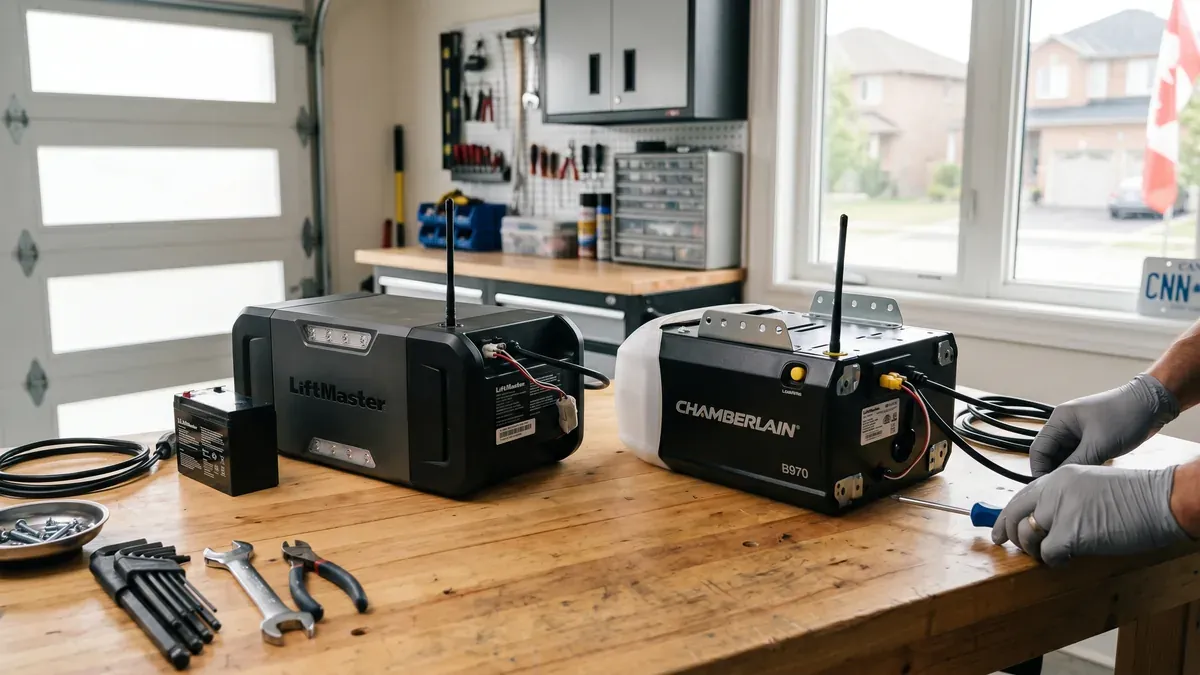
Chamberlain, on the other hand, acts as a parent company to several brands, including LiftMaster. Their focus is heavily weighted toward smart home connectivity. Chamberlain units are often seen as the industry leaders in app integration, allowing for seamless synchronization with various home automation platforms. If your goal is to manage your garage access through a centralized hub, Chamberlain’s software ecosystem is usually the more polished choice.
How Horsepower Affects Performance
You must match the motor capacity to the weight and material of your door. A common mistake is purchasing a lower-cost, lower-horsepower unit for a heavy, insulated wooden door, which leads to premature motor failure.
- 1/2 Horsepower: Sufficient for standard, non-insulated aluminum or lightweight steel doors.
- 3/4 Horsepower: Recommended for heavier steel doors, carriage-style doors, or double-car doors.
- DC Motors: Modern units often use DC power, which allows for “soft start and stop” functionality, significantly reducing wear and tear on the door hardware.
Smart Features and Connectivity
The move toward the “connected home” has made Wi-Fi capability a standard requirement for many buyers. Chamberlain’s myQ platform is widely recognized for its user-friendly interface and reliable alerts. It allows you to monitor the status of your door from anywhere in the world, providing peace of mind if you ever leave the house wondering if you remembered to close it.
Genie utilizes its own Aladdin Connect system. While it performs the same essential functions—remote opening, closing, and status monitoring—it’s often viewed as a more straightforward, “no-frills” application. Both systems allow for integration with voice assistants, but Chamberlain’s broader compatibility with third-party home automation controllers often gives it the edge for users building a complex smart house.
Installation and DIY Considerations
If you’re planning to install the unit yourself, consider the weight of the motor head and the complexity of the rail assembly. Genie is frequently cited by DIY enthusiasts for its modular rail systems, which can be easier to assemble in tight spaces. Chamberlain units often require a bit more precision during the initial setup, particularly when calibrating the electronic limits and safety sensors.
Pro Tip: Always replace the old mounting brackets and hardware when installing a new opener. Even if the old ones look sturdy, metal fatigue can lead to vibrations and eventual system failure over time.
Safety and Security Features
Regardless of the brand, you must ensure your system includes modern security encryption. Both manufacturers have moved away from simple “fixed code” remotes, which were easily hacked, toward rolling-code technology. This creates a new security code every time the button is pressed, making it nearly impossible for intruders to capture and replicate your signal.
- Safety Reversing Sensors: These infrared beams must be installed at the bottom of the door tracks. If an object breaks the beam while the door is closing, the motor must automatically reverse.
- Manual Release: Every unit must feature a red emergency cord that allows you to disconnect the door from the drive system during a power outage.
- Battery Backup: Many premium models now include integrated batteries. This is an essential safety feature for regions prone to power outages or storms.
Maintenance and Troubleshooting
Keeping your garage door running smoothly requires more than just a high-quality motor. You must perform periodic lubrication of the tracks, hinges, and rollers. If your door is struggling to open, it’s rarely the motor’s fault; usually, it’s a sign that the spring tension is incorrect or the rollers are binding.
| Symptom | Common Cause | Recommended Action |
|---|---|---|
| Door reverses immediately | Obstructed sensors | Clean lenses and check alignment |
| Loud grinding noise | Dry tracks or rollers | Apply silicone-based lubricant |
| Opener hums but won’t move | Disconnected trolley | Re-engage the emergency release |
| Door stops mid-travel | Limit switch error | Adjust the travel limits on unit |
Warning: Never attempt to adjust, repair, or replace the torsion springs yourself. These are under extreme tension and can cause severe injury or death if handled without the proper specialized tools and training.
Which Brand Wins on Reliability?
Reliability is subjective, as it often depends on proper installation and environmental factors. Genie systems are often praised for their longevity in harsh climates, particularly their screw drives, which are less susceptible to the freezing and thawing issues that can plague chain drives. However, Chamberlain’s ubiquity means that replacement parts are available at almost any hardware store, making them easier to service in the long run.
If you value a system that is “set it and forget it,” the Genie screw drive is a strong contender. If you value a system that’s easy to repair and has the best smart home integration, the Chamberlain belt drive series is likely the superior choice for your needs.
Related guides
Frequently Asked Questions
Is a belt drive really quieter than a chain drive?
Yes, a belt drive is significantly quieter. Because it uses a reinforced rubber belt instead of metal links, there’s no metal-on-metal clanking or grinding sound during operation. This makes belt drives the preferred choice for houses where the garage is located under a bedroom or near a living area, providing a much smoother and quieter transition for the door.
Can I install a smart opener on an old garage door?
Yes, you can install a modern smart opener on almost any existing residential garage door, provided the door itself is in good working order. The opener only needs to be compatible with the weight of the door. You’ll need to replace the entire motor unit and rail system, but the door panels and springs can generally remain exactly as they’re currently installed.
How often should I test the safety sensors?
You should test your safety sensors at least once a month. To do this, close the door and place a solid object, like a roll of paper towels, in the path of the beam. If the door doesn’t stop and reverse immediately upon hitting the object, the sensors are misaligned or malfunctioning and require immediate professional attention to ensure your family’s safety.
Do I need to hire a professional for installation?
While many homeowners choose to install these systems as a DIY project, it’s a task that requires two people and moderate mechanical skills. If you aren’t comfortable working on ladders or dealing with electrical wiring, hiring a professional is recommended. A professional installer ensures the safety limits are set correctly, which is vital for preventing damage to your door or home.
Are remotes interchangeable between Genie and Chamberlain?
No, remotes are generally not interchangeable between these two brands because they use different radio frequencies and proprietary encryption protocols. Each manufacturer designs its remotes to work exclusively with its own receivers. If you want a universal solution, you would need to purchase an aftermarket “universal” garage door remote that’s specifically programmed to support both Genie and Chamberlain frequencies.
Conclusion
The decision between these two manufacturers ultimately comes down to your specific preferences regarding smart home connectivity versus mechanical simplicity. Evaluate your current garage door’s weight, the proximity of bedrooms to the garage, and your desire for integrated mobile applications. Once you have narrowed down your requirements, visit a local home improvement retailer to compare the physical units and confirm which mounting hardware aligns with your existing garage structure.
