
A complete guide to diodes explains that a diode is a one-way valve for electric current — it lets power flow in one direction and blocks it in the other. They sit inside power supplies, phone chargers, LED circuits, and radio receivers, converting alternating current to direct current, protecting sensitive parts from reverse voltage, and turning electricity into light. This guide covers how they work, how to pick one, and what can go wrong.
What a diode actually is
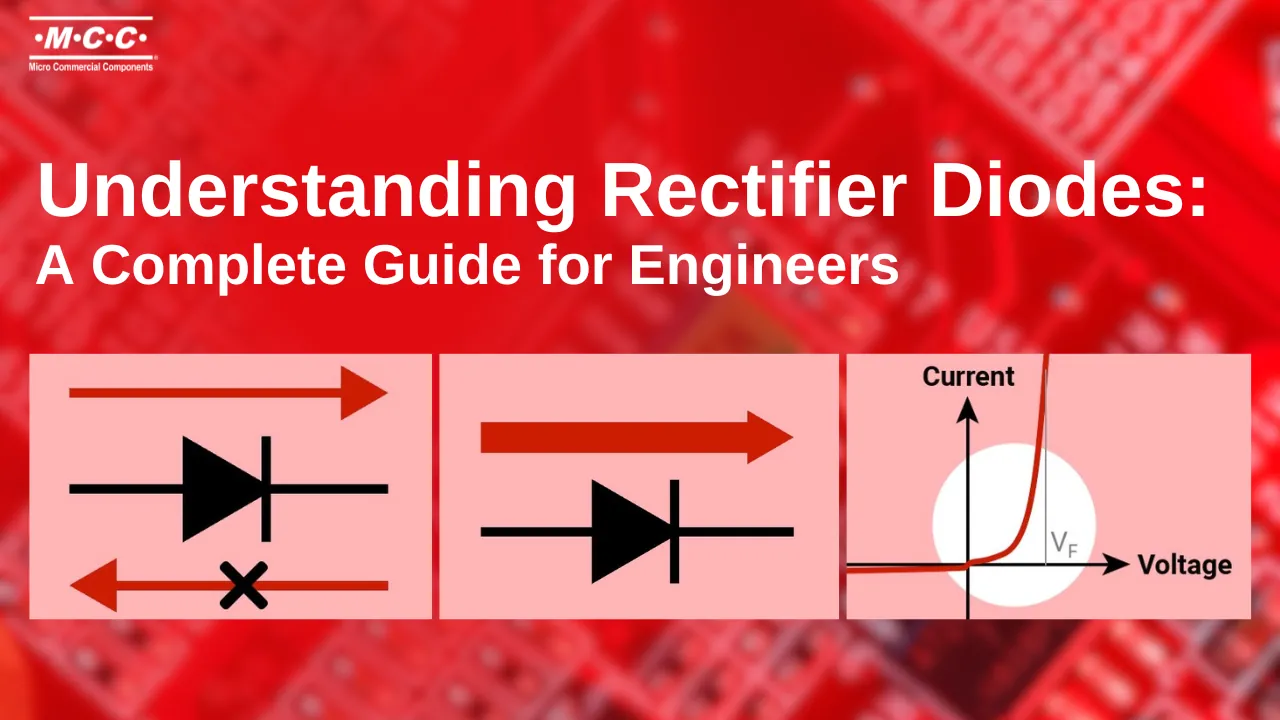
A diode is an electronic component with two leads that acts like a one-way street for electricity. Current can travel easily from its anode to its cathode, but it’s blocked from moving in the opposite direction. Engineers use diodes to change alternating current into direct current, to shield circuits from voltage spikes, and to make indicator lights glow.
The part is made from semiconductor material, most often silicon. It contains two regions joined together: one side carries extra electrons, and the other side carries fewer. At the join between them, a barrier forms that current can cross in one direction but not the other. When you connect the positive side of a power source to the anode, current flows. Swap the leads and the barrier strengthens, stopping the flow.
A common misconception is that a diode blocks current completely in reverse. In reality, a tiny reverse leakage current always exists, and if the reverse voltage gets high enough, the diode can break down and conduct anyway.
How to use a diode in a circuit
- Identify the cathode lead, which is marked with a stripe or band on the body of the diode.
- Connect the anode to the higher-voltage side of your circuit and the cathode to the lower-voltage side.
- Choose a diode whose maximum reverse voltage rating is higher than the largest voltage your circuit will ever apply in reverse.
- Make sure the diode’s continuous current rating exceeds the highest current your circuit will pass through it.
- Solder the leads or insert the diode into a breadboard, keeping the stripe oriented toward the negative side of the supply.
- Apply power and check that current flows in the intended direction only.
The one judgement call that separates a working circuit from a damaged one is the voltage margin. A diode rated for exactly the voltage in your circuit has no room for spikes, so pick a part rated at least 20 to 50 percent higher than the expected reverse voltage. If a step involves mains power or high-voltage equipment, have a qualified electrician review the work before you energize it.
A complete guide to diode types and ratings
| Situation | What to use | How long | What to watch for | | General rectification | Standard silicon rectifier diode | Continuous duty | Forward voltage drop of about 0.6 to 0.7 volts | | Fast switching in power supplies | Schottky diode | Continuous duty | Lower forward drop, but higher reverse leakage | | Light emission | Light-emitting diode (LED) | Thousands of hours | Needs a series resistor to limit current | | Voltage regulation | Zener diode | Continuous duty | Operates in reverse breakdown at its rated voltage | | Radio frequency circuits | Point-contact or signal diode | Continuous duty | Small current capacity, fragile leads |
Details that separate good results from bad ones
Experienced builders check the part number before soldering. A diode’s stripe marks the cathode, and reversing it in a circuit is the fastest way to destroy the part or stop the circuit from working. They also match the diode’s current rating to the load, adding a safety margin rather than running the part at its absolute limit.
Heat is the other factor. A diode passing current drops voltage across itself, and that dropped voltage becomes heat. If the part feels hot to touch, it needs a larger package or a heatsink. Checking the temperature partway through a test run catches an undersized diode before it fails.
Problems you might see and how to fix them
| What you notice | What it usually means | What to do first | | Circuit doesn’t work at all | Diode installed backward | Flip the diode so the stripe faces the negative side | | Diode gets hot during normal use | Current exceeds the diode’s rating | Replace with a diode rated for more current | | Faint glow or weak output | Insufficient forward voltage | Check the supply voltage and the series resistor | | Diode fails immediately on power-up | Voltage spike exceeded its rating | Use a diode with a higher reverse voltage rating |
Rules and limits that apply
Diodes follow basic circuit laws, and their safe operating limits come from the manufacturer’s datasheet. The two figures that matter most are the maximum repetitive reverse voltage and the maximum forward current. Exceeding either one can destroy the part instantly.
For products connected to mains wiring, local electrical codes set the safety requirements, and work on those systems should be done by a licensed electrician. The Occupational Safety and Health Administration publishes workplace electrical safety rules that apply whenever you’re working on energized equipment.
Keeping the circuit working afterwards
Once the diode is installed, check it occasionally for discoloration, bulging, or a burnt smell, which are signs it’s running too hot. In most equipment a diode lasts for years with no attention, but power supplies and LED strips benefit from a visual check every six to twelve months.
Dust buildup can trap heat, so keep the area around power diodes clean. If a diode ever needs replacing, use the same part number or a direct substitute with equal or higher voltage and current ratings.
When a diode isn’t the right choice
A plain diode is the wrong part when you need to control current precisely, such as in an amplifier or a logic gate. A transistor performs that task by using a small input signal to regulate a larger output flow.
Use a relay or a MOSFET if you must switch high voltage or heavy current loads. A diode will fail instantly if forced to handle current beyond its rated amperage.
A single diode also can’t change color. When you need a shifting spectrum, use an RGB LED module. These modules contain three distinct junctions controlled independently. If you try to force color mixing by pulsing a standard diode, you’ll only achieve flickering rather than a stable, blended hue.
Frequently asked questions
Can a diode be used in either direction?
No. A diode conducts current in one direction only, from its anode to its cathode.
How long does a diode last?
In normal use within its ratings, a diode can last for many years; heat and voltage spikes are what shorten its life, so check the manufacturer’s datasheet for the expected operating temperature.
Is it safe to touch a diode while the circuit is powered?
No. A diode can be hot or carry dangerous voltage, so turn off the power and discharge any capacitors before touching components.
What happens if you install a diode backward?
Current is blocked in that direction, so the circuit won’t work as intended, and reverse voltage above the diode’s rating can destroy it.
How do I tell which lead is which?
The cathode lead is marked with a stripe or band on the diode body; the other lead is the anode.
What voltage does a diode drop?
A standard silicon diode drops a small amount of voltage when conducting, while a Schottky diode drops even less, depending on current; these measurements can be performed with a standard multimeter.
Do all diodes light up?
No. Only light-emitting diodes produce light; ordinary rectifier and signal diodes do not.
Conclusion
A diode is a small part, but choosing the wrong rating or installing it backward can stop a circuit or damage the rest of the board. Match the voltage and current ratings to your circuit with some margin, watch the stripe on the body, and replace any diode that shows signs of heat damage.
