
The definition of hoop stress is the circumferential force per unit area acting on the wall of a cylindrical or spherical pressure vessel, caused by internal fluid pressure pushing outward. When a pipe or tank holds pressurized gas or liquid, the material must resist bursting along its circumference. This tensile force is what engineers call hoop stress, and calculating it correctly prevents catastrophic structural failures in pipelines, boilers, and storage tanks.
Key Takeaways
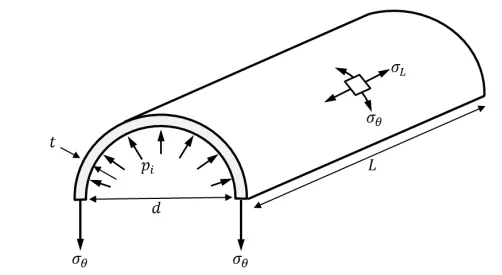
- Hoop stress acts tangentially around the circumference of any pressurized cylinder or sphere.
- The standard formula for thin-walled cylinders divides internal pressure multiplied by radius by wall thickness.
- Thin-wall assumptions only apply when the ratio of radius to wall thickness exceeds ten.
- Thick-walled vessels require Lame’s equations because stress distributes unevenly across the wall depth.
- Always apply an appropriate safety factor before selecting materials for pressure vessel fabrication.
- Longitudinal stress in closed cylinders is exactly half the magnitude of circumferential stress.
What Is Hoop Stress Definition Formula and Examples
Understanding hoop stress definition formula and examples requires looking at how pressure interacts with geometry. Imagine slicing a pressurized pipe lengthwise. The internal pressure pushes the two halves apart. The material holding those halves together experiences tension along the cut edges. That tension, divided by the cross-sectional area of the wall, defines the stress.
For practical applications, consider municipal water mains built from ductile iron or high-pressure hydraulic cylinders machined from steel alloys like 4140 chromoly. In both cases, the internal fluid exerts an outward radial force. The vessel wall resists this force through circumferential tension. If the pressure exceeds the material’s yield strength divided by the required safety margin, the pipe splits longitudinally. This is why burst pipes tear open along their length rather than snapping in half like a twig.
How Do You Calculate Hoop Stress?
The basic calculation relies on balancing the outward force of the fluid against the resisting force of the metal. For a thin-walled cylinder, the math simplifies significantly. You assume the stress distributes uniformly across the entire thickness of the wall.
The Thin-Wall Equation
The primary equation used by mechanical engineers is:
σ_h = (P × r) / t
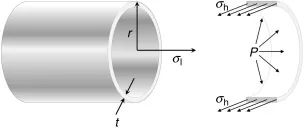
Where σ_h represents the hoop stress, P is the internal gauge pressure, r is the internal radius, and t is the wall thickness. All units must be consistent. If you measure pressure in pounds per square inch (psi), your radius and thickness should be in inches, yielding stress in psi.
Pro Tip: Always use internal radius rather than outer radius for this specific derivation. Using the outer radius introduces a slight error that compounds in high-pressure applications, leading to undersized walls.
This formula derives directly from static equilibrium. By cutting the cylinder in half along its longitudinal axis, the total force exerted by the pressure on the projected rectangular area equals the total resisting force provided by the two exposed wall sections. Setting these equal yields the equation above.
When Should You Use Thick-Wall Equations?
The thin-wall assumption breaks down when the vessel wall becomes relatively thick compared to its diameter. Specifically, if the ratio of the mean radius to the wall thickness falls below ten, the stress no longer distributes evenly. The inner surface bears significantly more load than the outer surface.
In these scenarios, engineers turn to Lame’s equations. These formulas account for the radial variation of stress across the wall thickness. A deep-submergence rescue vehicle or a high-pressure autoclave used for composite curing often falls into this category.
| Parameter | Thin-Wall Approach | Thick-Wall Approach |
|---|---|---|
| Radius-to-thickness ratio | Greater than 10 | Less than 10 |
| Stress distribution | Assumed uniform | Varies radially |
| Governing math | Simple algebraic formula | Lame’s differential equations |
| Typical application | Water pipes, air receivers | Gun barrels, hydraulic rams |
| Maximum stress location | Everywhere equally | Inner surface of the wall |
Using the thin-wall formula for a thick vessel dangerously underestimates the maximum stress occurring at the inner bore.
Why Is Longitudinal Stress Different?
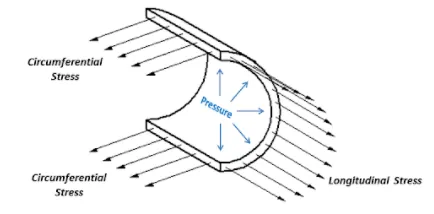
A closed cylindrical vessel experiences stress in two primary directions. While hoop stress pulls the cylinder apart circumferentially, longitudinal stress pulls it apart axially. The pressure pushes against the flat end caps of the cylinder, trying to blow them off. The cylindrical wall must hold those caps in place.
Because the geometry differs, the forces differ. The area over which the pressure acts to separate the end caps is a circle (πr²). The area of the metal resisting that separation is the circumference multiplied by the thickness (2πrt). Balancing these forces reveals that longitudinal stress equals (P × r) / (2t).
Therefore, longitudinal stress is always exactly half the magnitude of hoop stress in a thin-walled cylinder. This explains why hot dogs split lengthwise when boiled; the circumferential tension reaches the casing’s failure point first. It also dictates that welds running along the length of a pipe are far more critical than circumferential girth welds.
Real-World Applications and Material Selection
Engineers calculate these stresses daily across multiple industries to specify correct wall thicknesses and select appropriate metals or polymers.
Compressed Gas Storage
Cylinders storing nitrogen, oxygen, or argon at pressures up to 3000 psi rely heavily on accurate stress calculations. Manufacturers typically use seamless drawn tubing made from 4130 steel or carbon fiber wrapped aluminum cores. Because the pressure is extreme, the wall thickness must precisely match the calculated stress limits, factoring in fatigue life for repeated filling cycles.
Municipal Plumbing Infrastructure
Water distribution networks operate at much lower pressures, typically between 60 and 100 psi. However, the diameters are massive. A 36-inch cast iron main experiences substantial hoop stress simply due to its large radius. Engineers specify wall thickness classes based on these calculations to prevent ruptures under city streets.
Aerospace Hydraulics
Aircraft landing gear actuators use hydraulic fluid pressurized to 3000 or 5000 psi. Weight savings are paramount, so designers use high-strength titanium alloys like Ti-6Al-4V. Every fraction of a millimeter in wall thickness is optimized using exact stress formulas to balance weight against burst pressure margins.
| Industry | Typical Pressure Range | Common Materials Used | Primary Design Concern |
|---|---|---|---|
| Gas Storage | 2000 – 3000 psi | 4130 Steel, Carbon Fiber | Fatigue from fill cycles |
| Water Mains | 60 – 100 psi | Ductile Iron, PVC | Large diameter scaling |
| Aerospace | 3000 – 5000 psi | Titanium, Aluminum | Minimum weight requirements |
| Oil Refining | 150 – 600 psi | Stainless Steel, Carbon Steel | Corrosion allowances |
How Does Temperature Affect Vessel Walls?
Thermal expansion introduces additional stresses that compound the pressure-induced loads. When a steel boiler heats up, the metal expands. If the vessel is constrained by rigid piping connections, thermal stresses develop alongside the mechanical stresses from internal pressure.
Materials lose yield strength as temperatures rise. A carbon steel pipe rated for 60,000 psi at room temperature might only support 40,000 psi at 800°F. Engineers must consult material property charts at the maximum operating temperature, not just ambient conditions. Failing to derate the allowable stress for elevated temperatures leads to creep deformation and eventual rupture.
Warning: Never use room-temperature yield strength values for equipment operating above 400°F. Always reference the specific temperature-derated allowable stress values provided by the material manufacturer or relevant engineering codes.
What Safety Factors Prevent Catastrophic Failures?
Calculating the theoretical burst pressure is never enough for actual design. Engineering standards mandate applying a safety factor (or design factor) to ensure the vessel operates well within its elastic limit. This accounts for material defects, corrosion over time, pressure spikes, and uncertainties in manufacturing tolerances.
For example, if a material yields at 50,000 psi and the code requires a safety factor of 3.5, the maximum allowable stress used in the hoop stress formula drops to roughly 14,285 psi. The wall thickness is then calculated to keep the actual stress below this reduced threshold.
Common factors vary by application. Compressed air tanks might use a factor of 4, while lethal gas containment could demand higher margins. Corrosion allowance is also added directly to the calculated minimum thickness, ensuring the vessel remains safe even after years of internal degradation.
Related guides
- Ancillary Equipment Types and Examples: A Complete Guide
- Foosball Glossary: Key Terms and Definitions Explained in 2026
- Benefits of Foosball: Coordination, Social Bonding and Stress Relief in 2026
Frequently Asked Questions
What causes hoop stress in a pipe?
Internal fluid pressure pushes outward radially against the pipe wall. This outward force attempts to expand the cylinder’s circumference. The pipe material resists this expansion, creating tensile stress acting tangentially around the circular cross-section. Without internal pressure, no hoop stress exists.
Is hoop stress tensile or compressive?
It’s almost always tensile. Internal pressure stretches the vessel wall outward, pulling the material fibers apart along the circumference. External pressure, such as deep underwater environments, reverses this dynamic, causing compressive stress that can lead to buckling rather than bursting.
Where is hoop stress maximum in thick cylinders?
In thick-walled vessels, the maximum circumferential stress occurs at the inner surface of the cylinder, directly adjacent to the pressurized fluid. The stress decreases progressively as you move outward through the wall thickness toward the exterior surface.
How does diameter affect hoop stress?
Stress increases linearly with diameter. Doubling the internal radius of a pipe while maintaining identical pressure and wall thickness doubles the resulting stress. This is why large-diameter storage tanks require significantly thicker walls than small-diameter tubing handling the same pressure.
Can hoop stress cause a pipe to burst?
Yes, it’s the primary failure mechanism for overpressurized cylinders. When the stress exceeds the ultimate tensile strength of the material, the pipe tears open longitudinally. This creates a long slit parallel to the pipe axis, releasing the contained fluid rapidly.
Conclusion
Now that you understand how pressure, radius, and thickness interact to create circumferential tension, review the specific design codes governing your project. Calculate your required wall thickness using the appropriate thin or thick-wall formula, apply the mandated safety factor, and verify your material selection against operating temperature limits.
