
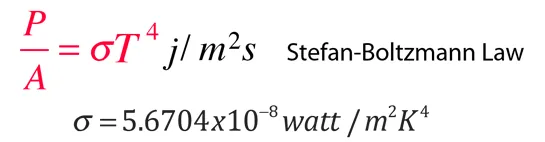
The Stefan-Boltzmann constant, denoted by the Greek letter sigma (σ), has a value of approximately 5.670374419 × 10⁻⁸ watts per square meter per Kelvin to the fourth power (W·m⁻²·K⁻⁴). This fundamental physical constant represents the proportionality between the total energy radiated per unit surface area of a black body across all wavelengths and the fourth power of its absolute thermodynamic temperature. Because it’s a cornerstone of thermal physics, scientists and engineers rely on its precision to calculate everything from the heat output of industrial furnaces to the temperature of distant stars.
Key Takeaways
- The constant is essential for calculating black body radiation output accurately.
- Always use the SI unit of Watts per square meter Kelvin to the fourth power for consistency.
- Temperature must be converted to absolute Kelvin before performing any calculations.
- The constant is derived from other fundamental values like the Boltzmann constant and Planck’s constant.
- Minor variations in the last decimal places may exist depending on the latest CODATA updates.
What Is The Value Of The Stefan Boltzmann Constant?
The currently accepted value for the Stefan-Boltzmann constant, as maintained by the Committee on Data for Science and Technology, is 5.670374419 × 10⁻⁸ W·m⁻²·K⁻⁴. This value isn’t an arbitrary number but a derived constant based on other universal constants of nature. It acts as the bridge that connects the microscopic world of quantum mechanics with the macroscopic world of thermal dynamics.
When you’re performing high-precision engineering, such as designing heat shields for aerospace applications or calibrating thermal imaging cameras, using the most recent CODATA value is vital. Any deviation, even if seemingly small, can compound across complex systems, leading to significant errors in energy balance equations.
Understanding The Stefan Boltzmann Law
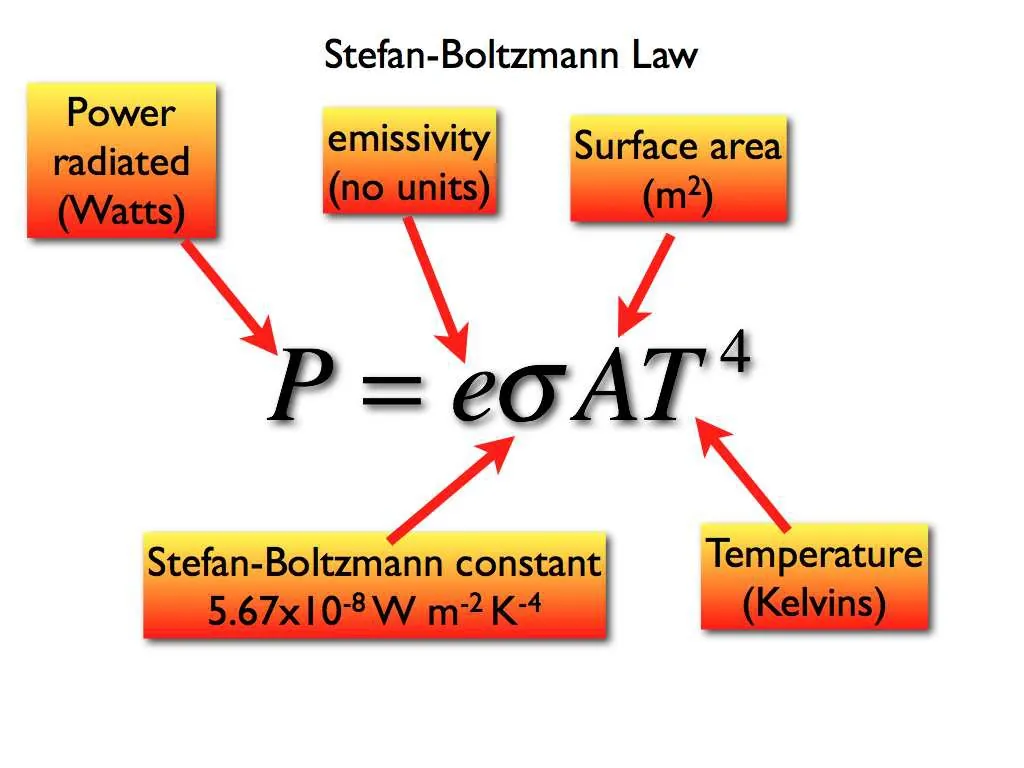
The Stefan-Boltzmann law states that the power radiated from a black body is directly proportional to the fourth power of its temperature. This relationship is expressed through the formula P = σAT⁴. In this equation, P represents the total power in watts, A is the surface area in square meters, and T is the temperature in Kelvin.
Because the temperature is raised to the fourth power, even a small increase in the heat of an object leads to a dramatic, non-linear increase in the amount of energy it emits. This is why a red-hot piece of metal glows significantly brighter than one that’s merely warm to the touch.
Key Variables In The Equation
- P: Radiated power (Watts)
- A: Surface area (Square meters)
- σ: Stefan-Boltzmann constant
- T: Absolute temperature (Kelvin)
Practical Applications Of The Constant
The constant is used across multiple industries to ensure safety and efficiency. Engineers use it to calculate the thermal load of electrical components, preventing overheating in small devices. In the field of astrophysics, it allows researchers to determine the luminosity of stars based on their perceived temperature. By knowing how much radiation a star emits, scientists can estimate its size and distance from Earth.
| Industry | Primary Use Case | Critical Factor |
|---|---|---|
| Aerospace | Heat shield design | Thermal dissipation |
| HVAC | Boiler efficiency rating | Infrared emission |
| Astronomy | Star luminosity estimation | Surface temperature |
| Electronics | Microchip cooling | Heat flux density |
How To Calculate Thermal Radiation
To calculate the radiation emitted by an object, you must first ensure that your temperature measurements are in Kelvin. If you’re working with Celsius or Fahrenheit, you must convert these values first. Once you have the Kelvin value, raise it to the power of four.
Multiply that result by the Stefan-Boltzmann constant and the surface area of the object. If the object isn’t a perfect black body, you must also incorporate the emissivity coefficient, which is a value between zero and one that describes how effectively the surface radiates heat compared to a theoretical ideal black body.
Steps For Standard Calculations
- Measure the surface temperature accurately.
- Convert the temperature units to absolute Kelvin.
- Calculate the object’s surface area.
- Determine the surface emissivity factor.
- Multiply all values by the constant.
Why Use Absolute Temperature Scales?
The Stefan-Boltzmann law relies on Kelvin because it’s an absolute scale where zero represents the total absence of thermal energy. Using Celsius or Fahrenheit would result in incorrect calculations because those scales have arbitrary zero points.
If you used Celsius in the equation, you would get negative values or zero results for temperatures at or below the freezing point of water, which doesn’t reflect the physical reality of thermal radiation. Always verify your input data to ensure you aren’t using relative temperature scales that could compromise your final results.
Common Sources Of Calculation Error
Errors in thermal calculations often stem from incorrect unit conversions or failing to account for the emissivity of materials. A shiny, polished metal surface will have a very low emissivity, meaning it radiates less heat than a matte black surface at the same temperature.
Failing to account for this difference is a frequent mistake in thermal management. Additionally, always double-check your scientific notation when inputting the constant into software like MATLAB or Excel. A misplaced decimal point in the exponent can lead to an error magnitude of ten or more, which is catastrophic in engineering scenarios.
| Common Mistake | Consequence | How To Fix |
|---|---|---|
| Using Celsius | Massive error | Convert to Kelvin |
| Ignoring Emissivity | Overestimated heat | Use material tables |
| Wrong Exponent | Power of 10 error | Check scientific notation |
| Surface Area Units | Wrong flux result | Use square meters |
Is The Constant Truly Universal?
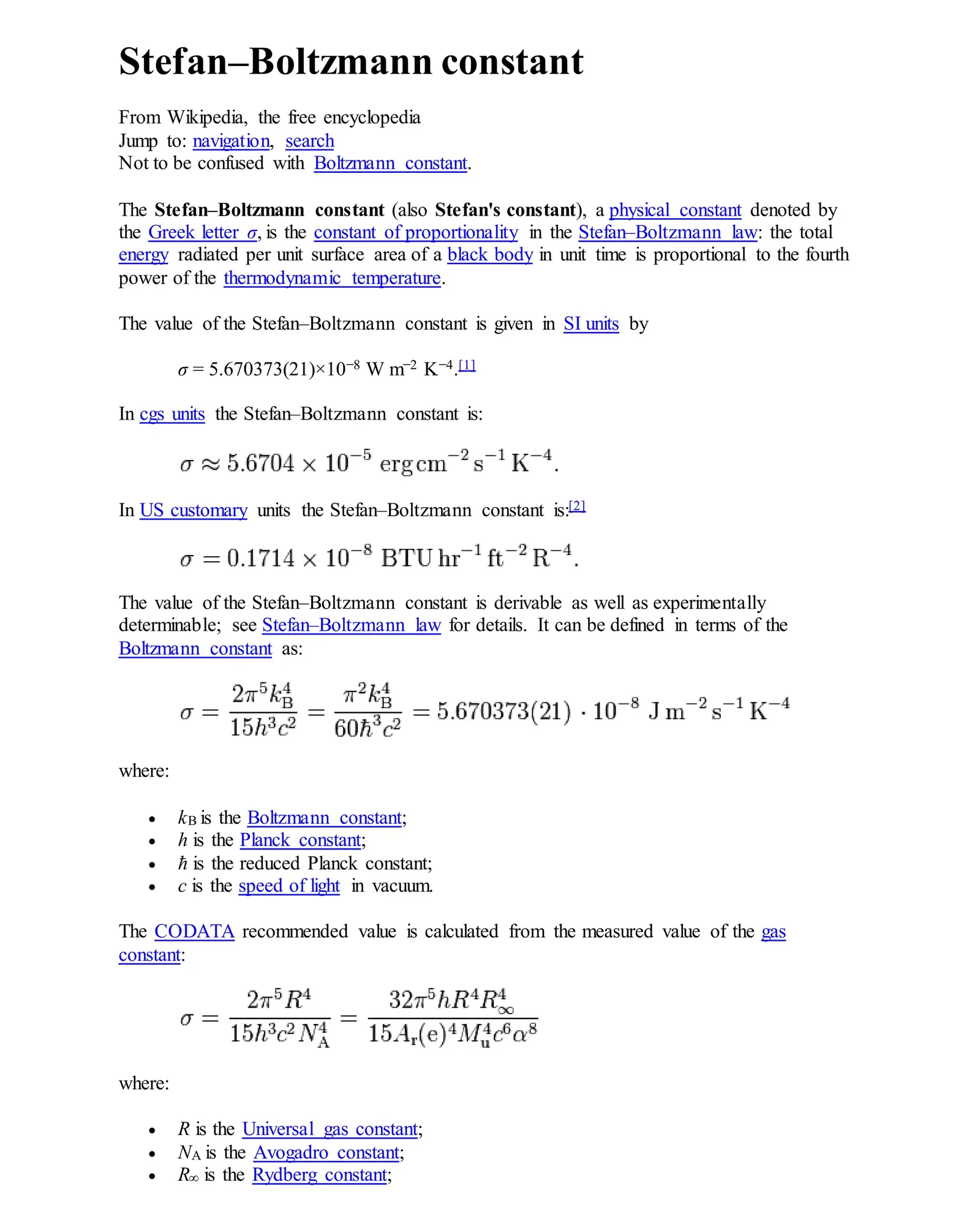
The Stefan-Boltzmann constant is considered a universal physical constant, meaning its value is the same throughout the observable universe. It’s derived from the speed of light, the Boltzmann constant, and Planck’s constant.
Because these three values are fundamental to the structure of our physical reality, the Stefan-Boltzmann constant remains invariant regardless of location. This universality allows astronomers to apply the same physics to distant galaxies as they do to objects here on Earth. It’s a fundamental pillar of modern thermodynamic principles.
Related guides
Frequently Asked Questions
What is the exact value of the constant?
The value is 5.670374419 × 10⁻⁸ W·m⁻²·K⁻⁴. It’s defined by the CODATA Task Group on Fundamental Constants. While you may see older textbooks list it as 5.67 × 10⁻⁸, modern scientific applications require the higher precision provided by the most recent internationally recognized standards to ensure accuracy in complex physical simulations and industrial modeling.
Do I need to use the constant for room temperature?
Yes, the law applies at all temperatures. Even at room temperature, objects emit thermal radiation, primarily in the infrared spectrum. While the total power emitted is relatively low compared to high-temperature objects, it’s still measurable and critical for applications like infrared sensors, thermal insulation testing, and sensitive equipment calibration where even minor heat signatures can interfere with the operation of the device.
How does surface emissivity change the result?
Emissivity is a multiplier between zero and one. If you’re calculating the actual heat loss of a real-world object, you multiply your ideal black body result by the material’s emissivity. For example, polished aluminum has a very low emissivity, often below 0.05, while a black painted surface can have an emissivity near 0.95, significantly increasing the actual radiation emitted.
Can I use this for non-black body objects?
The basic Stefan-Boltzmann law is specifically for ideal black bodies. For non-ideal objects, you must use the modified version of the equation which includes the emissivity term. This modified version is the standard for almost all practical engineering and physics problems, as very few materials in the real world behave as perfect black bodies under normal operating conditions.
What units should I use for the calculation?
You must use the SI system. Surface area must be in square meters, and temperature must be in Kelvin. If your data is in different units, such as square inches or degrees Celsius, you must perform the conversion to meters and Kelvin before applying the constant. Using mismatched units is the most common cause of significant calculation errors in thermal physics.
Conclusion
If you’re currently working on a thermal project, your next step should be to identify the specific emissivity of the material you’re analyzing. Once you have that value, verify your surface area measurement and ensure your temperature readings are converted into Kelvin. Use these figures to calculate your total radiated power, and always cross-reference your results against standard material emissivity tables to ensure your data is as precise as possible.
