
Centrifugal pumps are the workhorses of industrial and municipal infrastructure, moving fluids through everything from HVAC systems to massive water treatment facilities. Engineers and maintenance technicians often need to adjust the performance of these machines to meet changing demand, which is where understanding the pump affinity laws and their applications becomes essential. These mathematical relationships allow you to predict how changing the speed or impeller diameter of a centrifugal pump will impact its flow, head, and power consumption, enabling precise system optimization without the need for constant physical testing.
Key Takeaways

- Flow rate changes in direct proportion to the change in pump speed.
- Head pressure changes in proportion to the square of the speed change.
- Power consumption changes in proportion to the cube of the speed change.
- Impeller trimming provides a permanent, mechanical method to reduce pump performance.
- Variable frequency drives (VFDs) offer the most efficient way to modulate flow dynamically.
What Are the Affinity Laws?
The affinity laws are a set of three mathematical formulas used to predict the performance of a centrifugal pump under new operating conditions. These laws assume that the pump’s efficiency remains constant during the transition, which is generally true for small changes in speed or impeller size. By using these ratios, you can calculate the expected output variables based on known baseline performance data. These laws serve as the foundation for energy-efficient pumping strategies in modern industrial plants.
| Variable | Relationship to Speed (N) | Relationship to Impeller Diameter (D) |
|---|---|---|
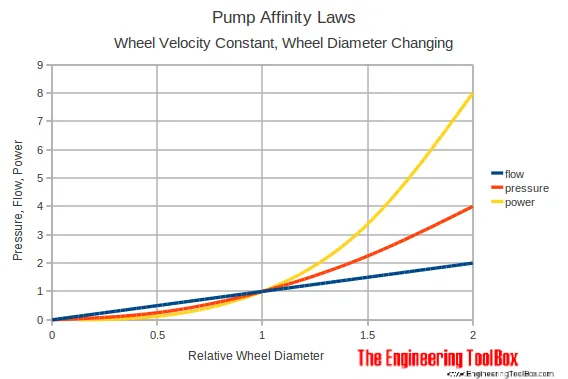
| Flow Rate (Q) | Q2 = Q1 * (N2/N1) | Q2 = Q1 * (D2/D1) |
| Head (H) | H2 = H1 * (N2/N1)² | H2 = H1 * (D2/D1)² |
| Power (P) | P2 = P1 * (N2/N1)³ | P2 = P1 * (D2/D1)³ |
How Does Speed Affect Performance?
Adjusting the speed of a pump is the most common way to change its output. When you increase the motor speed, the rotational velocity of the impeller increases, forcing more fluid through the casing. Because the flow rate is linear, doubling the speed will double the flow.
However, the head pressure follows a quadratic curve, meaning that a small increase in speed results in a much larger increase in pressure. This is why variable frequency drives are so popular; they allow for precise, energy-efficient control of motor speed, avoiding the energy waste associated with throttling valves.
Can Impeller Trimming Help You?
Impeller trimming is a mechanical process where the outer diameter of the pump impeller is physically machined down to reduce its size. This is a permanent modification used when a pump is consistently oversized for the application.
By reducing the diameter, you effectively lower the tip speed of the impeller vanes. This is a common practice in legacy systems where the original design flow rate is no longer required. It’s important to consult the manufacturer’s guidelines, as excessive trimming can reduce the pump’s hydraulic efficiency and potentially cause cavitation if the clearance between the impeller and the volute becomes too large.
Why Does Power Cube Matter?
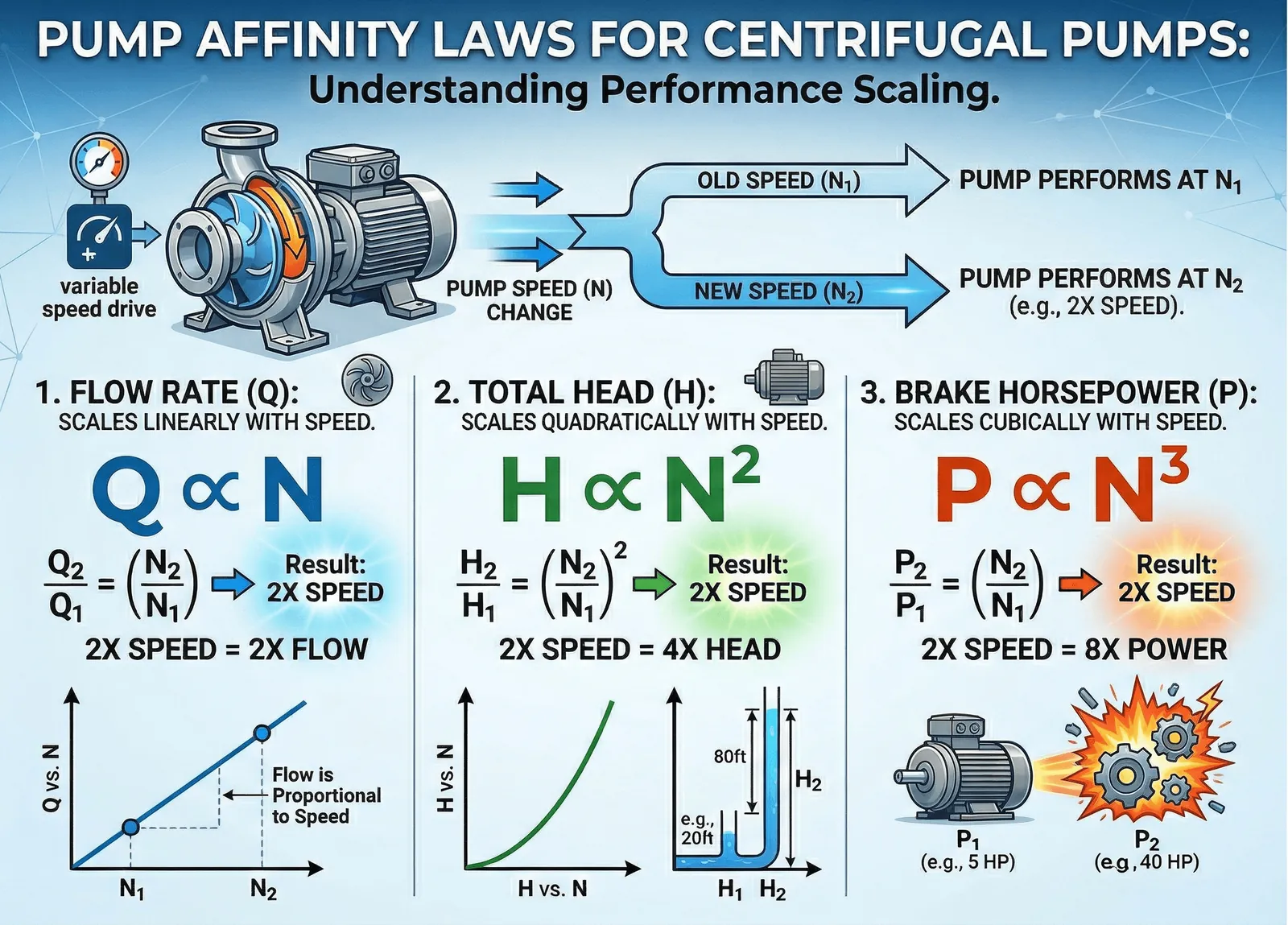
The most critical aspect of the affinity laws for facility managers is the power relationship. Because power consumption is proportional to the cube of the speed, even a minor reduction in speed leads to a massive decrease in electricity usage.
For instance, reducing the speed of a pump to 80% of its original value results in a power consumption reduction to approximately 51% of the original load. This non-linear relationship is the primary reason why Hydraulic Institute pump efficiency standards emphasize speed control as the most effective method for reducing operational costs in liquid transport systems.
How to Apply Pump Affinity Laws
To apply these laws effectively, you must first have a reliable set of baseline performance data. This is usually found on the pump’s original performance curve provided by the manufacturer. Follow these steps to ensure accuracy:
- Identify your baseline data points: current flow (Q1), current head (H1), and current speed (N1).
- Determine your target speed (N2) or required flow (Q2).
- Calculate the ratio (N2/N1).
- Apply the ratios to the three formulas for Q, H, and P.
- Verify that the new operating point still falls within the pump’s best efficiency point (BEP) range.
What Are Common Application Risks?
While the affinity laws are mathematically sound, they’re theoretical. In the real world, system resistance—often represented by the system curve—must be considered. A pump doesn’t operate in a vacuum; it operates against a specific pipe network. If you reduce the speed of a pump using the affinity laws, the pump will follow a new curve.
If the system curve is steep due to high static head, the pump may struggle to produce any flow at all if the speed is dropped too low. Always ensure that the pump isn’t operated below its minimum continuous stable flow to prevent mechanical damage.
Troubleshooting Performance Mismatches
If your calculated results don’t match the physical readings, check the following common issues:
- System Head: Have you accounted for static lift? The affinity laws assume a system that’s purely frictional.
- Efficiency Drop: Are you making a massive change in speed? Large changes can shift the pump away from its design efficiency, rendering the affinity laws less accurate.
- Measurement Error: Are your pressure gauges calibrated? Inaccurate input data leads to incorrect output predictions.
- Wear and Tear: Are the internal clearances of the pump within tolerance? Worn wear rings will drastically alter the actual performance compared to the theoretical curve.
When Should You Use VFDs?
Variable frequency drives are the preferred tool for speed control. They allow you to shift the pump’s operating point along the system curve dynamically. Unlike mechanical throttling, which forces the pump to work against a closed valve—wasting energy—a VFD slows the motor down to match the exact demand of the system. This is the gold standard for HVAC chilled water loops and municipal water distribution.
| Control Method | Energy Efficiency | Initial Investment | Maintenance Required |
|---|---|---|---|
| Discharge Throttling | Low | Low | Low |
| VFD Speed Control | High | High | Moderate |
| Impeller Trimming | Moderate | Medium | Low |
| Bypass Loops | Very Low | Medium | High |
Pro Tip for System Design
Pro Tip: Always plot your calculated operating points on the manufacturer’s original pump curve. If the new point falls outside the recommended operating range, you may need a different impeller size or a smaller pump entirely, rather than just relying on speed adjustment.
Frequently Asked Questions
Do the affinity laws work for all pump types?
The affinity laws are specifically derived for centrifugal pumps and fans. They don’t apply to positive displacement pumps, such as gear or piston pumps. In positive displacement pumps, the flow is directly proportional to the speed, but the head is determined by the system pressure, meaning these laws would lead to inaccurate conclusions for those specific types of hardware.
Can I use these laws for very large speed changes?
While the laws are mathematically consistent, they become less accurate as you move further away from the original design conditions. Large speed changes can cause the pump’s efficiency to drop significantly. For significant deviations, it’s best to consult the manufacturer’s performance curves for the specific speed in question rather than relying solely on the theoretical affinity calculations.
What is the biggest danger of trimming an impeller?
The most significant risk is creating excessive clearance between the impeller tips and the casing cutwater. This gap can lead to internal recirculation, which reduces hydraulic efficiency and increases vibration. Furthermore, once an impeller is trimmed, it’s a permanent modification; you cannot “add back” the material, meaning you have permanently limited the future maximum capacity of that specific pump.
Does the affinity law for power include motor efficiency?
The affinity laws calculate the power required at the pump shaft, known as brake horsepower. They don’t automatically account for the electrical efficiency of the motor or the VFD. When calculating total energy costs, you must divide the calculated shaft power by the combined efficiency of the motor and drive to get the true electrical power input from the grid.
How do I handle static head in my calculations?
The affinity laws are most accurate for systems where friction is the dominant source of head. If your system has a high static lift, the pump must overcome that lift before it can move any fluid. When calculating speed changes, ensure that your new head point remains above the static head requirement of your system, or no flow will occur.
Does impeller trimming affect the NPSH requirement?
Yes, trimming an impeller typically increases the Net Positive Suction Head Required (NPSHr) slightly because the reduced blade area may alter the flow patterns at the suction eye. Always verify the NPSHr after any mechanical modification to ensure that the pump isn’t at risk of cavitation, especially if the pump is already operating near its suction limits.
Conclusion
By mastering these relationships, you gain the ability to predict system behavior with high accuracy, saving significant energy and maintenance costs. Always verify your calculations against the specific performance curves for your pump model and consider the physical constraints of your piping network before implementing changes.
Your next step is to pull the original performance curve for your current system and compare your current operating point to your target demand to see if a simple speed adjustment can solve your efficiency challenges.
