
When you face a situation where your ge washer not filling with water, it can be incredibly frustrating to deal with a pile of laundry and a machine that refuses to cooperate. Whether you’re dealing with a top-load or front-load model, the lack of water intake usually stems from a handful of common mechanical or supply issues. Identifying the root cause quickly allows you to bypass expensive professional service calls and restore your appliance to full functionality.
Key Takeaways
- Check your home’s water supply valves to ensure they’re fully open and not obstructed by mineral buildup.
- Inspect the inlet hoses for kinks, bends, or blockages that prevent water from reaching the machine.
- Clean the inlet valve screens regularly to remove sediment that accumulates from your home plumbing.
- Verify the lid switch or door latch is functioning, as these safety sensors prevent water flow if the machine is “open.”
- Test the water inlet valve for electrical continuity if mechanical checks fail to resolve the issue.
Inspecting Your Water Supply Lines
The most common reason for a machine failing to fill is an interruption in the water supply. Before assuming a part is broken, check the physical connections behind the unit. Your washing machine connects to the home plumbing via two hoses: one for hot water and one for cold. If these hoses are pinched against the wall or kinked, the water flow will be insufficient or non-existent.
Water hoses are prone to kinking if the machine has vibrated out of position during a heavy spin cycle. Gently pull your washer away from the wall to inspect the lines. Ensure the shut-off valves on the wall are turned completely to the open position. If you recently had plumbing work done, these valves may have been left closed. Additionally, check for signs of moisture or bulging, which could indicate an internal blockage or hose failure.
| Component | Potential Issue | Recommended Action |
|---|---|---|
| Hot/Cold Hoses | Kinks or sharp bends | Straighten and secure hoses |
| Wall Valves | Closed or partially closed | Turn handle parallel to pipe |
| Hose Washers | Cracked or missing seals | Replace with new rubber gaskets |
| Inlet Screens | Sediment or mineral buildup | Remove and scrub with vinegar |
Cleaning the Inlet Valve Screens
Over time, minerals and debris from your local water supply can accumulate in the small mesh screens located inside the water inlet valve. These screens serve as a final defense for your machine’s internal components. When they become clogged, water pressure drops significantly, and the washer may time out or fail to fill entirely.
Warning: Always shut off the water supply at the wall valves and unplug the power cord before disconnecting any hoses to prevent flooding or electrical shock.
To clean the screens, unscrew the hoses from the back of the washer. Use a pair of needle-nose pliers to carefully pull the mesh screens out of the inlet ports. If you see buildup, soak the screens in white vinegar for thirty minutes and gently brush them clean. Reinstall the screens and verify that the hose washers are in good condition before reattaching the hoses.
Is the Door Latch Functioning?
Modern washing machines use safety sensors to prevent the unit from operating while the lid or door is open. If the sensor fails to detect that the door is closed, the control board will prevent the water inlet valves from opening. This is a critical safety feature designed to avoid accidental flooding in your laundry room.
- Lid switches on top-load models: Check for a small plastic tab that engages the switch when the lid closes. If the tab is broken, the machine won’t fill.
- Door locks on front-load models: Listen for a distinct “click” when you close the door. If you don’t hear the mechanism engage, the door lock may be faulty.
- Sensor alignment: Sometimes the door simply needs to be pressed firmly to engage the locking pin.
If the machine displays an error code related to the door lock, such as “dL” or a flashing light, your issue is likely the sensor rather than the water supply.
Testing the Inlet Valve Solenoids
The water inlet valve is an electromagnetic device that opens and closes to let water into the drum. It contains solenoids that receive electrical signals from the main control board. If these solenoids burn out, the valve will remain permanently closed regardless of what the control board dictates.
You can test the valve using a multimeter set to the Ohms (resistance) setting. With the machine unplugged, remove the top or back panel to access the valve. Disconnect the wire harness from the solenoid and touch your multimeter probes to the terminals. A functional solenoid typically shows a reading between 500 and 1500 ohms. If the reading is infinite or zero, the solenoid is defective and requires a full valve replacement.
Pressure Switch and Hose Issues
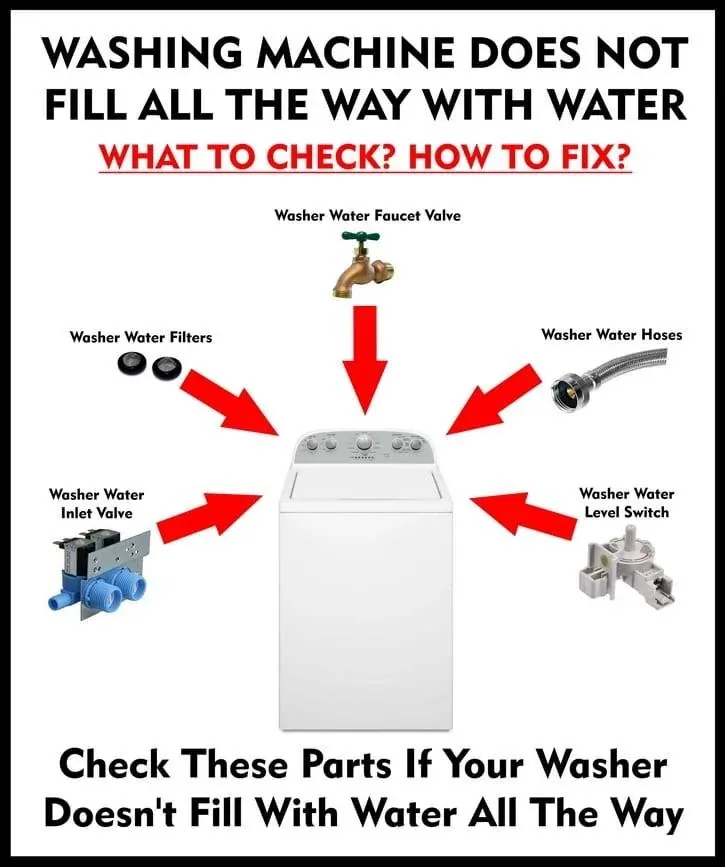
The water level pressure switch is responsible for telling the control board how much water is in the tub. It uses a small plastic tube connected to the side of the tub to measure air pressure. If this tube is disconnected, clogged with debris, or cracked, the control board won’t receive the signal that the tub is empty, or conversely, it may think the tub is already full.
Pressure sensors must remain airtight to function correctly. Inspect the small plastic hose for any cracks or loose connections at the tub or the switch end. If the hose is brittle, replace it immediately. A faulty switch can also be the culprit if it gets stuck in the “full” position, preventing the valve from ever opening to start the fill cycle.
Why is Water Pressure Low?
Sometimes the washer isn’t filling because the home water pressure is insufficient. If you notice that your kitchen or bathroom faucets also have low pressure, the issue is with your home’s main water supply or the municipal line. However, if the pressure is fine elsewhere, check the specific inlet hoses for the washer.
- Verify that the wall valves are fully open.
- Ensure that the hoses aren’t twisted or kinked behind the heavy machine.
- Check for a failing pressure regulator in your home plumbing system.
If you have a water softener system installed, ensure it isn’t currently in a regeneration cycle, which can sometimes reduce water flow to individual appliances.
Understanding Control Board Failures
The main control board acts as the brain of your washing machine. It interprets signals from the lid switch, pressure sensor, and timer, then sends power to the inlet valves. While rare compared to mechanical issues, control boards can suffer from short circuits or damaged relays that prevent them from triggering the water flow.
If you have verified that the inlet valves, switches, and supply lines are all functioning, the control board might be the source of your problem. Before replacing the board, check for any visible signs of damage, such as burnt components or corroded connections on the board itself. A professional diagnostic tool or a specific service manual for your model can help you perform a “factory test mode” to see if the board is successfully sending power to the valves.
Is the Water Temperature Set Correctly?
Occasionally, a washer will fail to fill because it’s waiting for a specific temperature setting that it can’t reach. For example, if you have selected “Hot” wash, but the hot water shut-off valve is closed, some machines will pause and wait indefinitely for the water temperature to equalize.
Try selecting a “Cold” wash cycle to see if the machine begins filling. If it fills on “Cold” but not on “Hot,” you have confirmed that the hot water supply line is blocked or the hot water inlet valve solenoid is burnt out. This simple test is a fast way to isolate whether the issue is with the machine’s programming or its hardware.
Checking for Error Codes
Modern GE washers are designed to communicate issues through the control panel. If your washer isn’t filling, look for blinking lights, specific patterns of LEDs, or alphanumeric codes on the display. These codes provide a shortcut to the exact component that’s failing.
Common codes often relate to:
- F01: Indicates a communication error between the main board and a component.
- F02: Often relates to a water level sensor or pressure switch issue.
- F05: Frequently points to a water inlet or valve problem.
Consult your owner’s manual or the GE website to decode the specific light pattern shown by your machine. This prevents you from replacing functional parts and directs your efforts to the specific sensor or wire that’s reporting the error.
Safety Precautions for Repairs
Before performing any internal work, you must prioritize your safety. Electricity and water are a dangerous combination, and your washing machine holds both. Always follow these steps to ensure you don’t cause further damage or personal injury during your troubleshooting process.
- Unplug the unit before removing any panels or touching internal wiring.
- Turn off the water supply valves completely to avoid leaks when disconnecting hoses.
- Wear protective gloves to prevent injury from sharp metal edges inside the machine chassis.
- Use a multimeter to verify that power is disconnected before touching electrical terminals.
Related guides
- Best Smart Water Bottles in 2026
- Are Salt Water Pools Warmer? The Truth Explained in 2026
- 5 Best Water Softeners for Well Water: Our Top Picks in 2026
Frequently Asked Questions
Why does my washer hum but not fill?
A humming noise often indicates that the control board is sending power to the water inlet valve, but the valve is unable to open. This is usually caused by a clogged inlet screen, a closed wall valve, or a failed solenoid within the valve itself. Ensure your water supply is fully turned on before attempting to replace any internal components of the machine.
How do I reset my GE washer?
To reset a GE washer, unplug the machine from the power outlet for at least one minute. Then, plug it back in and open and close the lid six times within a twelve-second period. This process can clear minor electronic glitches in the control board that might be preventing the fill cycle from starting correctly or causing the unit to hang in a specific mode.
Can a bad lid switch stop the water?
Yes, a faulty lid switch is a common cause for a washer that won’t fill. The machine is programmed to cut off water flow if it detects that the lid is open to prevent potential water damage in your home. If the switch is broken or the plastic actuator tab is snapped, the machine will act as if the door is open, even when it’s closed.
How much does a new inlet valve cost?
Replacing a water inlet valve is a relatively affordable repair. You can typically expect to pay between $25 and $85 for the replacement part, depending on your specific GE model and whether you purchase an OEM part or an aftermarket alternative. If you hire a professional technician to perform the labor, you should budget an additional $100 to $200 for the service call and installation.
Is it worth fixing an old GE washer?
If your washer is less than seven to ten years old, it’s usually worth fixing, especially if the problem is a simple inlet valve or a lid switch. However, if the repair requires a new control board or if the machine has multiple failing components, the cost of parts and labor may exceed half the price of a new machine, making replacement a more logical long-term financial decision.
Conclusion
To get your washing machine running again, start by checking that your water valves are fully open and that your inlet hoses are free of kinks. If the water supply is clear, perform a continuity test on the inlet valve solenoids to see if they need to be replaced. If you remain unsure about handling electrical components, contact a licensed appliance repair technician to avoid risks.
