
You can spot mustard algae by looking for a slimy, yellow-brown coating on pool walls that feels slippery and difficult to remove. A simple test involves wiping the surface with a white cloth; if the stain turns yellow or green and leaves a residue, you have confirmed the presence of this specific algae. This guide covers how to identify it, the exact chemicals needed to kill it, and the steps to stop it from coming back.
What mustard algae actually is
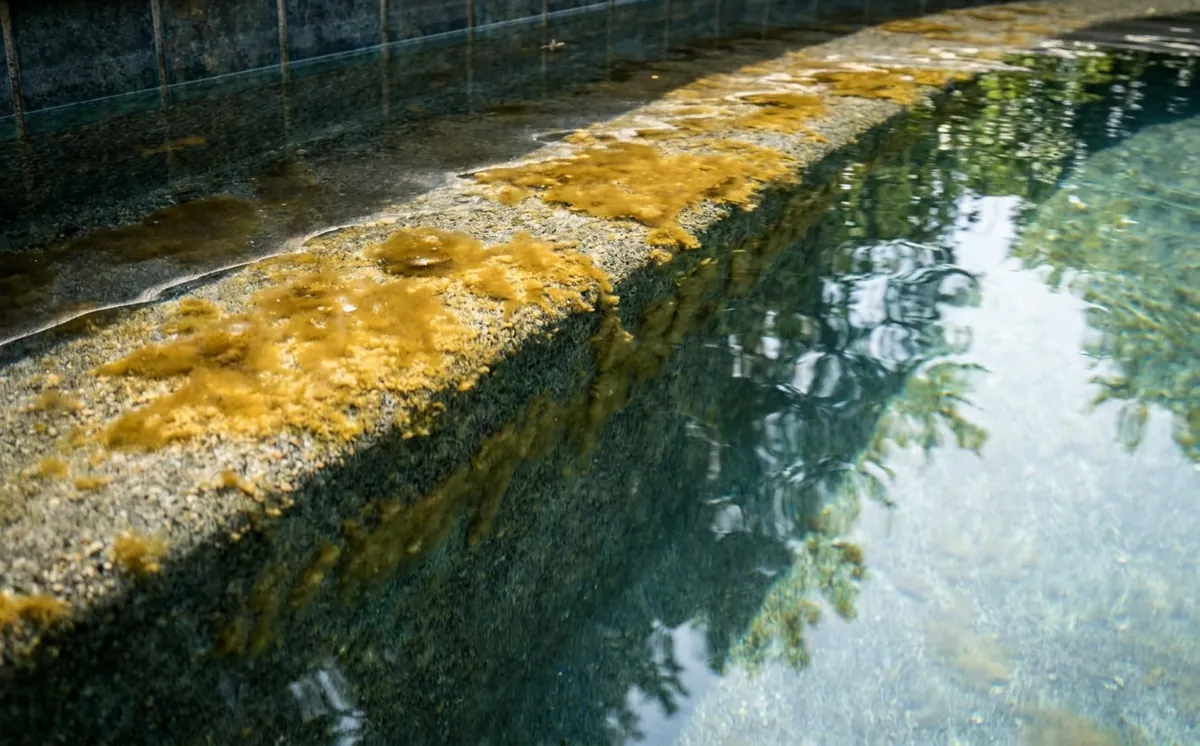
Mustard algae is a microscopic plant that thrives in pools with low chlorine or poor circulation. It appears as a dull yellow or tan film, distinct from the bright green clumps of common algae. You’ll usually find it hiding in shaded corners, behind ladders, or on the deep end where water movement is slow.
Many mistake it for dirt or pollen, vacuuming it up without killing the spores, which allows rapid regrowth. Its cell wall is thicker than other algae, blocking standard chlorine from penetrating and destroying it. Unlike floating green algae, mustard algae sticks tightly to surfaces, creating a rough texture that can damage pool liners if ignored.
To confirm you’re dealing with mustard algae and not just debris, rub the spot firmly with your finger. If the film feels slimy and stubbornly adheres to the surface without washing away easily, it’s likely mustard algae. Green algae, by contrast, often smears into a slimy paste when rubbed. This simple tactile test prevents the costly mistake of treating a clean surface with harsh chemicals or ignoring an active infestation.
Because the thick cell wall resists shock treatments, simply raising your chlorine level often fails to stop the spread. You must physically scrub the affected areas to break the protective layer before applying algaecide. Without this mechanical step, the chemical sits on top of the wall, leaving the colony alive beneath.
If you suspect mustard algae, don’t rely solely on visual inspection after a heavy rain or windstorm, as pollen can mimic its color. Pollen typically floats or settles as loose particles that can be vacuumed up, whereas mustard algae remains stubbornly attached to surfaces for days.
Test your water chemistry immediately; if free chlorine reads above 3 ppm yet the stain persists, you’re facing a resistant strain. In these cases, increase your brushing frequency to twice daily and use a specialized mustard algae killer rather than a general-purpose product. Ignoring the need for physical agitation costs you weeks of re-treatment and potential liner damage.
How to test for mustard algae
Finding out if you have this problem starts with a visual check followed by a simple physical test you can do yourself. Don’t wait for a professional unless the situation looks severe, as early detection makes the job much easier. Follow these steps to confirm the issue and get ready for treatment:
- Turn off your pool pump and let the water sit still for at least one hour so any floating particles settle down.
- Walk around the pool deck and look closely at the bottom and sides, especially in areas that don’t get direct sunlight.
- Use a clean white cotton cloth or a paper towel to firmly rub a suspicious yellow or brown patch on the wall.
- Examine the cloth immediately; if it shows a yellow or greenish stain that doesn’t wash off easily, you have found mustard algae.
- Check the texture of the spot by running your gloved hand over it; it should feel gritty or like fine sandpaper, unlike smooth dirt.
- Test your water chemistry using a reliable kit to check your free chlorine level, as low levels create conditions favorable for algae growth, though mustard algae can persist even at moderate levels.
- If the stain is faint but persistent, apply a small amount of liquid chlorine directly to the spot and wait 15 minutes to see if it lightens.
- Record your findings and note the location so you know exactly where to focus your brushing and chemical treatment later.
The single most important judgment call here is deciding whether to treat the whole pool or just the affected area. If the stain is isolated to one corner and your water chemistry is perfect, you might only need spot treatment.
However, if you see multiple spots or your chlorine levels are low, you must treat the entire volume of water to prevent hidden spores from spreading. Never try to remove heavy buildup with a pressure washer, as this can force the spores into your filtration system and cause permanent clogging.
Key numbers and settings at a glance
Getting the right numbers is crucial because mustard algae needs specific conditions to die and stay dead. Below are the essential figures you need to track during your testing and treatment process.
| Situation | What to use | How long | What to watch for |
|---|---|---|---|
| Initial visual check | White cloth or paper towel | 1-2 minutes | Yellow/green stain on fabric |
| Texture verification | Gloved hand | 30 seconds | Gritty, sandpaper-like feel |
| Water chemistry test | Chlorine/pH test strips | 5 minutes | Free chlorine under 1 ppm |
| Spot treatment trial | Liquid chlorine (10% bleach) | 15-20 minutes | Stain fading or disappearing |
| Full shock treatment | Calcium hypochlorite granules | 24-48 hours | Water turning cloudy then clear |
| Algaecide application | Polyquat-based algaecide | 4-6 hours before filter run | No immediate color change |
| Brushing frequency | Nylon brush for vinyl/plastic | 15-20 minutes daily | Loosening of surface film |
| Filter cleaning cycle | Backwash or rinse mode | 10-15 minutes | Pressure gauge dropping 5 psi |
Details that separate good results from bad ones
Experienced pool owners know that simply adding chemicals isn’t enough to beat this stubborn invader. They understand that the physical act of breaking the algae’s protective layer is just as important as the chemical dose. Before adding any shock treatment, they spend extra time brushing every inch of the pool surface, paying special attention to corners and steps where water stagnates. This mechanical action cracks the thick cell wall, allowing the chlorine to reach the inside of the organism.
Beginners often skip this step or rush through it, thinking the chemicals will do all the work, which results in the algae surviving and returning within days. A critical factor is maintaining high chlorine levels for a longer period; while green algae dies quickly, mustard algae requires sustained exposure to oxidizers to be fully eradicated.
Professionals also monitor their filter pressure closely, knowing that dead algae cells can clog the system faster than expected. They backwash the filter more frequently during treatment to ensure the water stays clear and the chemicals circulate effectively. Ignoring the filter can lead to a situation where the pool looks clean on the surface but remains full of dead spores trapped in the plumbing.
Common problems and quick fixes
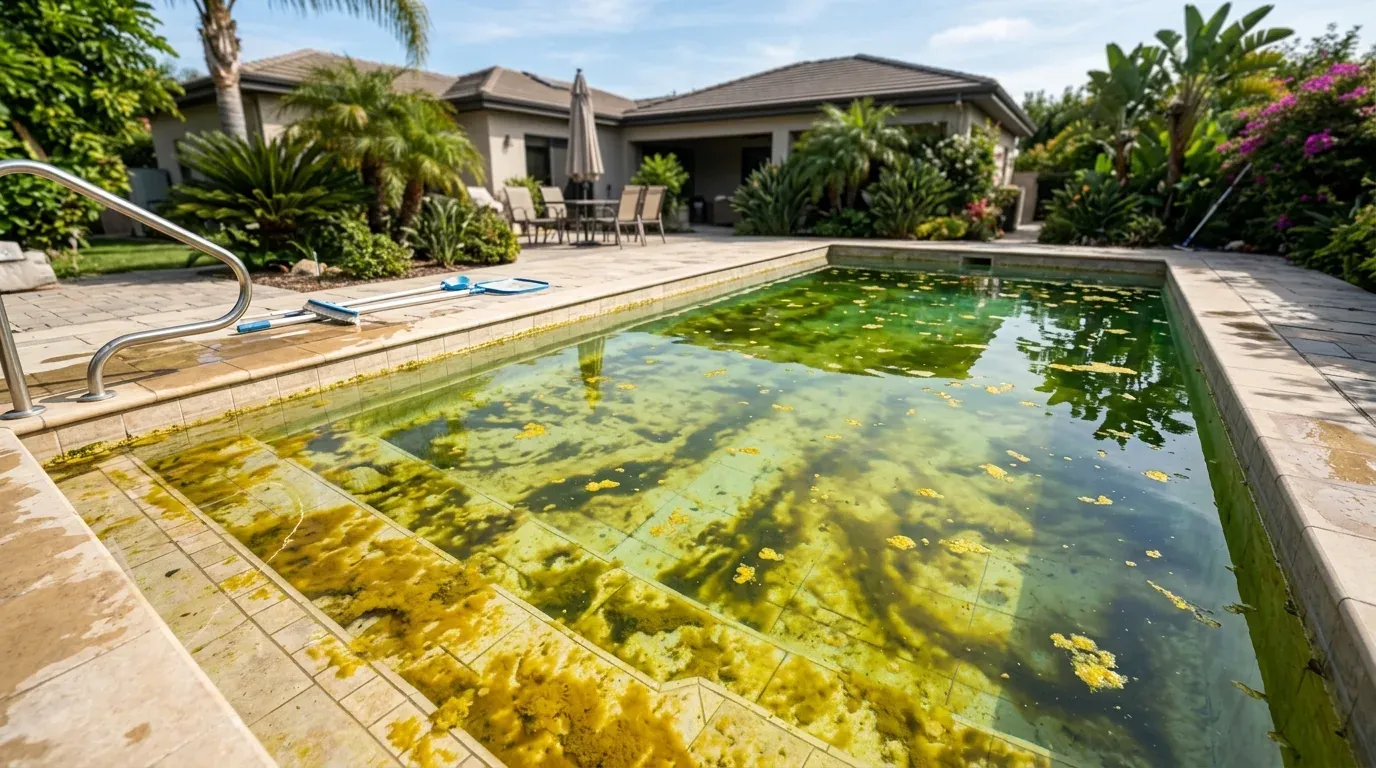
Sometimes the signs you see don’t match what you expect, or the treatment seems to fail despite following instructions. Here is how to match what you notice with the likely cause and the best first step to take.
| What you notice | What it usually means | What to do first |
|---|---|---|
| Stain turns green after brushing | You have mixed green and mustard algae | Increase chlorine dose by 50% |
| Stain doesn’t fade with chlorine | Cell wall is too thick for current dose | Brush vigorously for 20 minutes |
| Water stays cloudy after shock | Dead cells are clogging the filter | Backwash or clean the filter media |
| Algae returns in 2 days | Circulation is poor in that area | Clean skimmer baskets and return jets |
| Pool liner feels rough everywhere | Heavy biofilm buildup has formed | Apply a specialized enzyme cleaner |
| Chlorine drops instantly after adding | High organic load or low pH | Adjust pH to 7.2-7.6 before shocking |
If the stain smears green immediately after brushing, you’re likely dealing with green algae, not mustard algae, which typically leaves a yellow or brown residue. Adding more chlorine without addressing this specific mix will only waste chemicals and time. Don’t guess at the amount; an under-dose allows the colony to recover within hours.
When water remains cloudy after a shock treatment, the problem is rarely the chemical itself but the filtration system. Dead algae cells act like fine silt, blocking pores in your filter media almost instantly.
If you simply add more shock, you create a thicker sludge that settles into the pool floor. Instead, backwash your sand filter until the pressure gauge drops, or rinse your cartridge elements thoroughly. This mechanical removal is faster than waiting for the pump to clear the debris naturally.
A common mistake occurs when owners brush stains for only five minutes and assume failure. Thick-walled algae requires thorough and vigorous scrubbing to break the protective layer before chemicals can effectively penetrate. Skipping this step costs you days of wasted effort and extra product. If the water clears but the stain remains, you haven’t brushed long enough, not used the wrong chemical.
Rules that matter for safety
There are strict limits on how much chlorine and other chemicals you can safely put into your pool water. The Centers for Disease Control and Prevention (CDC) recommends keeping free chlorine levels between 1 and 3 parts per million (ppm) for safe swimming. When treating an active infestation, you may need to raise this level temporarily, but never exceed 10 ppm without consulting a professional.
If your test strip reads above 5 ppm, wait at least four hours before allowing children to swim, as their skin absorbs chemicals faster than adults. A common mistake is adding shock treatment while the sun is directly overhead; UV rays break down chlorine rapidly, wasting money and leaving the water unprotected by evening. Instead, apply high-dose treatments after sunset or when the sky is overcast to ensure the chemical remains effective long enough to kill algae.
Mixing different types of chemicals, such as chlorine and acid, can create dangerous gases that harm your lungs and eyes. Always add chemicals to the water, never the other way around, and wear gloves and eye protection during the process. If you accidentally splash liquid chlorine on your skin, rinse immediately with cool water for fifteen minutes; don’t use hot water, which opens pores and increases absorption.
If you’re unsure about the correct dosage for your specific pool size, contact a certified pool technician or check the label on your chemical container carefully. Local regulations may also require you to report certain chemical spills or disposal methods, so check with your city’s health department before starting major treatments. Never pour leftover chemicals down a storm drain, as this contaminates local waterways and can result in fines exceeding $1,000 per incident.
Keeping it working afterwards
Once you have cleared the algae, you need a routine to keep it from coming back. Run your pool pump for at least 8 to 12 hours every day. This ensures constant water movement and chemical distribution.
Split that run time into two cycles if your pump has a timer. One cycle in the morning and another in the late afternoon works well. Algae spores germinate fastest in warm, still water during peak sunlight.
Test your water chemistry twice a week. Focus on maintaining a free chlorine level of at least 1 ppm. Keep your pH between 7.2 and 7.6.
At a pH of 7.8, chlorine is only about half as effective as it’s at 7.4. That drop alone lets green algae survive a normal dose. Test the water at elbow depth rather than skimming the surface layer.
Brush the pool walls and floor once a week. Do this even if you don’t see any visible growth. Brushing prevents spores from settling and forming a protective layer.
Pay special attention to the steps, light niches, and behind the ladder. Water flows poorly in these spots, so biofilm anchors there first. Use a nylon brush for vinyl or fiberglass pools. A stainless steel bristle brush works on plaster without tearing the finish.
Keep your filter clean by backwashing when the pressure gauge rises 5 to 10 pounds per square inch above normal operating pressure. Store your algaecide in a cool, dry place away from direct sunlight. Heat degrades its active ingredients fast.
If you notice any discoloration returning, address it immediately with a small dose of shock. Don’t wait for it to spread. Catching a faint green tint early saves you from draining half the pool later.
When to use a different approach
This standard testing and treatment method works for most residential pools, but some situations require a completely different strategy. If your pool is made of plaster and the algae has been present for months, the stains may have penetrated the porous surface beyond the reach of standard brushing. In this case, you might need to use a specialized stain remover or consider resurfacing the affected area.
Another scenario where this approach fails is if your pool has a saltwater generator that’s malfunctioning; the low chlorine output will constantly allow algae to regrow no matter how much you treat it. Here, you must repair or replace the salt cell before any chemical treatment will be effective.
A common mistake is adding more algaecide while ignoring the broken cell, which wastes money and leaves the water cloudy for weeks. Check your generator’s output reading first; if it stays below 10% despite clean electrodes, the unit needs immediate service.
Finally, if you live in an area with extremely hard water, the minerals can bind with the algae, making it resistant to typical algaecides. For these cases, a professional assessment is necessary to determine if sequestering agents or a complete water replacement is the better option.
If your calcium hardness exceeds 400 parts per million and the algae returns within three days of shock treatment, don’t add more chemicals. Instead, drain and refill half the volume to reset the mineral balance. Attempting to force standard doses through high-mineral water often causes scaling on your heater and pump, leading to costly repairs that could have been avoided by simply lowering the concentration.
Frequently asked questions
Can I use regular bleach to kill mustard algae?
Yes, regular household bleach containing 5-6% sodium hypochlorite can kill mustard algae, but you need a very large amount. You must calculate the exact volume based on your pool size to avoid damaging the liner or equipment. However, liquid chlorine designed specifically for pools is often more concentrated and contains stabilizers that last longer in sunlight.
Why does mustard algae come back so fast?
It comes back quickly because its spores are incredibly tough and can survive in low-chlorine environments for long periods. Even if you kill the visible algae, any remaining spores hidden in the filter or plumbing can restart the growth cycle within 24 to 48 hours. Poor water circulation is another major factor, as stagnant water allows new spores to settle and multiply before the chemicals can reach them.
How long does it take to remove mustard algae completely?
It typically takes 2 to 4 days of aggressive treatment to remove mustard algae completely from a standard residential pool. This timeline assumes you’re brushing the pool daily, maintaining high chlorine levels, and running the filter continuously. If the infestation is severe or the water chemistry is unbalanced, it could take up to a week to see clear water.
Is it safe to swim while treating mustard algae?
No, it isn’t safe to swim in your pool while actively treating mustard algae with high levels of shock or algaecide. The elevated chlorine levels required to kill the algae can cause skin irritation, red eyes, and respiratory issues for swimmers. You should wait until the free chlorine level drops back to the safe range of 1 to 3 ppm before entering the water.
What happens if I don’t brush the pool before adding chemicals?
If you don’t brush the pool first, the chemicals will likely fail to penetrate the thick outer layer of the algae cells. The algae will survive the treatment and continue to grow, wasting your money on chemicals that didn’t work. Brushing physically breaks the protective shell, allowing the chlorine to enter and destroy the organism from the inside out.
Conclusion
Keep an eye on your water balance to stop this algae from returning. You’ll want to brush the walls weekly and maintain proper chlorine levels so it never gets a chance to grow again. With these simple habits, you can enjoy a sparkling clean pool all summer long without any slimy surprises.