
Choosing between reverse osmosis vs distillation depends on your specific water quality needs, as the former is better for daily tap water purification while the latter is superior for removing almost all contaminants. If you need to remove high levels of dissolved solids like salt from well water, you’ll find that reverse osmosis is the more energy-efficient choice for a home. However, if you must eliminate every trace of biological or chemical impurity for laboratory use, distillation provides a more reliable result.
Comparing water purification methods
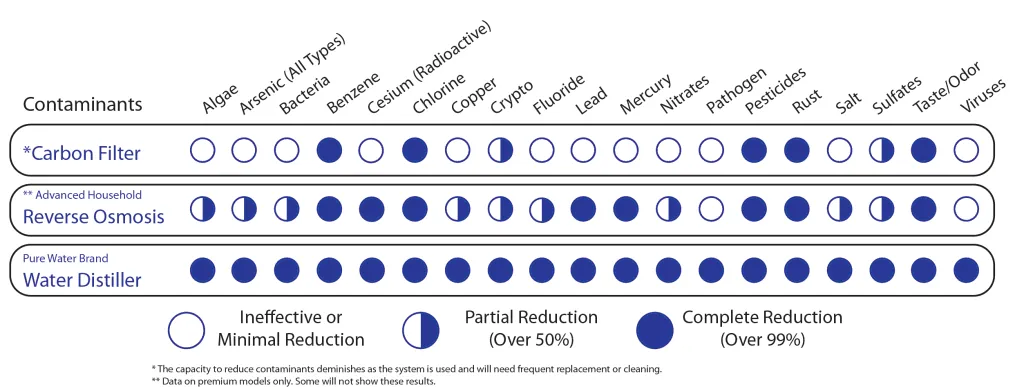
| Method | How long | Effort | Cost | Best for |
|---|---|---|---|---|
| Reverse Osmosis | Slow | Low | Medium | Daily drinking water |
| Distillation | Very slow | High | High | Purest possible water |
| Carbon Filtration | Fast | Low | Low | Improving water taste |
Reverse osmosis systems are usually installed under a sink and provide a steady supply of treated water. These units typically produce between 30 and 50 gallons of water per day, making them sufficient for a family of four. If your home has high water pressure, you can expect faster output, but low-pressure households should add a booster pump to maintain efficiency.
Distillation requires you to manually fill a unit and wait for the boiling and cooling process to finish. If you need more than a few gallons a day, the slow speed of a distiller often becomes a major bottleneck for a household. While distillation removes almost all dissolved solids, it also strips away beneficial minerals, leaving the water tasting flat.
Carbon filtration is the most accessible choice, yet it fails to remove heavy metals or nitrates. Use carbon filters only when your primary concern is chlorine or organic compounds that affect flavor. If your local water source is a private well, avoid relying solely on carbon. In these cases, you must pair the filter with a UV light system to neutralize bacteria.
Using reverse osmosis for home water
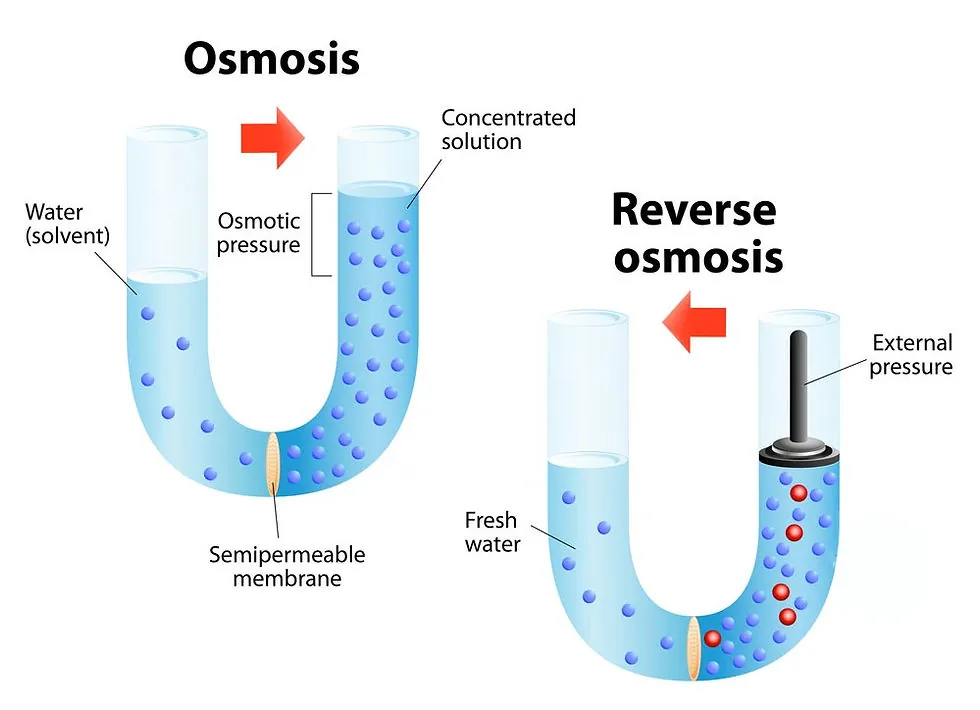
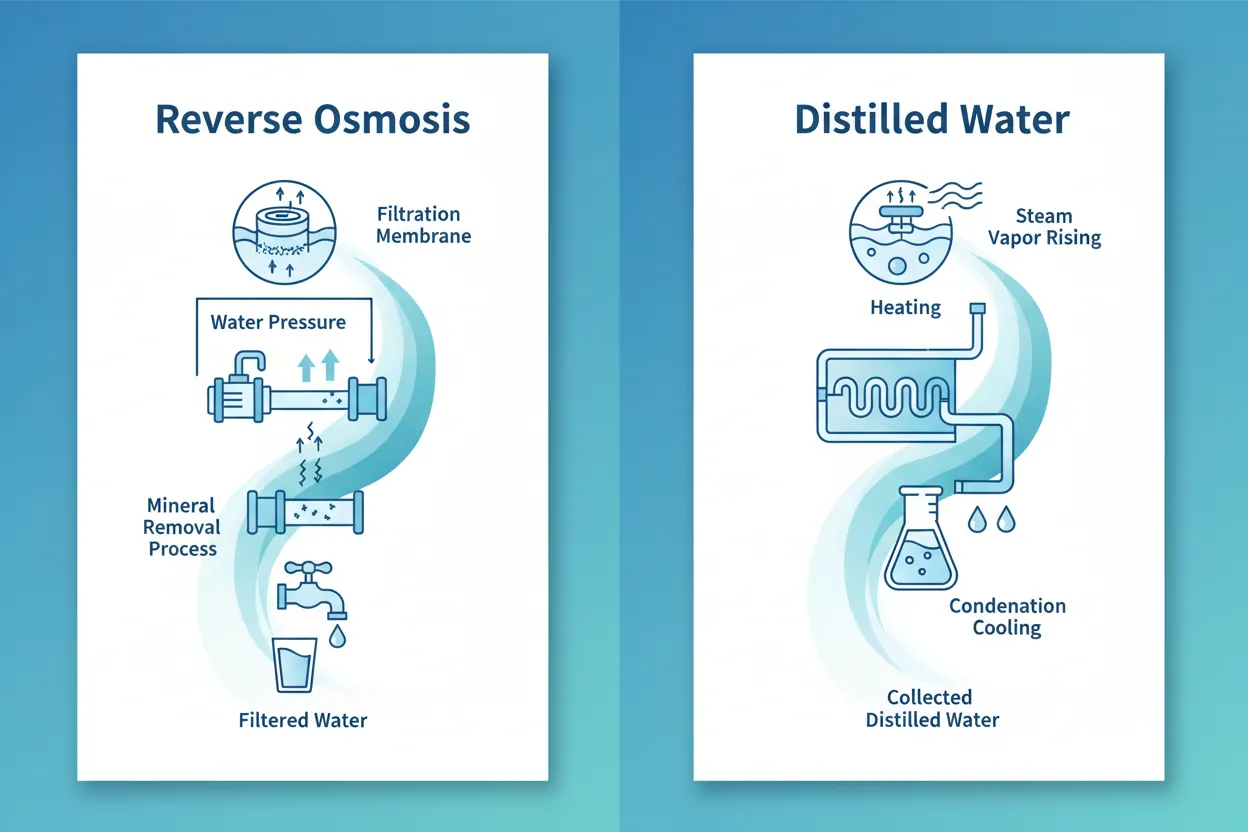
Reverse osmosis works by pushing water through a semi-permeable membrane to trap impurities. This process is effective at removing heavy metals, fluoride, and common bacteria.
Connect the unit to your cold water supply line. Ensure the pre-filter is installed to protect the membrane from sediment. Allow the tank to fill, which typically takes 2 to 4 hours depending on your water pressure. Open the dedicated faucet to dispense the treated water as needed.
If your home has a water softener, install the reverse osmosis unit after it. Softened water prevents calcium buildup on the membrane, effectively doubling its lifespan. If you notice the flow rate dropping to a trickle, check the air pressure in the storage tank. It should read between 7 and 10 PSI when empty.
Most homeowners fail by ignoring the carbon post-filter. While the membrane handles the heavy lifting, the post-filter polishes the taste. Neglecting this change leads to a lingering plastic or stagnant flavor in your glass.
This method is excellent for households that want cleaner-tasting water without daily maintenance tasks. It isn’t for people who need medical-grade water, as it may leave tiny traces of dissolved gases or volatile organic compounds. You must change the pre-filters every 6 months to prevent the membrane from clogging, which is a common mistake that ruins the system’s output.
Using distillation to purify water
Distillation mimics the natural water cycle by boiling water into steam and then cooling it back into a liquid. This leaves behind almost all minerals, salts, and heavy metals.
- Fill the boiling chamber with tap water up to the marked line.
- Turn on the heating element and wait for the water to boil.
- Collect the condensed steam in a separate glass or stainless steel container.
- Clean the boiling chamber after every use to prevent mineral buildup.
If your tap water contains volatile organic compounds like benzene or pesticides, distillation alone may fail. These chemicals often have boiling points lower than water, meaning they vaporize and re-condense into your purified supply. If you detect a chemical odor in your tap water, add a carbon post-filter to your system to capture these specific contaminants.
Most home units produce only one gallon of water every four to six hours. Don’t attempt to speed up the process by overfilling the chamber, as this leads to boiling over and damages the heating element.
Distillation is highly effective at removing biological contaminants and radioactive particles. These systems are capable of removing most inorganic contaminants, though they require significant electricity to operate. The main weakness is the high energy cost and the time required to produce small amounts of water.
Selecting the right purification method
If you’re in a hurry, choose reverse osmosis because it provides a pressurized supply of water on demand. For those doing this for the first time, reverse osmosis is also easier to maintain since it uses automatic filtration stages rather than manual heating. If you want the absolute best result for specialized tasks like medical equipment or sensitive plants, choose distillation.
The trade-off is simple: you choose between the convenience of an automated, low-energy system or the extreme purity of a manual, high-energy process. If your starting water has high mineral content, distillation will require frequent, labor-intensive cleaning of the heating element. Reverse osmosis, meanwhile, is sensitive to incoming water pressure; if your home pressure is below 40 PSI, you may need a booster pump to get consistent results.
Most beginners mistakenly assume that all filtration systems remove every contaminant equally. In reality, reverse osmosis excels at removing dissolved solids, but it struggles with volatile organic compounds that distillation eliminates easily. Check your local water report for chlorine or sediment levels before purchasing. If your report shows high levels of heavy metals, prioritize a system with a dedicated lead-reduction stage.
If you produce more than five gallons of water per day, the energy costs of distillation will quickly exceed the price of replacement filters. For high-volume needs, stick to reverse osmosis to avoid constant maintenance. If you only need a few liters for specific lab work or humidifiers, the slow, manual nature of distillation is a worthwhile trade for the superior chemical purity it provides.
Standards for home water safety
Regardless of the method you choose, you must ensure your system is certified for the specific contaminants you want to remove. Look for products tested against standards set by the National Sanitation Foundation (NSF). Before you start, test your local water using a home kit to identify if you’re dealing with heavy metals, bacteria, or simple chlorine taste.
Most consumers make the mistake of buying a general-purpose filter that claims to improve taste but fails to capture volatile organic compounds. If your test detects lead, you must select a system with an NSF/ANSI 53 or 58 certification. Standard carbon pitchers won’t remove heavy metals, and relying on them creates a false sense of security that leaves you exposed to toxic ingestion.
Check your system regularly to ensure that filters or membranes aren’t past their service life, following the specific intervals recommended in your owner’s manual based on your usage. A filter that has reached its capacity can become a breeding ground for bacteria, potentially making your water quality worse than if you had used no filter at all.
If your water has lead or other toxic chemicals, don’t rely on basic carbon filters; you need a system specifically rated for those contaminants. If you’re ever unsure about the safety of your water after treatment, contact your local municipal water department for a professional laboratory analysis. This lab report is the only way to confirm if your home system is effectively neutralizing the specific hazards identified in your initial testing.
Frequently asked questions
How long does a reverse osmosis membrane last?
A reverse osmosis membrane typically lasts for a set duration, assuming you replace the pre-filters on schedule. If you live in an area with very hard water, you may need to replace it sooner to maintain flow rates. You can tell it’s time to change the membrane when the water flow from the faucet becomes noticeably slower or the taste of the water begins to change.
Is it safe to drink distilled water every day?
Yes, it’s safe to drink distilled water, provided you get your necessary minerals from a balanced diet. Distillation removes all minerals, including beneficial ones like calcium and magnesium, which can make the water taste flat. Because it lacks minerals, distilled water can also be slightly acidic and might leach minerals from your pipes if they’re made of certain metals.
How much water does a distiller waste?
A distiller doesn’t waste water in the same way as reverse osmosis, but it uses a significant amount of electricity to boil the liquid. While reverse osmosis systems discharge several gallons of waste water for every gallon produced, a distiller uses nearly all the water you put in. The primary cost here is the energy required to heat the water to its boiling point.
What happens if I don’t change my filters?
If you don’t change your filters, the contaminants trapped by the system can begin to leak back into your water supply. A clogged filter also puts extra strain on the entire unit, which can lead to leaks or a complete failure of the pump. Always follow the manufacturer’s schedule for filter replacements to ensure the system continues to function at its rated capacity.
Can distillation remove all bacteria?
Yes, the high heat involved in the boiling process is highly effective at killing bacteria, viruses, and parasites. Distillation is one of the most reliable ways to make water biologically safe if you’re unsure about the quality of your source. However, it doesn’t remove certain volatile chemicals that have a lower boiling point than water, which may end up in the final product.
Is reverse osmosis better than boiling?
Reverse osmosis is better for removing dissolved minerals and heavy metals, whereas boiling is specifically for killing biological pathogens. Boiling water doesn’t remove lead, arsenic, or salts; in fact, it concentrates them as the water evaporates. Use reverse osmosis for daily drinking water and boiling only as a temporary emergency measure to make water safe from bacteria.
Conclusion
The choice between these two technologies rests on whether you value the convenience of a continuous flow or the purity of a process that eliminates almost everything but the water molecule itself. By testing your water first, you can avoid paying for a system that doesn’t address the specific issues in your home.