
Breaking large, overwhelming tasks into smaller, manageable steps that take no more than 20 minutes to complete is the most effective way to stop procrastinating.
Your results will shift based on your current energy levels, the complexity of the project, and your immediate environment. This guide provides the tools to navigate these variables so you can regain control of your time.
Stop procrastinating on hard tasks
If you’re facing a large task, you likely feel paralyzed by the sheer size of the work. You should begin by writing down every single part of the project as a separate, simple action. If you have a report to write, your first step is not “write the report,” but “open a document and write the title.”
Once you have your list, set a timer for 10 minutes and commit to working on only the first item. If you finish it, you can stop, or you can choose to do one more tiny step. The goal is to lower the stakes so much that your brain stops seeing the task as a threat. This approach works because it replaces the fear of failure with the satisfaction of completing a concrete, small goal.
The drivers of your focus
Three main factors determine whether you’ll start a task or continue to delay it. People often blame their lack of willpower, but the real issue is usually the way they organize their work.
- Task Clarity: If you don’t know exactly what the first step is, you’ll naturally avoid the work. You can fix this by defining the very first physical movement required to start, such as “find the file” or “type the first sentence.”
- Environment: If your workspace is full of distractions, your brain will choose the path of least resistance. Clear your physical desk of everything except the one task you’re currently doing to help your mind settle.
- Energy Management: Many people try to do hard tasks when they’re already tired. If your energy is low, do the simplest possible version of your task; if your energy is high, tackle the hardest part first.
The mistake people make most often is waiting for the “right mood” to begin. This costs them hours of productivity, as the desire to work almost always appears after you have already started, not before.
Steps to take control
- Pick one specific task you have been putting off for more than two days.
- Divide that task into at least five pieces that take under 20 minutes each.
- Choose the easiest, fastest piece to do first to build immediate momentum.
- Clear your phone and computer of notifications to remove external interruptions.
- Set a timer for 20 minutes and start only the first piece of the task.
- Ignore the rest of the project until that first 20-minute block is done.
- Take a 5-minute break away from your screen to recharge your focus.
- Repeat the process for the second piece of your list.
The key judgment call is knowing when to stop. If you reach your 20-minute limit and feel exhausted, stop immediately. Pushing through severe fatigue often leads to poor work, which makes you more likely to procrastinate the next time. If you feel energized, you can continue, but keep the 20-minute segments as your baseline. Professional productivity experts follow the Pomodoro Technique to maintain this rhythm, which helps you track your output and manage your limits without overworking your brain.
Situations and actions
| The Situation | What to do | Time required | What to watch for |
|---|---|---|---|
| Fear of failure | Break task smaller | 5 minutes | Negative self-talk |
| Too many tasks | Pick one only | 1 minute | Multi-tasking urge |
| Low energy | Do easiest part | 10 minutes | Feeling guilty |
| High energy | Do hardest part | 20 minutes | Avoiding breaks |
| Distractions | Change location | 2 minutes | Phone notifications |
By shrinking the task until it feels trivial, you reduce the perceived difficulty that triggers avoidance. Focus only on the immediate, tiny action rather than the final outcome.
If your list feels overwhelming, the urge to multitask will spike. This is a cognitive trap. Picking one single item allows you to focus your attention on one goal at a time. You gain clarity by ignoring the noise of the other pending items.
Low energy often triggers a cycle of guilt that drains you further. By choosing the easiest part of a project, you create a low-friction entry point. This builds a feedback loop of small wins that naturally elevates your mood.
Conversely, high energy is a perishable asset. Use this window to tackle the most demanding, cognitively heavy tasks while your executive function is at its peak. Don’t squander this state on administrative busywork.
Finally, distractions are often environmental cues. Changing your physical location severs the association between your current space and your habit of losing focus. Moving to a new room or desk resets your sensory input, making it easier to re-engage with your work without the constant pull of familiar digital interruptions.
Details that change your output
Setting up for success
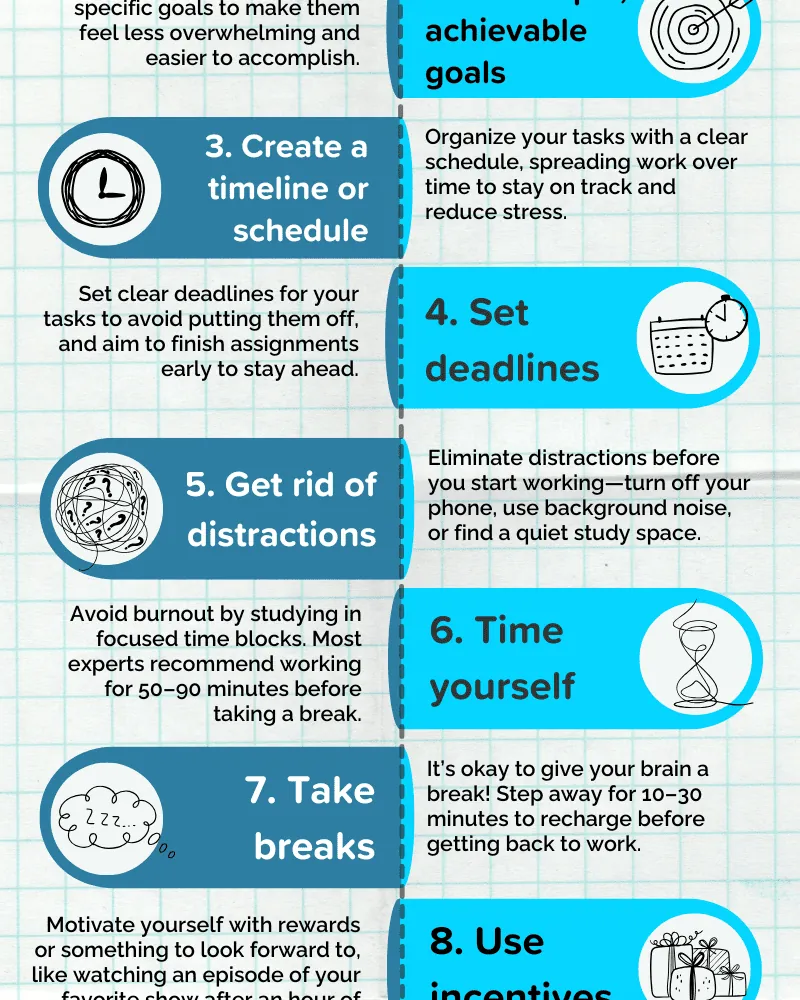
Experienced people prepare their tools before the timer starts. If you need a specific file, a textbook, or a research note, have it open on your screen or sitting on your desk before you begin. Beginners often try to find their tools while the clock is ticking, which breaks their focus and gives them an excuse to stop.
Managing your internal state
People who manage their time well ignore the urge to perfect their work on the first try. They accept that the first version will be messy and focus only on getting the words or actions onto the page. If you spend your time worrying about the quality of the result before you have even started, you’re choosing to delay the work rather than improve it.
Common problems and fixes
| What you notice | What it means | What to do first | How to stop it |
|---|---|---|---|
| Feeling overwhelmed | Task is too big | Break into pieces | Write down steps |
| Getting distracted | Task is boring | Limit to 20m | Hide your phone |
| Feeling tired | Low energy | Rest 15 mins | Adjust your schedule |
| Perfectionism | Fear of judgment | Write “draft” | Lower your standards |
| Stalling | Unclear goal | Define step one | Make it a verb |
The rules of time management
There are no universal laws that dictate how you must work, but the U.S. Office of Personnel Management suggests that clear goal-setting is the foundation of individual performance. You should check your own progress against your personal goals rather than comparing your pace to others.
If you find that you can’t start a task despite breaking it down, you might need to reconsider if the task is actually necessary or if you’re missing a skill required to complete it.
When a task feels like a wall, ask yourself if you’re avoiding the work or the outcome. Procrastination often acts as a shield against the fear of failure or the discomfort of being a beginner. If you lack the technical ability, the time management rule shifts from “doing” to “learning.”
You must distinguish between a lack of motivation and a lack of preparation. If you’re stuck because you don’t know the next step, your plan is incomplete. Break the task into smaller, physical actions that require no decision-making.
If you still can’t begin, the task may be misaligned with your actual priorities. Re-evaluating the necessity of the project prevents you from wasting energy on work that doesn’t move your primary goals forward.
Managing the effort
This work requires mental effort rather than money. The cost is your time and your ability to focus, which are both finite resources. When you plan your day, assume that you only have about 4 hours of high-intensity focus available. If you try to force yourself to work for 8 hours straight, your efficiency will drop, and you’ll likely find yourself procrastinating to cope with the mental strain.
To manage this finite energy, prioritize your most cognitively demanding tasks during your peak alertness window. Most people find this occurs early in the morning, but you should track your own energy levels for a few days to be certain. Once that window closes, shift your remaining time toward administrative tasks or low-stakes maintenance work.
If you ignore these biological limits, you’ll eventually hit a wall where your brain resists further exertion. This isn’t a lack of willpower; it’s a physiological signal that your cognitive fuel is depleted. By front-loading your hardest work, you ensure that your best effort goes toward the projects that actually move the needle, rather than wasting your limited focus on minor chores.
Keeping your momentum
Once you finish a task, record what you completed in a simple list. This visual proof of your progress helps your brain associate work with reward, which makes it easier to start the next time.
Reviewing this list at the end of each day provides a tangible record of your output. When you see a series of crossed-off items, you interrupt the cycle of feeling unproductive. This shift in perspective transforms your momentum from a fleeting feeling into a verifiable track record.
If you notice yourself slipping back into old habits, don’t try to fix everything at once. Attempting a total overhaul often leads to immediate burnout. Instead, treat a lapse as a neutral signal that your current pace is unsustainable.
Just return to the 20-minute timer rule and start with one small task. By lowering the barrier to entry, you bypass the friction that usually keeps you stuck.
Maintaining your system is about consistency, not perfection. If you miss a day, simply begin again with the next logical step. Your momentum isn’t defined by a flawless streak, but by how quickly you return to your established rhythm after a distraction.
When this approach fails
If you find that even after breaking tasks down you still can’t start, you may be dealing with burnout or a lack of motivation regarding the project itself. In these cases, taking a full day of rest is often more productive than forcing yourself to work.
When rest doesn’t restore your drive, examine the project’s purpose. You might be stalling because the goal no longer aligns with your values or current priorities. If the work feels inherently meaningless, no amount of discipline will bridge that gap. You must either redefine the objective or acknowledge that the task is a poor fit for your goals.
If you have been struggling to finish tasks for months and it affects your daily life, consider speaking with a professional counselor or a coach. They can help you identify if there’s a deeper issue, such as anxiety or a need for better organizational support, that simple time-management tricks can’t fix.
Related guides
- Start stop circuit what they are where they are used and how to wire
- Electric Current Definition and Types: A Simple Guide
- How Structural Health Monitoring Systems Work: A Simple Guide
Frequently asked questions
Can I stop procrastinating in one day?
You can stop the immediate cycle of delay in one day by completing a single, small, 20-minute task. While building a new habit takes consistent effort over weeks, the relief of finishing one thing happens as soon as you complete that first step.
Why do I always wait until the last minute?
You wait until the last minute because the pressure of a deadline provides a temporary spark that overrides your brain’s resistance to starting. This creates a stressful cycle, so replace the deadline pressure with a self-imposed 20-minute timer to start earlier.
How long should my breaks be?
Your breaks should be between 5 and 10 minutes for every 20 to 50 minutes of work. Use this time to stand up, stretch, or drink water, as stepping away from the screen allows your brain to reset and maintain focus.
Is it safe to use apps to block distractions?
It’s safe to use app blockers to limit your access to social media or news sites while you work. These tools are helpful if you find yourself opening distracting tabs automatically, but remember that the true solution is learning to manage your focus.
What happens if I miss a scheduled task?
If you miss a scheduled task, don’t punish yourself or try to double your workload the next day. Simply reset your list, pick the most important piece, and start with a fresh 20-minute timer to get back on track.
Does it matter if I work in the morning or night?
It doesn’t matter what time of day you work, as long as you choose a time when your energy is highest. Track your own focus for three days to see if you’re more alert in the morning or the evening, then plan your work accordingly.
Conclusion
Start by choosing one task that has been on your mind for a few days. Break it into small pieces, set a timer for 20 minutes, and complete the first one immediately to see the result. If you feel intense anxiety that prevents you from starting even the smallest step, stop and seek professional support.

2 thoughts on “How to Stop Procrastinating With Simple Task Management Steps”