
The Reynolds number is a dimensionless quantity used in fluid mechanics to predict the flow patterns of a fluid by calculating the ratio of inertial forces to viscous forces. By providing a single numeric value, engineers can determine whether a fluid will move in a smooth, predictable path or a chaotic, swirling mess, which is essential for everything from designing aircraft wings to ensuring efficient water flow through pipes. Understanding this value allows professionals to scale experiments and predict how fluids behave across vastly different speeds and sizes without needing to build a full-scale prototype every time.
Key Takeaways
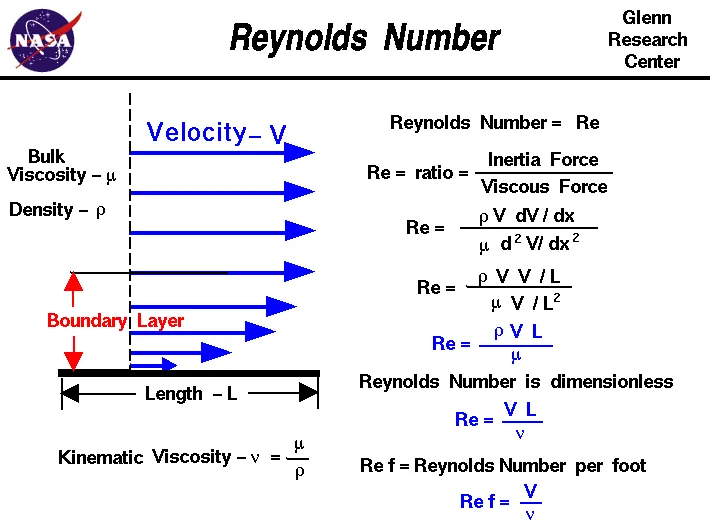
- Calculate the Reynolds number using the formula Re = (density × velocity × characteristic length) / dynamic viscosity.
- Use values below 2,300 to identify laminar flow where fluid particles move in orderly, parallel layers.
- Identify values above 4,000 as turbulent flow, characterized by chaotic eddies, vortices, and rapid mixing.
- Apply the transition range (2,300 to 4,000) to understand where flow becomes unstable and unpredictable.
- Leverage this metric to optimize energy efficiency in industrial piping and vehicle aerodynamics.
What Is the Reynolds Number?
At its core, this number represents the balance between the momentum of a fluid and its internal resistance to shearing, known as viscosity. When inertial forces dominate, the fluid ignores the smoothing effect of viscosity, leading to turbulence.
When viscous forces dominate, the fluid clings to itself and surfaces, resulting in smooth, layered motion. This concept is named after Osborne Reynolds, who demonstrated the transition between these flow states in the late 19th century. By mastering this ratio, engineers ensure that machines operate within their intended physical parameters, preventing issues like structural fatigue or inefficient heat transfer.
Why Is It Important?
This metric serves as the primary tool for fluid dynamics analysis. Without it, scientists would struggle to apply data from small-scale wind tunnel tests to massive aircraft or large-scale water distribution networks. It provides the mathematical bridge between a model and the real-world application.
By ensuring the Reynolds number remains consistent between a scaled model and the final product, engineers can achieve “dynamic similarity,” meaning the physical forces acting on the fluid behave identically, regardless of the size of the apparatus.
How to Calculate It
To find this value, you must gather four specific physical properties of the system. The standard formula is Re = (ρvL) / μ.
| Variable | Definition | Typical Unit (SI) |
|---|---|---|
| ρ (rho) | Fluid density | kg/m³ |
| v | Flow velocity | m/s |
| L | Characteristic length | meters (m) |
| μ (mu) | Dynamic viscosity | Pa·s |
Pro Tip: Always ensure your units are consistent before performing the calculation; mixing imperial and metric units is the most common cause of errors in fluid modeling.
Understanding Flow Regimes
The behavior of a fluid changes drastically based on the magnitude of the calculated value. Identifying the regime is critical for selecting the right mathematical model for your project.
Laminar Flow
In this regime, the fluid moves in smooth, parallel paths with no cross-currents. It’s highly predictable and common in low-speed scenarios or when dealing with highly viscous fluids like oil or honey.
Turbulent Flow
This state involves chaotic, irregular motion. It increases drag on objects moving through the fluid and enhances the rate of heat transfer. While often unwanted due to energy loss, it’s sometimes intentionally induced for better mixing in chemical reactors.
Transition Zone
Flow between 2,300 and 4,000 is considered transitional. It’s highly sensitive to surface roughness, vibrations, and small disturbances. Engineers typically avoid designing systems to operate within this range because the flow behavior can flip unpredictably between laminar and turbulent states.
Real-World Applications
The implications of this number extend across multiple engineering disciplines. From aerospace to medical device manufacturing, the Reynolds number dictates design choices that save lives and reduce costs.
- Aerospace Engineering: Designing wing profiles to minimize drag and prevent stall conditions.
- Civil Engineering: Calculating pressure drops in municipal water delivery systems to prevent pipe bursts.
- Biomedical Engineering: Modeling blood flow through arteries to understand plaque buildup and vascular resistance.
- Chemical Processing: Optimizing the mixing speed in reactors to ensure uniform product consistency.
Comparing Flow Characteristics
| Feature | Laminar Flow | Turbulent Flow |
|---|---|---|
| Velocity Profile | Parabolic | Flat or Blunted |
| Mixing | Low | High |
| Energy Loss | Lower | Higher |
| Predictability | High | Low |
Are There Limitations?
While the Reynolds number is an essential tool, it isn’t a universal solution. It works best for Newtonian fluids, such as water or air, where the viscosity remains constant regardless of the stress applied. For non-Newtonian fluids—like blood, paints, or polymer melts—the standard calculation may fail to capture the full complexity of the flow.
In these cases, engineers must use more advanced models that account for shear-thinning or shear-thickening properties. Furthermore, the number assumes a steady-state flow; it doesn’t account for rapid, time-dependent fluctuations that occur in highly dynamic systems.
How Geometry Affects Flow
The characteristic length (L) in the formula changes depending on the geometry of the object or conduit. For a circular pipe, L is the diameter. For flow over a flat plate, L is the distance from the leading edge. Choosing the correct length is vital, as using the wrong dimension will result in an inaccurate number and, consequently, a flawed design.
Troubleshooting Common Errors
Warning: Don’t assume that a high Reynolds number always means a worse design; in some cases, such as heat exchangers, turbulence is desirable to maximize the transfer of thermal energy.
- Unit Mismatch: Check that your velocity is in meters per second and viscosity is in Pascal-seconds.
- Wrong Length: Ensure you’re using the correct hydraulic diameter or characteristic length for your specific shape.
- Ignoring Temperature: Viscosity is highly temperature-dependent; measure the fluid temperature accurately before calculating.
- Surface Roughness: If your pipe is old or corroded, the internal friction will be higher than the Reynolds number alone might suggest.
Frequently Asked Questions
Is the Reynolds number always dimensionless?
Yes, it’s a dimensionless quantity. Because the units in the numerator (density × velocity × length) are canceled out by the units in the denominator (viscosity), the final result is just a pure number. This allows engineers to compare the behavior of different fluids—such as air and water—using the same mathematical framework, regardless of their individual physical properties.
What happens if the flow is turbulent?
When flow becomes turbulent, it creates chaotic eddies and vortices. This increases the amount of energy required to move the fluid through a pipe and increases the drag force on objects like airplanes or ships. While turbulence is often avoided in piping to save pumping energy, it’s frequently desired in heat exchangers to improve the efficiency of thermal transfer between surfaces.
Can I calculate it for gases?
Yes, you can use the Reynolds number for gases just as you would for liquids. The formula remains identical. You simply need to use the density and dynamic viscosity values for the specific gas at the pressure and temperature of your system. It’s a standard practice in aerodynamics to determine how air will flow over an aircraft’s fuselage or wings at high altitudes.
Does surface roughness impact the value?
The Reynolds number calculation itself doesn’t include surface roughness as a variable. However, surface roughness significantly affects the transition point between laminar and turbulent flow. In very smooth pipes, the transition may occur at higher values, whereas in rough pipes, the transition to turbulence happens much sooner, often complicating the prediction of the flow regime.
Why is 2,300 the magic threshold?
The value of 2,300 is an empirical observation derived from experiments in circular pipes. It represents the point where the viscous forces are no longer strong enough to dampen out small disturbances in the fluid. Beyond this threshold, these disturbances grow, leading to the breakdown of laminar flow into the chaotic state of turbulence. Different geometries will have different critical threshold values.
Conclusion
Understanding the Reynolds number is the first step toward mastering fluid mechanics and improving the efficiency of your designs. By calculating this ratio, you gain the ability to predict how your systems will perform before building them. Start by identifying the fluid properties in your current project and applying the formula to see if your flow is currently laminar or turbulent.
