
Swimming pools don’t attract snakes because the water itself doesn’t pull them in. A snake won’t cross a yard just to swim. What brings them close is food, shade and shelter hiding around the pool deck. If you’ve got frogs, mice or thick plants near the water’s edge, you’ll see them.
Three things change your odds: your climate, how much prey lives nearby, and what kind of landscaping touches the concrete. The rest of this page explains exactly how each one works.
When swimming pools attract snakes
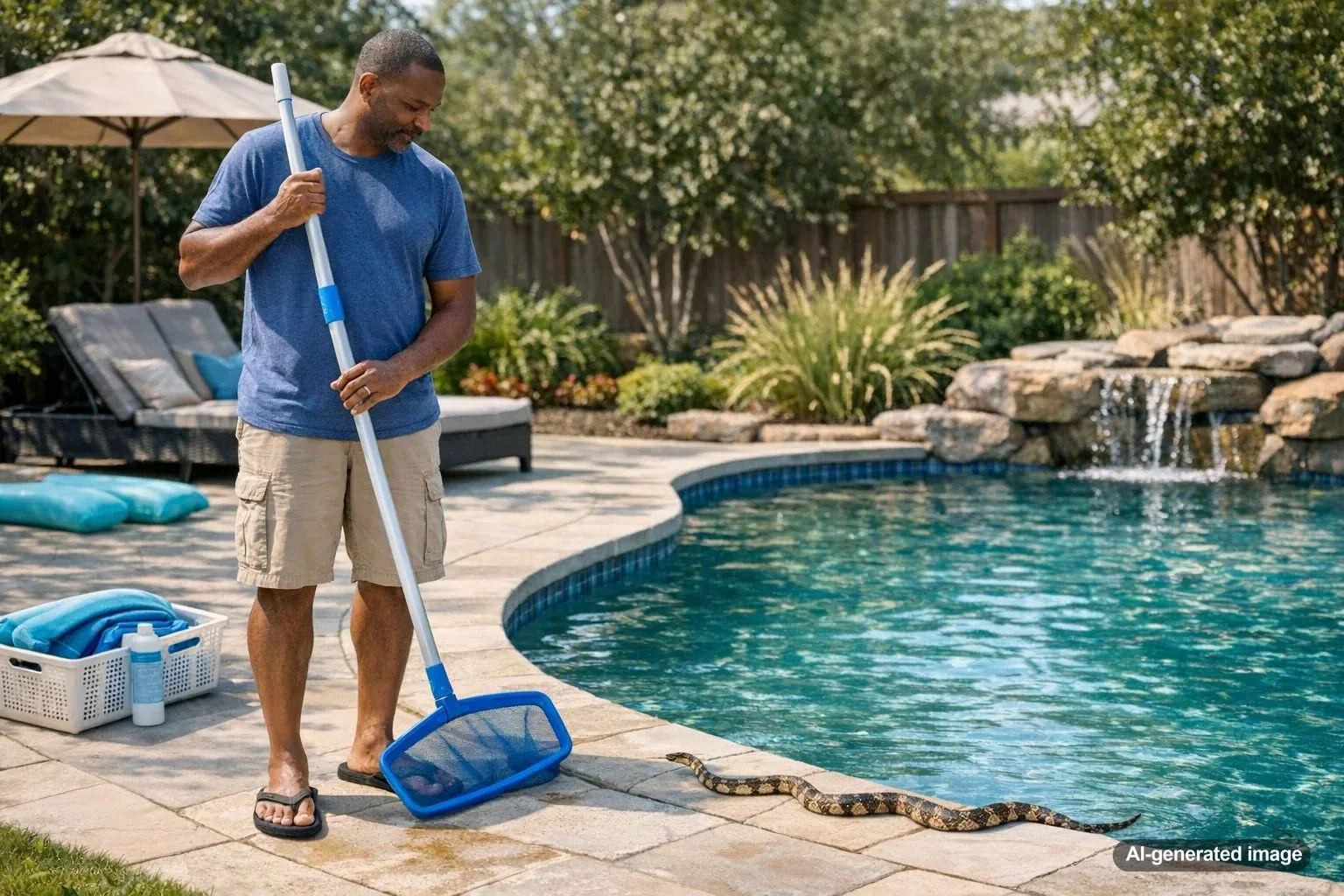
People who search for this usually fall into three groups, and they need different answers. The first group just spotted a snake on the pool deck and wants it gone right now. They don’t care about biology; they need safe removal steps and a way to keep the next one out. This page serves them best, because it covers both the immediate fix and the longer prevention work.
The second group is shopping for a new pool or moving to a house that has one. They’re trying to weigh the risk before they commit.
The third group found a snake inside the skimmer basket or floating in the water. They’re worried about damage to the pump, contamination of the water, or whether it’s safe to swim again. That’s a maintenance and sanitation question, not a wildlife one.
If that’s you, read your pool filter’s manual for debris removal, then check the CDC’s guidance on recreational water illness to see if you need to shock the water. Don’t use this page’s landscaping advice to solve a plumbing problem.
This article assumes you already have an outdoor pool in a region where snakes live, and you want to stop them from visiting the area around it.
What actually draws them close
Snakes don’t seek out chlorinated water. They follow three things, and each one changes your odds in a different direction. Knowing which one applies to your yard tells you exactly where to start.
Prey animals living nearby
Food is the strongest pull. If frogs, lizards, mice or large insects gather near your pool, snakes will hunt there too. A yard with a pond, dense ground cover or unsecured trash cans feeds the prey, and the prey feeds the snakes. You can check this yourself: sit quietly near the pool at dusk for 10 minutes. If you hear frogs or see mice, you’ve got a food source that needs managing before any fence will help.
Shelter under the deck
Piles of leaves, stacked firewood, unused pool toys and gaps under concrete decking give snakes a place to hide from heat and predators. A clean, open deck offers nothing. If you store equipment directly against the pool coping, you’re building a habitat. Move storage at least 3 feet away from the water’s edge to remove that shelter.
Warm surfaces after dark
Concrete and stone hold heat long after the sun drops. On cool nights, snakes use those warm surfaces to regulate their body temperature. This matters most in spring and fall when daytime highs are between 60°F and 80°F. In midsummer, the concrete is often too hot for them during the day, so they shift to early morning or night visits.
Vegetation touching the hardscape
Bushes, tall grass or vines that grow right up to the pool coping create a covered highway. Snakes rarely cross wide open spaces where birds can spot them. Trim every plant back so there’s at least 12 inches of bare ground between the greenery and the concrete.
The factor people get wrong most often is blaming the water. Draining a pool won’t fix a snake problem if the yard still holds mice and leaf piles. Fix the food and the shelter first.
How to keep snakes away from the pool
You don’t need chemicals or traps. You need to remove the reasons they visit. Follow these steps in order, because each one builds on the last.
- Walk the entire pool perimeter in daylight. Look for gaps under the deck, stacked items, leaf piles and overgrown plants within 3 feet of the coping. Write down every spot that offers shade or hiding space.
- Clear all debris, toys and stored equipment away from the pool area. Move firewood and compost bins at least 20 feet from the water’s edge. You’ll know this step worked when the deck is completely bare except for furniture you use daily.
- Cut back grass, shrubs and vines so no vegetation touches the concrete or fencing. Leave a 12-inch gap of bare soil or short turf all the way around. Check by walking the perimeter — you shouldn’t brush against any plant while standing on the pool deck.
- Seal cracks in the concrete coping, gaps under the deck and holes around pipe entries with expanding foam or mortar. Use a flashlight at night to spot openings you missed during the day. If a gap is wider than a quarter inch, a snake can fit through it.
- Install a fine-mesh hardware cloth fence, with openings no larger than a quarter inch, buried 4 inches deep and standing 30 inches tall around the pool area. Angle the top outward at 30 degrees so climbing becomes difficult.
- Reduce prey by eliminating standing water outside the pool, securing trash lids and using outdoor lighting that doesn’t draw heavy insect swarms. Fewer bugs mean fewer frogs and lizards.
- Run your pool pump on its normal cycle. Moving, treated water is less appealing to prey animals than a stagnant surface, which indirectly lowers snake visits.
- Inspect the skimmer basket every morning before anyone swims. Remove any debris or animals immediately.
If you find a venomous species you can’t identify safely, don’t try to move it yourself. Call your local animal control office or a licensed wildlife removal service. Handling an unknown snake risks a bite that requires emergency medical care.
Situations that change your approach
Different yards create different problems, and the same fix won’t work everywhere. Match your setup to the right action below.
| Your situation | What to do | What it takes | Watch for |
|---|---|---|---|
| Rural yard near woods | Install mesh fence, clear 3-foot border | One weekend, moderate cost | Snakes digging under mesh |
| Suburban lot with neighbors | Focus on prey reduction and sealing gaps | Few hours, low cost | Mice moving between yards |
| Pool built into a slope | Add retaining wall barriers and drainage | Professional help needed | Water pooling under deck |
| Screened pool enclosure | Repair torn screens, seal door gaps | Few hours, low cost | Gaps wider than quarter inch |
| Above-ground pool on grass | Keep grass mowed short within 6 feet | Weekly mowing effort | Snakes hiding under support rails |
| Natural or saltwater pool | Manage surrounding habitat aggressively | Ongoing seasonal work | Frogs breeding in untreated edges |
Each row is a distinct setup. An above-ground pool sitting on unmowed grass faces a completely different risk than a screened-in concrete pool, so pick the row that matches your actual yard.
Details that separate good results from poor ones
Checking the perimeter correctly
A quick glance from a patio chair misses almost everything. Get down to ground level and look along the base of the deck, the fence line and the coping joints. Snakes travel tight against vertical surfaces, so the danger zone is the bottom 6 inches. If you can slide your fingers into a crack under the concrete, that’s an entry point.
Seal those gaps with a flexible exterior caulk or mortar, depending on the material. Rigid fillers crack when the ground shifts with temperature changes, reopening the path within a single season. Recheck sealed spots after the first hard rain. Water pressure pushes weak seals loose, and you won’t see the failure until something uses it.
Managing the trade-off between looks and safety
Tall ornamental grasses and lush ground cover make a pool area feel like a resort. They also create perfect hunting lanes. The trade-off is real: you either accept a higher chance of wildlife visitors, or you maintain a trimmed, open border that looks more structured. There’s no middle ground that satisfies both fully.
If you keep decorative plants, confine them to raised beds set back at least 3 feet from any surface a snake could use for warmth. Line the bottom of those beds with hardware cloth before adding soil. That stops burrowing from underneath while letting you keep the greenery you want. Skipping the buried mesh means the bed just becomes a taller hiding spot.
Snake problems and how to fix them
When something goes wrong, the sign you notice points to the cause. Match what you see to the right fix.
| What you notice | What it usually means | What to do first | How to stop it happening again |
|---|---|---|---|
| Shed skin on the deck | Snake rested here recently | Search nearby gaps for the animal | Seal cracks under the coping |
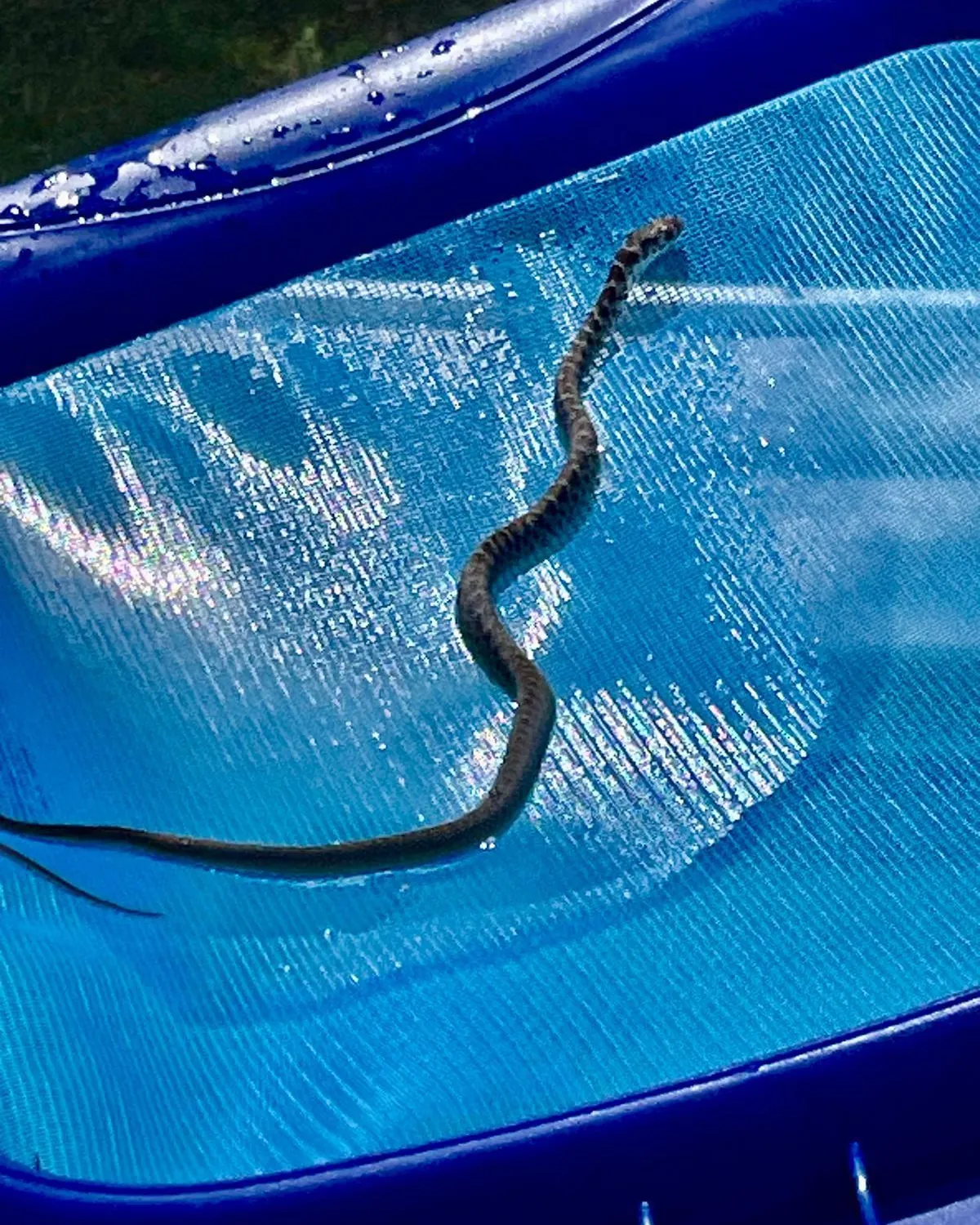
| Snake inside the skimmer | Animal fell in while hunting | Turn off pump, scoop with net | Cover skimmer opening at night |
| Tracks in dust near pump | Nocturnal visitor seeking warmth | Check electrical housing for gaps | Install mesh barrier around equipment |
| Frogs gathering at night | Food source is drawing hunters | Adjust pool lights to reduce bugs | Eliminate standing water nearby |
| Holes dug under fence | Burrowing species bypassing barrier | Fill holes, bury mesh deeper | Extend buried mesh to 6 inches |
Don’t guess at a species based on color alone. If you can’t tell whether it’s venomous from a safe distance, treat it as dangerous and call a professional.
Rules and safety limits to follow
Local wildlife laws decide what you’re allowed to do. In the US, many native snake species are protected by state law, meaning you can’t kill them even on your own property. Check your state’s fish and wildlife agency website for the exact list of protected species where you live. Killing a protected animal carries fines that vary by state.
Pool chemical handling follows EPA regulations. Never pour algaecides, chlorine shock or any other pool chemical onto the ground or into landscaping to repel animals. Those products are registered pesticides, and using them as animal repellents violates federal label law. The EPA pesticide guidelines explain what counts as legal use.
If you install a fence, local building codes may dictate its height, setback distance from the property line and materials. A mesh barrier that violates your zoning rules gets torn down by the city, wasting your time and money. Pull the permit requirements from your county’s building department page before you dig.
Any removal involving a suspected venomous snake isn’t a DIY job. One misidentified bite can cause tissue damage or worse. Licensed wildlife control operators carry the training and tools to handle that safely.
What this actually costs
The price depends entirely on which steps you need. If your yard only requires clearing debris and trimming plants, you’ll spend nothing but a Saturday afternoon. That’s the baseline.
Adding a physical barrier changes the math. Hardware cloth is inexpensive relative to other options at most home centers, assuming standard rolls. For a typical rectangular pool deck, you’re looking at an affordable amount in mesh alone, plus stakes and zip ties. Burying it adds labor time — plan for several hours of digging if you do it yourself.
Professional exclusion work runs higher. A wildlife control company installing a full perimeter barrier typically charges based on linear footage and site difficulty. A flat yard with easy soil access costs less than a sloped lot with tree roots blocking the trench. Get three written quotes that specify the mesh gauge and burial depth before choosing one.
Chemical repellents sold at garden centers are inexpensive per bottle relative to a physical barrier. They wash away after rain, so you’re buying them repeatedly throughout the warm months. That recurring expense adds up fast compared to a one-time physical barrier. Compare the total seasonal cost of reapplication against the single installation price of mesh.
Keeping the yard clear afterwards
One cleanup doesn’t last forever. Plants grow back, mulch spreads and gaps reopen as the ground freezes and thaws. The sign that your work is failing is the return of prey animals. If you start seeing frogs or mice near the pool again, the habitat conditions have reset.
Walk the perimeter once a month during the warm season. Check the mesh fence for rust holes, bent sections or spots where soil erosion has exposed the bottom edge. Re-bury any lifted sections immediately. A gap that stays open for a week is long enough for an animal to find it.
Keep your mowing schedule consistent. Grass that grows past 3 inches near the deck recreates the cover you removed. After heavy storms, clear fallen branches and leaf buildup from the coping joints before they mat down into shelter.
Record what you find during inspections. Note the date, location and type of issue — a gap, a shed skin, overgrown ivy. Patterns in that log tell you which side of the pool needs more attention, so you stop guessing and start targeting the weak spots.
When a pool barrier isn’t the answer
Not every snake sighting calls for the steps above. If you live in a heavily wooded rural area where snakes are constant, a small mesh fence around one pool won’t change the broader habitat pressure. You’d need full property exclusion, which is a different project requiring professional assessment.
If the snake is inside your house rather than near the pool, the entry point is structural, not environmental. Pool landscaping fixes won’t help. You need a foundation inspection to find the gap in your siding, vents or doors. Call a pest exclusion specialist for indoor intrusions.
If you’re dealing with a species listed as endangered or threatened in your state, modifying its habitat without a permit is illegal. Stop work and contact your state wildlife agency before altering anything. They’ll tell you whether you need a permit or if a specific relocation protocol applies.
Trying to handle any of these situations with pool-deck methods wastes time and can create legal liability. Match the scale of the problem to the right tool.
Frequently asked questions
Can snakes climb into an above-ground pool?
Yes, if the outer wall has texture, supports or nearby objects they can grip. Smooth metal walls are harder for them, but wooden frames or stacked deck blocks provide a ramp. Keep climbable items pulled back at least 2 feet from the pool’s outer edge.
Why do I find snakes in my skimmer basket?
Skimmers offer shade, moisture and trapped insects or small frogs. Snakes enter through the open mouth while hunting or cooling off. Covering the skimmer opening with a fitted mesh screen at night prevents entry without blocking water flow during pump cycles.
How long does a snake stay near a pool?
They don’t establish permanent territory around a pool unless food and shelter remain available. A passing snake might rest on warm concrete for a few hours, usually at dawn or dusk. If you see the same spot used repeatedly over several days, prey is present nearby.
Is it safe to swim after finding a snake?
Yes, once the animal is removed and the water is circulating normally. Snakes don’t contaminate pool water the way fecal matter does, and standard chlorine levels neutralize bacteria quickly. Run your pump for one full cycle before swimming if you’re concerned about surface debris.
What happens if a snake falls into the pool?
It will try to reach the nearest edge. Most snakes can swim, but smooth pool walls prevent them from climbing out, leading to exhaustion. Use a long-handled leaf net to guide or lift it out. Don’t use a vacuum line or skimmer suction, which can injure the animal.
Does chlorine keep snakes away?
No. Chlorine treats waterborne pathogens; it doesn’t act as an animal repellent. Snakes aren’t drinking the pool water, so chemical concentration doesn’t deter them. Relying on chlorine levels to manage wildlife leaves the actual attractants — food and shelter — completely untouched.
Do pool lights attract snakes?
Lights attract insects, insects attract frogs and lizards, and those prey animals attract snakes. The light itself isn’t the draw; the food chain it starts is. Switching to yellow bug bulbs or reducing nighttime illumination near the water breaks that chain at the first link.
Can a snake get through a pool screen enclosure?
Yes, if the mesh has tears, gaps at the frame joints or spaces wider than a quarter inch. Small species slip through damaged screening easily. Inspect the entire enclosure monthly, patching holes with screen repair tape or replacing torn panels before warm weather begins.
Your first step around the pool
Walk your pool perimeter today and write down every gap, leaf pile or plant touching the concrete. Pick the three worst spots and clear them this weekend. You’ll know it worked when you stop seeing frogs or mice resting near the water’s edge at dusk. If you find a snake you can’t identify from 6 feet away, stop working and call your local wildlife control office.