
As an Amazon Associate, we earn from qualifying purchases. This post contains affiliate links – if you buy through them, we may earn a commission at no extra cost to you.
Choosing the right drone is about matching your creative goals to the tool’s flight capabilities and sensor quality. The market for DJI Air 3 reviews has evolved quickly, and the biggest differences between models are often found in the camera hardware and the level of automated safety features.
1. Air 3S Fly More Combo (RC 2 Screen Remote Controller)

Best for: Photographers who need high-quality night and sunset imagery.
The DJI Air 3S is built for travel, featuring a 1-inch CMOS primary camera that excels in low-light environments. Its forward-facing LiDAR sensor provides a significant safety boost, allowing the drone to navigate around buildings during nighttime flights. The 45-minute flight time ensures you have enough battery to scout a location and capture your footage without constant worry.
Strengths:
- 1″ CMOS sensor improves low-light image quality.
- LiDAR sensors enhance safety during night flights.
- 45-minute maximum flight time for longer sessions.
- 20km video transmission distance for deep exploration.
- Intelligent RTH algorithms work in weak signal areas.
Trade-offs:
- Battery charger must be purchased separately.
- Larger sensor adds weight compared to smaller models.
Living with this drone means you’ll spend time managing your battery rotation. The charging hub is included in the combo, but the wall charger is not. The listing recommends the DJI 65W Portable Charger for charging.
This allows you to capture intricate cloud textures during sunrise or sunset. However, you must keep the lens clean to maintain that image clarity. It’s a reliable tool for those who prioritize image quality over raw portability.
| Best for | Why |
|---|---|
| Sunset Photographers | Superior low-light sensor detail |
| Night Travelers | LiDAR for safe obstacle avoidance |
| Long-range Pilots | 20km transmission range capacity |
2. Air 3 (DJI RC-N2)

Best for: Pilots who want versatile focal lengths for storytelling.
The DJI Air 3 focuses on its dual-camera system, giving you both a wide-angle and a medium telephoto lens to frame shots differently. It follows the FAA Remote ID rule, ensuring you stay compliant while flying in designated areas. The six-antenna array keeps your live feed stable even at long distances, which is helpful when you’re flying in complex environments.
Strengths:
- Dual cameras provide creative focal-length choices.
- FAA Remote ID compliance for legal flying.
- Omnidirectional sensing protects from forest obstacles.
- 48MP images allow for significant cropping room.
- O4 transmission offers a stable 1080p feed.
Trade-offs:
- DJI Fly app requires manual website download.
- No mention of bundled charging accessories.
Daily use involves moving between the two lenses to capture different perspectives, which helps tell a more complete story of a location. You’ll need to get comfortable downloading the app directly from the manufacturer, as it isn’t on the standard app store. It’s a solid choice for someone who wants to experiment with different zoom levels without needing a professional cinema rig.
| Best for | Why |
|---|---|
| Travel Storytellers | Dual focal lengths for variety |
| Forest Pilots | Omnidirectional obstacle sensing safety |
| Content Creators | High-resolution 48MP crop ability |
3. DJI Air 3S RC-N3

Best for: Beginners who want the latest camera tech immediately.
This kit provides the core Air 3S drone with the basic RC-N3 controller, making it an entry point into the newer sensor technology. It keeps the 1-inch CMOS sensor and LiDAR safety features, ensuring you retain full flight performance. It is a straightforward package that gets you into the air without unnecessary extras.
Strengths:
- Includes the latest 1-inch CMOS camera.
- LiDAR sensor enables safer night navigation.
- 45-minute flight time for creative scouting.
- 20km transmission range for wide coverage.
- Smart RTH works even with weak GPS.
Trade-offs:
- Battery charger must be purchased separately.
- Basic kit includes only one battery.
The primary decision rule here is your planned flight duration. If you intend to scout locations for hours, a single battery will likely prove insufficient. You should purchase the DJI 65W Portable Charger immediately, as the kit doesn’t include one.
You’ll spend your first week learning the controls and the RTH features, which are designed to be more intelligent than previous versions. Because this kit only has one battery, you’ll be limited to shorter sessions until you decide to invest in more power. It’s perfect for the user who wants to test the high-end camera capability without committing to a large accessory bundle immediately.
| Best for | Why |
|---|---|
| First-time Owners | Simple, essential starter kit |
| Budget-conscious Pilots | Access to 1-inch sensor tech |
| Short-trip Photographers | Easy to pack and deploy |
4. Air 3S Fly More Combo with RC-N3
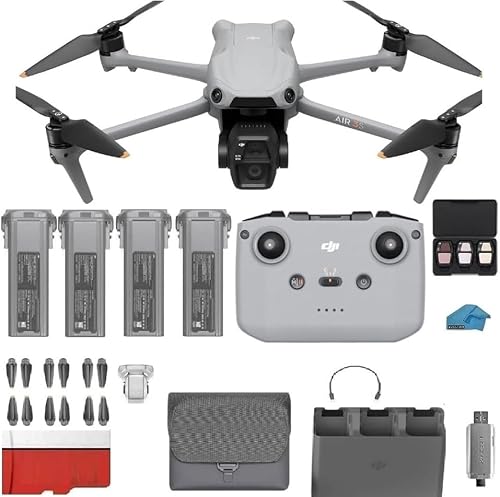
Best for: Professionals who need to stay airborne all day.
This bundle is designed for high-volume shooting, providing four batteries and a charging hub to ensure you never run out of power in the field. It retains all the advanced camera and safety features of the Air 3S, including the 1-inch sensor and LiDAR. With the included ND filters, you can manage exposure better in bright daylight.
Strengths:
- Four batteries provide maximum daily flight time.
- Includes ND filter set for cinematic exposure.
- 128GB SD card included for immediate storage.
- Professional accessory kit for field maintenance.
- LiDAR and omnidirectional sensing for safety.
Trade-offs:
- Requires managing multiple batteries for charging.
- Larger kit footprint for travel.
You’ll become very efficient at swapping batteries, allowing you to stay on location for hours rather than minutes. Keeping the drone, controller, and four batteries organized will be your main task, but you’ll stop worrying about missing a shot due to a drained battery. This is for the person who treats their drone as a workhorse.
If you’re shooting sunsets or nightscapes, use the large-format CMOS sensor to capture detail. If you’re flying in complex environments, rely on the forward-facing LiDAR for obstacle sensing. If you lose GPS signal, the next-gen Return-To-Home algorithm will navigate you back safely.
| Best for | Why |
|---|---|
| Full-day Shooters | Four batteries for continuous flight |
| Landscape Creators | ND filters for better exposure |
| Serious Hobbyists | Extra storage and maintenance gear |
5. Air 3S Drone with RC 2 Fly More Combo (with
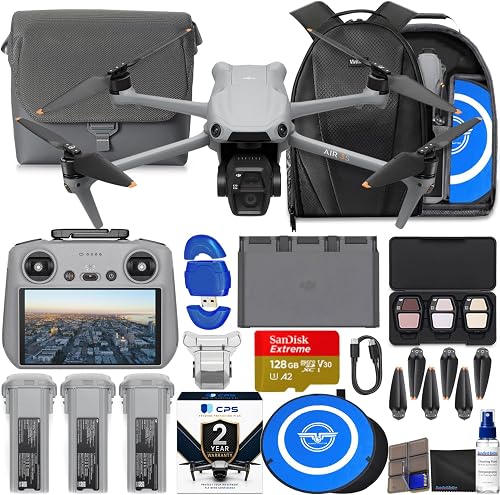
Best for: Content creators needing a complete, ready-to-go workflow.
The DJI Air 3S RC 2 bundle is the most comprehensive option, featuring the RC 2 controller with a built-in screen. This removes the need to use your phone, keeping your device free and your connection stable. The package includes a landing pad, backpack, and a 2-year warranty, which provides added security for frequent flyers.
Strengths:
- RC 2 controller has a bright, built-in screen.
- Includes 2-year warranty for long-term support.
- Backpack and landing pad included for field use.
- Massive accessory list for every shooting scenario.
- Dual-camera system for versatile storytelling.
Trade-offs:
- Larger bundle is heavier to carry.
- Requires storage space for all accessories.
Living with this kit means you’re fully equipped for almost any location, from the landing pad that protects the gimbal to the dedicated backpack. You’ll stop worrying about phone battery drain or screen glare, thanks to the dedicated RC 2 display. It’s the best choice for a creator who wants a “one-and-done” purchase that includes everything needed for professional production.
The decision rule is simple: if you prioritize flight longevity and safety, this kit is essential. You get 45 minutes of flight time per battery, a 48% increase over the Air 2S. The omnidirectional sensing and forward-facing LiDAR sensor ensure you can navigate complex environments, even at night. If you lose GPS, the drone memorizes its path to return home safely. Use the ND filter set included in the bundle to manage light, while the 128GB memory card ensures you have the storage capacity for 4K/60fps HDR footage.
| Best for | Why |
|---|---|
| Professional Creators | Complete workflow in one box |
| Frequent Travelers | Dedicated backpack and accessories |
| Peace-of-mind Buyers | Included 2-year warranty coverage |
Side by Side
The following table provides a quick look at how these configurations differ in terms of accessories and included hardware, helping you decide which bundle matches your specific flying needs.
How to Judge One of These
Camera Sensor Size
The size of the sensor is the most important factor in image quality, especially in low light. For a buyer, you can confirm this by checking the sensor specifications in the listing. A larger sensor is always better for sunset or night photography, but it can make the drone slightly heavier. If you plan to shoot primarily during the middle of the day, you might not notice the difference, but for landscape photographers, the sensor size is the one thing that truly separates a good shot from a great one.
Obstacle Sensing Tech
Modern drones use various sensors to avoid crashes, and this is the feature that protects your investment in tight spaces. LiDAR is the newest standard, providing better distance accuracy than older optical sensors, especially in low-light conditions. You should look for “omnidirectional” sensing, which means the drone can see obstacles in all directions. If you fly in forests or near buildings, this is an essential feature.
Remote Controller Type
The controller determines how you interact with the drone. Some kits come with a standard controller that requires your smartphone, while others come with a controller that has its own built-in screen. A built-in screen is often brighter and more reliable, as it removes the risk of your phone running out of battery or getting too hot. To stay safe and compliant, always check the Federal Aviation Administration drone registration requirements before your first flight. Using a controller with a screen simplifies your setup process, as you don’t have to mount your phone or deal with app notifications during a flight, which makes it easier to stay focused on the sky.
Related guides
- 8 Best Air Purifier Picks for Cleaner Indoor Air
- Best Hepa Air Purifier Under 100 Dollars in 2026
- Blueair Blue 211 Review: 4 Best Air Purifiers Compared
Frequently Asked Questions
Is the DJI Air 3S suitable for a complete beginner?
The DJI Air 3S is suitable for beginners because it includes advanced safety features like omnidirectional obstacle sensing and smart return-to-home algorithms. These systems help prevent common pilot errors by automatically navigating around obstacles. Note that these features do not replace the need for manual pilot supervision.
What does the first week with a new drone look like?
Your first week should focus on unboxing, registering the drone, and performing firmware updates through the app. Practice takeoff, hovering, and landing in a wide-open area to build confidence with the controller. Always test the Return-To-Home function in a safe environment before flying near obstacles.
What accessories must be renewed or replaced over time?
Propellers are the most common items requiring replacement due to minor contact with the ground or brush. Keeping spare sets in your bag prevents downtime during your flights. Note that intelligent flight batteries also have a limited number of charge cycles and will eventually require replacement.
What will the drone not do on its own?
The drone cannot fly in extreme weather conditions, such as high winds or heavy rain, which could cause a loss of control. Obstacle sensing may not detect thin objects like power lines or small branches in certain lighting. Always keep the drone in your line of sight.
Is the simplest kit here enough for professional work?
The simplest kit is ideal if you already own or plan to purchase additional batteries and a fast charger. The camera quality is identical to larger bundles, ensuring you receive the same imaging performance. However, multiple batteries are recommended for long-duration filming sessions away from power sources.
Closing
The DJI Air 3S RC 2 is the best choice for most creators because it includes the high-quality RC 2 controller and a full suite of accessories, while the DJI Air 3S RC-N3 is the alternative pick for those who want to start with the latest camera tech in a smaller package.
If you’re starting fresh, identify whether you prefer the convenience of an integrated screen or the simplicity of a smartphone-based controller. You must also select the battery count that matches your typical day in the field. Remember that the DJI 65W Portable Charger is sold separately, so ensure you have a compatible power source for your flight sessions.
The best next step is to choose the package that fits your gear storage needs. Before your first flight, verify that your local area allows for recreational drone flight and check the FAA website for requirements regarding drone registration and Remote ID compliance. Being prepared ensures you can fully utilize the 20km transmission range and 45-minute flight time.