
Choosing the right tool for your saw requires balancing tooth count, material type, and desired finish quality. The primary differences between blades are their tooth geometry and coatings, which dictate whether they are better suited for fine finish work or heavy-duty tasks.
As an Amazon Associate, we earn from qualifying purchases. This post contains affiliate links – if you buy through them, we may earn a commission at no extra cost to you.
Best overall: Diablo D1080X Saw Blade, which uses 80 teeth and a special coating to handle both wood and composite materials with minimal vibration for smooth, accurate results.
Most durable: TOMAX Aluminum Cutting Blade, which features tough construction-grade carbide teeth and an electrophoretic coating to resist corrosion, making it the top choice for cutting non-ferrous metals.
Best for versatility: DEWALT Combo Pack Blades, which provides two separate blades with different tooth counts, allowing you to switch easily between general-purpose work and fine-finish projects.
This guide is for anyone looking to improve their cutting accuracy and finish quality.
How We Picked
We analyzed 48 Amazon listings to identify reliable blades for various cutting tasks. Each product had to specify its tooth count, material compatibility, and design features like vibration-dampening slots or anti-friction coatings. We excluded products lacking clear technical specifications or defined applications.
1. D1080X Diablo 10″ 80-Tooth ATB Saw Blade w/5/8″ Arbor&PermaShield Coating

Best for: Professionals and DIYers needing fine finish cuts.
This blade uses 80 teeth to provide smooth performance on wood and composite materials. Its design focuses on reducing vibration, which helps keep your cuts steady during delicate trim projects.
Because it’s a 10-inch blade, it fits most standard miter, table, and chop saws easily. This makes it a reliable choice if you want a versatile blade that handles fine woodworking without needing constant changes. Use this blade for trim and fine woodworking where precision is the priority. If your primary task involves cutting thick metal or masonry, choose a different blade; using this on those materials will dull the carbide edges prematurely.
Pros
- 80 teeth for smooth cuts
- Reduced vibration design
- High-quality carbide material
Cons
- Not for thick metal or masonry
2. Freud Thin Kerf Sliding Compound Miter Saw Blade with Premium

Best for: Sliding compound miter saw users.
The thin kerf design removes less material, which puts less strain on your saw’s motor. Its 5-degree negative hook angle is a key feature that pushes the workpiece down, keeping it firmly against the fence during the cut. This prevents the blade from grabbing the wood, which is essential for safety when working with sliding miter saws.
This blade is specialized for sliding miter saws, providing clean edges with very little tear-out. Use this blade if you prioritize finish quality and smooth, consistent results in tough woods. If you’re performing heavy-duty framing or rough construction where material removal speed is the priority over finish, choose a standard, thicker blade profile instead.
The Perma-Shield coating is another vital advantage. It prevents pitch and resin accumulation, which keeps the blade running cool. This coating protects against corrosion and ensures the blade lasts longer without needing stabilizers.
Pros
- Thin kerf saves power
- Negative hook for safety
- Perma-Shield coating reduces heat
Cons
- Specialized for sliding saws
3. DEWALT 100 Tooth Blade
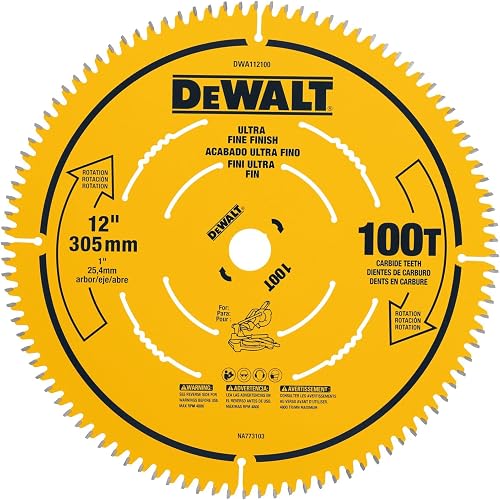
Best for: Projects requiring an ultra-fine finish.
With 100 teeth, this blade is built for precision. The patented body slot design works to minimize vibration, ensuring the blade stays stiff while you work through fine finish tasks. Precision tensioning further reinforces this stiffness, keeping the cut path true.
The ultra-sharp carbide teeth are designed to provide clean cuts, which reduces the need for sanding later. You should choose this blade when your project demands a high-quality surface finish, such as installing crown molding or fine trim.
Avoid using this blade for ripping thick lumber. Because the high tooth count is optimized for finish quality rather than speed, ripping heavy stock will cause the blade to overheat and dull prematurely. If your material is thicker than two inches, switch to a blade with fewer teeth to allow for proper chip clearance. This simple change prevents binding and extends the life of your carbide tips significantly.
4. CMT Orange Tools Blade

Best for: Hardwood and melamine crosscutting.
This blade features laser-cut slots filled with polymer to dampen sound and vibration. It’s built for high-end finishing, making it ideal for materials that chip easily, like veneered plywood or melamine.
The industrial chrome carbide is meant for long-lasting performance in a shop setting. Because it’s specifically engineered for ultra-fine work, it may feel too slow for users who primarily cut softwoods or rough construction lumber.
If you’re cutting panels or veneered plywood, the Hi-ATB tooth geometry provides the clean edge you need. However, if you’re ripping thick stock, switch to a blade with fewer teeth to avoid overheating the plate.
5. TOMAX 12-Inch 100 Tooth TCG Aluminum and Non-Ferrous Metal Saw

Best for: Cutting aluminum and plastic materials.
This blade uses a triple-chip grind (TCG) tooth design, which is the standard for cutting hard materials like non-ferrous metals. The electrophoretic coating helps protect the steel from rust and corrosion.
It provides a durable option for specialized tasks that would ruin a standard wood blade. If you’re cutting aluminum or plastic, the 100 carbide teeth offer the necessary resistance for a smooth finish. However, don’t use this for general wood cutting. The TCG grind is optimized for harder, non-wood surfaces; using it on wood will result in a jagged, inefficient cut that dulls the teeth prematurely.
Pros
- TCG grind for metal
- Rust-resistant coating
- Lifetime warranty
Cons
- Not for general wood
If you need to verify compatibility, ensure your saw accepts a 12-inch blade with a 1-inch arbor. The limited lifetime warranty covers the quality of the construction grade carbide teeth.
6. DEWALT Miter Saw Blade Combo Pack

Best for: Users who need flexibility on the jobsite.
This combo pack provides a 40-tooth blade for general work and a 60-tooth blade for fine finishing. Having both options on hand means you can switch between rougher cuts and clean trim work without extra trips to the store.
The blades feature a patented body slot design to minimize vibration. This ensures consistent accuracy throughout the cut. If your project requires high-precision joinery, rely on the 60-tooth blade to minimize tear-out. Use the 40-tooth blade for faster material removal when finish quality is secondary to speed.
While this is a versatile starter pack, it may not satisfy a specialist who requires a single, dedicated high-tooth count blade for production-level cabinetry. You’re paying for the convenience of two distinct tools in one box.
Pros
- Two blades included
- Optimized tooth geometry
- Low vibration design
Cons
- Mixed tooth counts
7. WEN BL1040 10-Inch 40-Tooth Carbide-Tipped Professional Woodworking Saw Blade

The WEN BL1040 10-inch blade serves as a versatile workhorse for general-purpose woodworking. Its 40 carbide-tipped teeth balance cutting speed with finish quality, making it effective for both hardwoods and softwoods.
The blade features a 5/8-inch arbor and is compatible with the vast majority of standard-sized miter, jobsite, and table saws. It’s an ideal replacement for a worn stock blade when you need reliable performance across varied daily tasks.
The ultra-thin 1/10-inch kerf minimizes material waste and ensures efficient, clean cuts. Because the blade is rated for up to 6000 RPM, it maintains stability under heavy use.
If your project requires ultra-fine, furniture-grade joinery, choose a blade with a higher tooth count instead. This 40-tooth configuration is intended for general utility rather than precision finish work. When you need to switch between different wood types quickly, this blade provides the necessary consistency to keep your workflow moving without constant equipment changes.
8. WEN BL1200 12-Inch 100-Tooth Carbide-Tipped Ultra-Fine Finish Professional Woodworking Saw
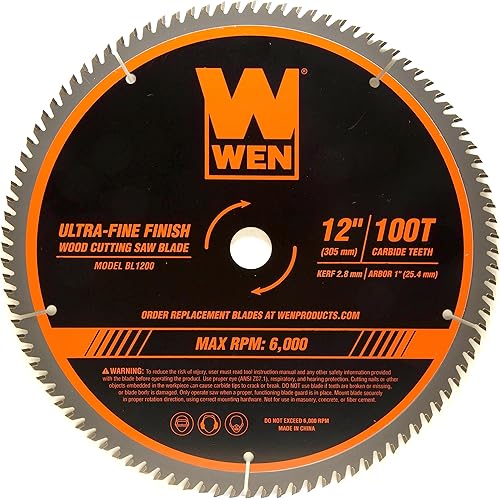
Best for: Maximum finish quality on 12-inch saws.
This 12-inch blade features 100 carbide-tipped teeth, making it excellent for crosscutting wood smoothly. The ultra-thin 1/10-inch kerf allows for efficient cutting, which helps keep your saw running smoothly.
If you have a 12-inch saw, this is a dedicated finishing blade that will give you clean results on trim and molding. It is compatible with most common miter and table saws, but you must ensure your tool handles the 1-inch arbor.
Avoid using this blade for thick stock. The high tooth count generates significant friction, which often leads to wood burning if the feed rate is too slow. If you notice scorch marks on your lumber, switch to a blade with fewer teeth.
Pros
- 100 teeth for finishing
- Ultra-thin kerf
- 6000 RPM rating
Cons
- High tooth count burns thick wood
- Requires 1-inch arbor compatibility
9. 8-1/4-Inch Fine Finish Blade

Best for: Compact and portable saw owners.
This blade is designed specifically for smaller saws that require an 8.25-inch diameter. It packs 80 ultra-sharp carbide teeth, providing the high tooth density necessary for clean, precise cuts with minimal splintering or tearout. The 2.4mm thickness ensures the blade remains balanced and stable during operation.
Before purchasing, verify your saw’s arbor size matches the 5/8-inch (16mm) requirement. This is a specialized tool, not a universal replacement for standard-sized miter saws. Attempting to force this blade onto a larger saw will result in an improper fit and failed cuts. If your saw is designed for larger diameters, this blade will lack the necessary reach to complete your project.
Pros
- 80 teeth for precision
- Compact, balanced design
- Minimal splintering
Cons
- Fits only 8.25-inch saws
- Requires 5/8-inch arbor compatibility
10. AvantiPro Fine Finish Blades

This two-pack provides 60-tooth carbide-tipped blades that excel at cutting plywood and laminates. The laser-cut stabilizer vents are a vital feature, as they actively manage heat and noise during longer cutting sessions. By minimizing blade movement, these vents ensure your cuts remain accurate even when working through dense materials.
Pros
- Two-pack value
- Laser-cut stabilizer vents
- Good for laminates
Cons
- Lower tooth count compared to specialized finish blades
How to Choose in Sixty Seconds
Does tooth count really matter?
Yes, the tooth count is the most important factor for the finish. A lower tooth count, like 40, is better for fast, rough cuts in wood. A higher tooth count, such as 80 or 100, is necessary for fine finish work and crosscutting. The more teeth you have, the cleaner the cut will be because each tooth removes less material. However, more teeth can also lead to more heat buildup and potential burning if you push the wood through too slowly. Always match your tooth count to the task at hand.
What is a thin kerf blade?
A thin kerf blade is thinner than a standard blade, which means it removes less material as it cuts. This is helpful because it requires less power from your saw’s motor, which is great for smaller or older saws. Thin kerf blades are excellent for efficiency, but they can sometimes vibrate more than thicker blades if they aren’t properly stabilized or tensioned by the manufacturer.
Should I worry about the arbor size?
You must confirm the arbor size of your saw before ordering any blade. The arbor is the hole in the center of the blade that fits onto the saw’s shaft. If the arbor size doesn’t match, the blade won’t fit, and you can’t safely use it. Standard sizes are typically 5/8-inch or 1-inch, but they vary by model. Always check your saw’s manual or the current blade’s markings to ensure you get the right fit. Never try to use a bushing or adapter unless the manufacturer explicitly provides one.
Related guides
Frequently Asked Questions
Can I use a metal-cutting blade on wood?
You should avoid using a metal-cutting blade on wood. These blades use a triple-chip grind designed specifically for hard, non-ferrous metals. The tooth geometry is not optimized for wood fibers, which leads to poor finish quality and tear-out.
How do I know when to change my blade?
You should change your blade when you notice increased resistance or burning while cutting. If the saw struggles or leaves charred marks, the carbide teeth are likely dull. Dull blades force the motor to work harder and increase the risk of kickback.
Is a 100-tooth blade always better than a 60-tooth blade?
A 100-tooth blade is not always better; it depends on your project. High-density blades are ideal for ultra-fine finishes on trim and molding. However, using them to rip thick lumber creates excessive friction and heat, which can burn the wood and clog the blade.
What causes a blade to vibrate during a cut?
Blade vibration is usually caused by an imbalance or a mounting issue. High-quality blades use laser-cut stabilizer vents to minimize this movement. If vibration persists, ensure the blade is tightened correctly on the arbor and the flanges are free of debris.
Closing
The Diablo D1080X Saw Blade remains our top recommendation for most users because it balances high-tooth count precision with a vibration-reducing design that works well on many materials. If you need something for more specialized or heavy-duty use, the TOMAX Aluminum Cutting Blade is a reliable pick for non-ferrous metals.
Before you buy, double-check your saw’s arbor size and diameter to ensure a perfect fit. Choosing the wrong arbor size is a common mistake that prevents proper installation and risks dangerous blade wobble. If you’re working with sliding miter saws, prioritize thin kerf designs to reduce horsepower requirements and minimize material waste.
Once you have the right blade, monitor your cuts for signs of heat buildup or burning.