
Selecting a budget miter saw depends on whether you need a simple tool for basic lumber or a sliding model for wider boards. These picks range from compact units for tight spaces to heavy-duty saws with multi-material capability. The main difference lies in cutting capacity, motor power, and the extra features that simplify your daily tasks.
As an Amazon Associate, we earn from qualifying purchases. This post contains affiliate links – if you buy through them, we may earn a commission at no extra cost to you.
Best overall: Metabo HPT C10FCG2, as it balances a high-power 15-Amp motor with a lightweight, portable frame and a 5-year warranty that offers long-term reliability for most users. Best for the first-time buyer: DEKOPRO 10-Inch Miter Saw, which provides essential single-bevel features in a highly compact, 20.5 lb frame that’s easy to manage in small home workshops. Best for heavy-duty use: NOVORIK Sliding Miter Saw, which features a robust 15-Amp motor and sliding rails that allow for a larger cutting range on tougher materials like soft metals.
This guide is for anyone looking to equip their workshop with a capable saw without overspending on unnecessary features.
How We Picked
We compared 48 different miter saw listings to identify the best options for various skill levels and project requirements. Our selection process focused on clear, manufacturer-stated specifications, including motor amperage, cutting angles, and included accessories like clamps or dust bags. We excluded any products that didn’t provide sufficient technical data to verify their core capabilities. Every recommended saw is evaluated based on its reported construction, stated cutting range, and the specific utility it offers for common workshop tasks.
1. Metabo HPT 10-Inch Compound Miter Saw

Best for: General woodworking and home renovation projects.
This 10-inch compound miter saw uses a 15-Amp motor to reach 5,000 RPM, which provides the necessary power for smooth, consistent cuts in wood. Its single-bevel design is straightforward to operate, while the improved miter scale helps you achieve the specific angles required for trim and framing. The 24 lb weight makes it easy to move between different work areas as your project demands.
Because it lacks a sliding rail, this saw is limited to cutting materials that fit within its fixed blade width, which might frustrate users needing to crosscut very wide boards. It isn’t the ideal choice for someone who needs to cut wide stock or intricate metal pieces frequently.
Pros
- High 5,000 RPM motor speed
- Lightweight 24 lb design
- Includes 5-year warranty
Cons
- No sliding rail system
- Single bevel design only
2. Evolution Power Tools R185SMS+ Sliding Miter Saw with Multi-Material Cutting
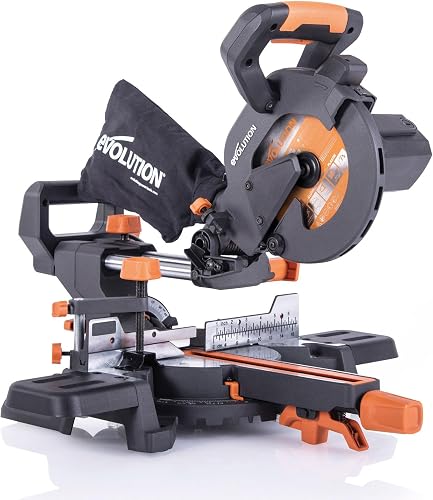
Best for: Projects involving wood, plastic, and metal.
This sliding miter saw stands out because it’s designed to cut through multiple materials, including mild steel, using a single tungsten carbide-tipped blade. The sliding function allows you to tackle wider boards than a standard fixed saw, providing more versatility for varied construction tasks. It features a heavy-duty cast aluminum base that provides a stable foundation for more demanding on-site jobs.
The multi-material focus means the gear ratios and motor speed are optimized for durability rather than just high-speed wood cutting. It isn’t suitable for a woodworker who only needs a lightweight, high-speed saw for fine finish carpentry, as the focus here is on heavy-duty performance.
Pros
- Cuts wood, metal, and plastic
- Sliding rail for wide boards
- Heavy-duty aluminum base
Cons
- Specialized for multi-material use
- Heavier than basic wood saws
3. DEKOPRO 10-Inch Compound Miter Saw

Best for: Beginners and small workshop organization.
The DEKOPRO 10-Inch Miter Saw is built for simplicity, using a 13-Amp motor that still hits 5,000 RPM for clean cuts in wood and laminates. Its lightweight 20.5 lb build and locking head make it exceptionally easy to store on a shelf or move between a garage and a workspace. The transparent blade guard is a helpful touch, as it gives you a better view of the cut line during detailed trim work.
The 13-Amp motor is slightly less powerful than the heavy-duty versions found on larger saws, which means it may struggle with very thick or dense hardwoods. It isn’t recommended for professional-grade industrial work where high-torque, constant use is expected.
Pros
- Very lightweight at 20.5 lbs
- Compact head locks for storage
- Transparent guard for visibility
Cons
- 13-Amp motor is smaller
- No sliding rail capacity
4. DOVAMAN 10-Inch Sliding Miter Saw

Best for: Large-scale projects requiring wide cuts.
This sliding saw features a 15-Amp motor and a dual-speed setting, allowing you to switch between 5,000 RPM and 3,200 RPM depending on the material you’re cutting. The 13-inch sliding rail and extendable side tables give you a generous cutting range of up to 4 x 13 inches. It also includes a laser guide to help you line up your cuts accurately before the blade makes contact.
The complexity of the dual-speed motor and sliding rails makes this saw larger and potentially more difficult to calibrate than a fixed-head model. It isn’t the best choice for someone who needs a simple, “grab-and-go” tool for quick, small jobs.
Pros
- Dual-speed motor settings
- Large 4 x 13 inch capacity
- Built-in laser guide
Cons
- More complex setup required
- Larger physical footprint
5. SEESII 8-1/4″ Compound Miter Saw with Laser 4900RPM Single Bevel

Best for: Precision-focused framing and trim work.
This saw includes an integrated laser marker that projects a clear line onto your workpiece, which helps eliminate guesswork during repetitive cuts. The 4,900 RPM motor is designed to handle hardwoods and lumber efficiently, making it a strong choice for renovation tasks. It also features tilt protection and dual-switch activation, which adds a layer of safety for home users who are still learning the basics of saw operation.
The 8-1/4 inch blade size limits the depth of cut compared to larger professional models, meaning it can’t handle as thick a piece of material. It isn’t suitable for users who primarily need to cut large, thick timbers or wide crown molding that exceeds its specific capacity.
Pros
- Integrated laser guide system
- Dual-switch safety activation
- Includes extension tables
Cons
- Smaller 8-1/4 inch blade
- More limited cutting depth
6. WEN MM0713 9.5-Amp 7.25-Inch Single Bevel Compact Sliding Compound Miter

Best for: Tight workspaces and wall-flush operation.
The WEN MM0713 uses a unique dual-rail system that allows the saw to slide while remaining flush against a wall. This design minimizes the machine’s footprint, making it a major advantage in a crowded garage or small shop.
Its 9.5-Amp motor is specifically tuned for crosscutting boards up to 11.5 inches wide and 2.5 inches thick. While compact, it handles standard trim and finish work with ease. Use the onboard LED cutline guide to illuminate the exact path of the blade, which is essential for accuracy in dim workshop lighting.
If you’re cutting dense, heavy-duty materials or thick structural lumber for outdoor decking, choose a larger saw. This motor is optimized for efficiency on lighter stock rather than sustained, heavy-duty ripping.
Pros
- Compact dual-rail sliding system
- LED cutline illumination
- Includes two table extensions
Cons
- 9.5-Amp motor is smaller
- Limited to 7.25-inch blade
- Not for thick structural lumber
7. Hoteche 7-1/4-Inch Miter Saw 7.5A Compound Single Bevel Chop Saw

Best for: Small DIY projects and baseboard trimming.
This saw is built for portability, featuring a 7.5-Amp motor that’s sufficient for baseboards, crown molding, and smaller DIY tasks. The sliding arm provides a maximum crosscut capacity of 120mm x 45mm, which is enough for standard 2×4 lumber. It also includes a laser guide, which is a useful feature for ensuring your miter angles are accurate on decorative trim work.
If you’re cutting 90-degree angles, the saw handles 120mm by 45mm. For crown molding requiring 45-degree bevels, the limit is 85mm by 45mm. Use the included extension bars when working with wide boards to prevent tipping.
The smaller motor isn’t designed for continuous, high-volume production or cutting very thick, hard materials. It isn’t ideal for professional contractors who need a high-torque, heavy-duty saw for daily site work. Avoid forcing the blade through dense hardwoods; if the motor bogs down, reduce your feed rate to maintain a clean, splinter-free finish.
Pros
- Built-in laser guide
- Lightweight and compact
- Includes extension bars
Cons
- 7.5-Amp motor is lower power
- Not for thick lumber
8. Evolution Power Tools R210CMS Compound Miter Saw

Best for: Simple, reliable multi-material cutting.
This compact compound saw uses a 1,200W motor and a specialized 8-1/4 inch TCT blade to slice through wood, metal, and plastic. It’s a no-frills tool that prioritizes durability and simple adjustments, making it easy to master for a beginner. The 3-year limited warranty ensures the manufacturer supports the longevity of the tool.
Because it lacks a sliding rail, you’re restricted to the width of the blade’s rotation. This limits the size of the boards you can cut. If you’re working with wide trim or large timber, the lack of a sliding mechanism will prevent a clean, single-pass cut. Use this saw for smaller projects where precision at 45-degree miter and bevel angles is the priority.
If you need to crosscut stock wider than the blade diameter, look for a sliding model instead. Attempting to force wide material through this fixed-base saw will lead to uneven edges and binding.
Pros
- Cuts wood, metal, and plastic
- 3-year limited warranty
- Compact, simple design
Cons
- No sliding rail capacity
- Limited crosscut range
9. Ryobi 10 in. Compound Miter Saw with10 IN. COMPOUND MITER

Best for: Users who want a brand-standard wood saw.
This 10-inch compound miter saw is a straightforward option for woodworking, featuring an LED cutline guide to assist with alignment. It provides a standard compound cutting experience for typical home projects.
The listing doesn’t provide specific technical details like motor amperage or RPM, so it’s difficult to compare its power directly to other models. If you require precise performance metrics before committing to a purchase, this model will likely leave you guessing. Relying on vague specifications often leads to buying a tool that lacks the torque needed for dense hardwoods.
You should choose this saw only if you prioritize brand consistency over granular technical data. If your workflow demands a sliding capacity for wider boards, look elsewhere, as this fixed-arm design doesn’t offer that movement.
Pros
- Includes LED cutline guide
- Standard 10-inch blade size
Cons
- Limited technical data provided
- No sliding capacity mentioned
10. NOVORIK Single Bevel Compound Sliding Miter Saw

Best for: High-torque requirements and wide cuts.
The NOVORIK sliding saw features a powerful 15-Amp motor that reaches 4,000 RPM, which is well-suited for cutting through a variety of materials including wood and soft metals. The sliding rail system allows for a wider reach, and the laser guide helps keep your lines straight during complex cuts. It’s designed to be a heavy-duty option for those who need more power and reach than a basic saw provides.
The 4,000 RPM speed is slightly lower than some high-speed wood saws, meaning it focuses more on torque for tougher materials. It isn’t the best pick for a user who exclusively cuts thin, soft wood where higher RPMs might offer a slightly cleaner finish.
Pros
- Powerful 15-Amp motor
- Sliding rails for width
- Laser guide included
Cons
- Lower 4,000 RPM speed
- Heavier build
How to Choose in Sixty Seconds
Does motor amperage really matter?
Higher amperage usually means more power, which is important if you’re cutting through dense hardwoods or thick metal. If you’re only cutting thin trim or soft pine, a lower amperage motor will do the job just fine and save you on weight. Always check the Occupational Safety and Health Administration guidelines to ensure you understand the power and safety requirements for operating your specific model in a home workshop environment.
Should I get a sliding or fixed saw?
A sliding miter saw is better if you need to cut boards wider than the blade diameter, as the rails allow the blade to move across the material. Fixed saws are smaller, lighter, and often more precise for smaller pieces because they have fewer moving parts to vibrate or lose alignment. If you have limited space in your garage, a fixed saw is usually the better, more portable choice. However, if you plan on building furniture or working with wide boards, a sliding model is a necessary investment to avoid having to flip your boards over to finish a cut.
What features are essential for beginners?
Look for a saw with a clear laser guide or an LED light, as these help you see exactly where the blade will land before you start the motor. A sturdy clamp system is also vital, as it holds your material steady and prevents it from shifting during the cut, which is the most common cause of ruined pieces. Finally, make sure the saw has clear positive stops at common angles like 0°, 22.5°, and 45°. These stops let you lock the blade into the correct position instantly, which saves time and ensures consistent accuracy across all your projects.
Related guides
- Best Power Station for Home in 2026
- Best Foosball Tables for Home: 5 Top Picks in 2026
- 8 Best Swamp Cooler Picks for Effective Home Cooling
Frequently Asked Questions
What maintenance does a corded miter saw require?
Regular maintenance involves keeping the dust port and blade area clean to prevent motor overheating. You should check the carbon brushes periodically, as they wear down and eventually require replacement. Always unplug the saw before cleaning or changing the blade.
Is the simplest saw on the list enough for me?
A fixed-head saw is sufficient for home trim, picture frames, and basic furniture assembly. Models like the DEKOPRO 10-Inch Miter Saw provide essential bevel and miter adjustments without the extra weight of sliding rails. Only choose a sliding model if you need to crosscut boards wider than 8 inches.
What happens if the laser guide becomes misaligned?
Most laser guides can be realigned using small set screws if they drift from the cut line. Consult your owner’s manual to adjust the beam to match a test cut on scrap wood. If the laser remains unreliable, rely on physical cut marks and blade guard alignment for accuracy.
Can I use my miter saw for metal and wood?
You can only cut metal if the manufacturer specifically lists the tool as a multi-material saw, such as the Evolution R185SMS+. These models feature specialized blades and gearboxes designed to handle the density of steel. Using a standard wood-cutting saw on metal is dangerous and will ruin the blade.
Closing
Choosing the right miter saw depends on your primary material and the physical scale of your projects. The Metabo HPT C10FCG2 is the standard for woodworkers prioritizing long-term reliability, backed by a 5-year warranty. If you need to cut wide boards or varied materials like soft metal and PVC, look for a sliding model like the NOVORIK or DOVAMAN, which provide the extended rails necessary for larger crosscuts.
If you work primarily with steel, skip the wood-focused saws and choose a dedicated dry-cut saw like the Evolution R185SMS+. These use high-torque gearboxes to cut metal without coolant, leaving an instantly workable finish. Before buying, verify your storage space: sliding saws require more depth, while compact fixed units like the 20.5-lb DEKOPRO are easier to store in small garages. Always confirm if your project requires a laser guide for precision or if you prefer the simplicity of a standard blade guard.