
As an Amazon Associate, we earn from qualifying purchases. This post contains affiliate links – if you buy through them, we may earn a commission at no extra cost to you.
Finding the right drone can feel like a chore because there are so many options for different types of flyers. Whether you want to film sunsets or just learn the basics, the wrong pick will leave you frustrated with either missing features or too much gear to carry. Every drone in this list is judged on three things: what it excels at, what trade-offs you must accept, and what daily maintenance is required to keep it in the air.
1. Air 3S Fly More Combo (RC 2 Screen Remote Controller)

Best for: Travelers needing premium low-light performance and long flight times.
The DJI Air 3S Fly More is built for those who prioritize image quality during challenging light conditions. Its 1-inch CMOS primary camera is designed to handle sunsets and nightscapes with high dynamic range, while the dual-camera setup provides flexibility for framing. This combo includes the RC 2 remote, which features a built-in screen, removing the need to tether your phone during every flight.
Strengths:
- 1-inch CMOS sensor for better low-light detail.
- 45-minute maximum flight time per battery.
- Omnidirectional obstacle sensing with forward-facing LiDAR.
- Includes three batteries and a charging hub.
- RC 2 remote controller features a bright screen.
Trade-offs:
- Requires registration in many jurisdictions due to size.
Living with the DJI Air 3S Fly More means managing a multi-battery workflow. You’ll spend time rotating batteries through the charging hub to ensure you’re ready for a full day of shooting. You can stop worrying about signal loss during long-range flights, though you’ll need to keep the firmware updated through the DJI Fly app to maintain the best obstacle avoidance performance.
| Best for | Why |
|---|---|
| Serious Photographers | High-quality 1-inch sensor output |
| Frequent Travelers | Compact enough for easy transport |
| Long-Day Filming | Three batteries extend flight time |
2. DJI Air 3S RC-N3

Best for: Pilots who prefer using their own smartphone as a controller screen.
This version of the DJI Air 3S focuses on the core flight experience without the extra screen-integrated remote. It uses the RC-N3 controller, which keeps the drone’s advanced sensing and camera capabilities intact while reducing the total weight of your gear. It’s a solid choice for those who already own a high-quality smartphone and prefer its interface.
Strengths:
- Identical camera specs to the premium bundle.
- Advanced LiDAR-based nighttime obstacle sensing.
- 20km maximum video transmission range.
- Lightweight controller design.
- Next-gen smart return-to-home algorithms.
Trade-offs:
- Battery charger must be purchased separately.
- Includes only one battery in the package.
Owning this drone requires you to supply your own charging brick, so keep a compatible 65W charger on hand for efficient power-ups. You’ll need to attach your phone to the controller for every flight, which adds a few seconds of setup time. You can stop worrying about GPS reliability, as the upgraded algorithms handle return-to-home logic even in weak signal areas.
| Best for | Why |
|---|---|
| Smartphone Users | Uses your phone as the screen |
| Minimalist Flyers | Fewer accessories to manage |
| Budget-Conscious Pilots | Avoids the cost of a screen-remote |
3. Air 3S Fly More Combo (RC-N3)

Best for: Content creators needing a reliable, renewed setup for daily production.
This renewed DJI Air 3S Fly More package offers the same advanced camera and sensing features as the new model. By choosing this route, you gain the extended flight capability of three batteries and the convenience of the ND filter set, which is essential for achieving cinematic motion blur in bright conditions.
Strengths:
- Includes three intelligent flight batteries.
- Comes with a dedicated battery charging hub.
- Advanced 4K/60fps HDR video recording.
- Omnidirectional obstacle sensing for safety.
- ND filter set included for lighting control.
Trade-offs:
- Battery charger isn’t included in the box.
- Requires separate purchase of 65W charger.
You’ll need to maintain a disciplined charging schedule to keep your power supply ready for your projects. The listing doesn’t mention battery health status. You’ll stop worrying about lighting limitations, as the included ND filters help you manage exposure without needing to adjust your camera settings constantly.
| Best for | Why |
|---|---|
| Social Media Creators | Three batteries ensure all-day power |
| Vloggers | ND filters help in varied light |
| Serious Hobbyists | Full accessory set for flexibility |
4. Air 2S Fly More Combo with Smart Controller

Best for: Mid-range performance seekers who want a proven large-format sensor.
The DJI Air 2S remains a workhorse with its 1-inch CMOS sensor, capable of recording 5.4K video. It features the O3 transmission system, providing a reliable feed for those who don’t require the latest LiDAR-based avoidance. It’s a balanced machine for those who want high-resolution footage without the complexity of newer, more sensor-heavy models.
Strengths:
- Capable of 5.4K/30fps and 4K/60fps video.
- High-performance image sensor with large pixels.
- Four-direction obstacle sensing system.
- O3 image transmission technology.
- Intelligent MasterShots feature for automated clips.
Trade-offs:
- Shorter 31-minute flight time compared to newer models.
- Obstacle sensing is limited to four directions.
Living with this drone involves keeping the firmware current to ensure the O3 transmission stays stable. You’ll find that the 31-minute flight time is sufficient for most quick sessions, but you’ll need to plan for more frequent landings than with newer drones. You can stop worrying about color grading, as the 10-bit Dlog-M profile provides plenty of data for editing.
| Best for | Why |
|---|---|
| Cinematic Shooters | 10-bit color profile for editing |
| Automated Filming | MasterShots handles complex moves |
| Reliable Performers | Proven O3 transmission system |
5. Mavic Air 2 Fly More Combo with DJI Smart Controller
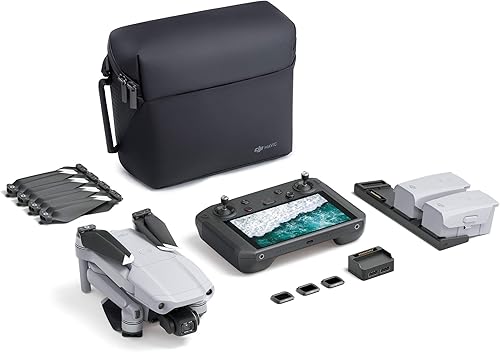
Best for: Beginners who want a highly versatile and stable quadcopter.
The Mavic Air 2 offers a balance of portability and power, featuring a 48MP camera and a 3-axis gimbal. It’s designed to be approachable, with intelligent tracking modes that help beginners capture professional-looking shots without advanced pilot skills. The included Smart Controller makes the flight experience more streamlined.
Strengths:
- 48MP photos with a 1/2-inch sensor.
- 3-axis gimbal for stable 4K video.
- Intelligent tracking modes like ActiveTrack 3.0.
- Three-direction obstacle sensing for safety.
- Includes a comprehensive accessory bundle.
Trade-offs:
- Smaller sensor size compared to Air 3S.
- 34-minute flight time is lower than modern standards.
Week to week, you’ll find it easy to manage the various cables included to keep your flight gear powered. You can stop worrying about tracking subjects, as the Spotlight 2.0 and POI 3.0 modes handle the movement for you.
| Best for | Why |
|---|---|
| New Pilots | Intuitive controls and tracking |
| Casual Photographers | 48MP stills for high detail |
| Versatile Users | Easy-to-use intelligent modes |
6. DJI Mavic 3

Best for: Professional imagers who demand the highest dynamic range.
The DJI Mavic 3 features a 4/3 CMOS Hasselblad camera, making it a professional-grade tool. With 12.8 stops of dynamic range, it’s designed to capture intricate details in both bright highlights and deep shadows. It’s a serious investment for those whose work requires the absolute best image quality available in a portable package.
Strengths:
- 4/3 CMOS Hasselblad camera for professional results.
- 46-minute maximum flight time.
- Omnidirectional obstacle sensing for maximum safety.
- O3 plus transmission for smooth live feeds.
- Advanced RTH for optimized flight paths.
Trade-offs:
- Professional-level gear requires more careful handling.
- Higher complexity for casual hobbyists.
Living with the Mavic 3 means treating it as a precision instrument. You’ll need to clean the Hasselblad lens regularly to ensure that professional sensor is always capturing sharp imagery. You can stop worrying about flight duration, as the 46-minute battery life is among the best for this class of aircraft.
| Best for | Why |
|---|---|
| Professional Cinematographers | 4/3 sensor dynamic range |
| Long-Mission Pilots | Extended flight time capability |
| Safety-Focused Users | Omnidirectional obstacle sensing |
7. Mavic 4 Pro Drone 6K60 HDR
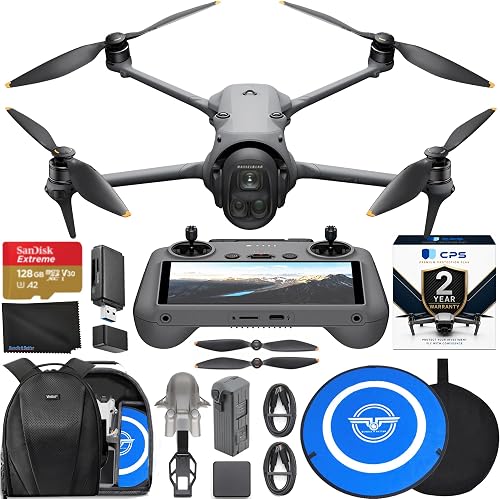
Best for: Pilots needing long-range reach and autonomous tracking.
The Mavic 4 Pro is a high-tech platform with a triple-camera system and ActiveTrack 360. It’s designed to make autonomous decisions, including navigating around obstacles and tracking moving vehicles from long distances. This bundle is comprehensive, providing everything from a memory card to an extended warranty.
Strengths:
- Advanced triple-camera system with 6K60 HDR.
- ActiveTrack 360 for autonomous subject tracking.
- 51-minute maximum flight time.
- O4+ transmission for 18.6-mile range.
- Includes 2-year CPS warranty.
Trade-offs:
- Very high technical complexity for simple flights.
- Large bundle requires significant storage space.
You’ll need to spend time learning the ActiveTrack 360 settings to get the most out of its autonomous features. Regular maintenance involves checking the fisheye sensors for dust to ensure the nighttime obstacle avoidance stays accurate. You’ll stop worrying about signal interference, as the O4+ technology is built to handle congested urban environments.
| Best for | Why |
|---|---|
| Automotive Cinematographers | Long-range vehicle tracking |
| High-Production Teams | 6K HDR and professional optics |
| Long-Range Explorers | Impressive 18.6-mile transmission |
8. Mini 4 Pro Fly More Combo with DJI RC 2

Best for: Pilots who want to avoid the hassle of registration.
The Mini 4 Pro is famous for being under 249 grams, which simplifies travel and legal requirements in many regions. Despite its small size, it doesn’t skimp on features, offering omnidirectional sensing and 4K/60fps HDR video. It’s the ideal choice for someone who wants to keep their gear light without losing professional-level software features.
Strengths:
- Under 249g, often requiring no registration.
- Omnidirectional obstacle sensing for safety.
- 4K/60fps HDR video for clear footage.
- ActiveTrack 360 for complex tracking shots.
- 20km FHD video transmission.
Trade-offs:
- Small frame can be more affected by wind.
- Requires specific batteries for maximum flight time.
You’ll need to ensure you’re using the correct battery type to unlock the full flight time and legal benefits. Week to week, you’ll appreciate how quickly you can pack this drone into a small bag. You can stop worrying about registration paperwork, allowing you to focus purely on finding the best locations for your shots.
| Best for | Why |
|---|---|
| Lightweight Travelers | Under 249g for easy portability |
| Beginners | Compact and easy to fly |
| Social Media Sharers | Vertical video recording mode |
9. DJI Avata 2

Best for: Pilots who want an immersive, first-person flight experience.
The Avata 2 is an FPV (First Person View) drone that puts you in the cockpit. With the included goggles and motion controller, you can perform flips and rolls using simple wrist movements. It’s built for excitement and unique perspectives, featuring built-in propeller guards for added safety during close-range flight.
Strengths:
- Immersive FPV experience with Goggles N3.
- Intuitive motion control via RC Motion 3.
- Built-in propeller guards for safety.
- 4K/60fps HDR video recording.
- RockSteady and HorizonSteady stabilization.
Trade-offs:
- FPV flying has a steeper learning curve.
- Not designed for traditional cinematic landscape photography.
Living with the Avata 2 means practicing your coordination with the motion controller. You can stop worrying about minor bumps, as the built-in propeller guards are specifically designed to protect the drone during creative FPV routes.
| Best for | Why |
|---|---|
| FPV Enthusiasts | Immersive Goggles N3 view |
| Action Filmmakers | Easy ACRO maneuvers and flips |
| Close-Range Pilots | Built-in propeller guards |
10. Neo Drone Fly More Combo with RC-N3 Controller

Best for: First-time drone users and casual content creators.
The DJI Neo is the most approachable drone in the lineup, focusing on simplicity and ease of use. It supports palm takeoff and landing, making it perfect for quick vlogs or social media clips. It’s a compact, friendly machine for those who have never flown a drone before but want to capture high-quality 4K video.
Strengths:
- Ultra-lightweight and compact frame.
- Palm takeoff and landing capabilities.
- Voice command support for hands-free control.
- Automated QuickShots for easy cinematic clips.
- Includes RC-N3 controller for manual flight.
Trade-offs:
- Level 4 wind resistance is lower than larger drones.
- Performance is optimized for casual use, not professional work.
You’ll find that the DJI Neo requires very little setup time, making it great for spontaneous trips. Keep the cleaning kit handy to ensure the lens stays clear for your vlogs. You can stop worrying about complex flight settings, as the automated modes do the heavy lifting for you.
| Best for | Why |
|---|---|
| First-Time Flyers | Extremely easy to operate |
| Vloggers | Quick and simple content creation |
| Casual Travel | Small size fits anywhere |
Side by Side
The following table provides a clear comparison of the key specifications and features for each drone discussed, helping you quickly identify which model aligns best with your specific needs for flight time, camera capability, and ease of use.
How to judge the best mid size DJI drone
Sensor Size and Quality
The sensor is the heart of your drone’s camera. A larger sensor, like the high-end CMOS found in many of these models, captures more light and detail. This is critical for dawn, dusk, or night flying. If you only plan to fly during bright midday hours, a smaller sensor might suffice, but for sunsets and nightscapes, the larger sensor is the difference between a grainy image and one that looks sharp. Before buying, check the sensor size listed in the specifications. If the listing doesn’t mention the sensor size, assume it’s a smaller unit meant for daylight use.
Obstacle Sensing Tech
Safety features have evolved from simple forward-facing sensors to omnidirectional sensing and LiDAR. Omnidirectional sensing means the drone can “see” in almost every direction, which is a massive help for beginners or when flying in complex environments like forests or around buildings. LiDAR adds an extra layer of precision for low-light scenarios. If you’re a beginner, prioritize models with omnidirectional sensing. You can verify this by checking the obstacle sensing section of the listing, which will specify the number of directions the drone can monitor.
Flight Time and Transmission
Flight time is the most practical limit on your creativity. A 45-minute flight time, as seen in the latest models, allows you to scout, frame, and capture multiple takes without landing. Paired with high-quality video transmission, like the DJI O4 system, you can fly further away while maintaining a smooth, clear feed on your screen. You can find official guidance on operating your drone safely and within legal limits through the Federal Aviation Administration. Always check your local laws, as these vary by region. Before you order, confirm the transmission range and battery life to ensure they match your typical project needs.
Closing
For most users, the DJI Air 3S Fly More is the best overall choice, offering a perfect balance of sensor quality, flight time, and advanced sensing for almost any project. If you’re a beginner who wants a simple, portable machine for social media, the DJI Neo is the ideal pick for its ease of use. To get started, review your primary shooting environment and select the model that fits your most frequent flight conditions.
Related guides