
As an Amazon Associate, we earn from qualifying purchases. This post contains affiliate links – if you buy through them, we may earn a commission at no extra cost to you.
Choosing the best rated drone with a camera comes down to flight weight, sensor size, and flight control. Some models pack large 1-inch sensors and obstacle sensors into tiny folding bodies, while other quadcopters trade advanced gimbals for simple controller-free tracking.
Best overall: DJI Mini 5 Pro gives creators a large 1-inch sensor, omnidirectional night obstacle sensing, and up to 52 minutes of flight per battery.
Best for active sports: HOVERAir X1 flies completely hands-free with enclosed safety guards and automatic tracking modes that follow you at speeds up to 15 mph.
Best simple setup: GPS 4K Drone features a built-in 4.5-inch screen on the remote, letting you fly right away without connecting your phone.
The rest of this guide covers options for all kinds of pilots, whether you need maximum flight time, lightweight travel gear, or dual cameras.
How We Picked
To find the top choices, we compared 48 retail listings to see what each quadcopter delivers out of the box. Every model on this list had to state its camera resolution, battery run time, motor type, and included package contents clearly. We set aside listings with incomplete flight specs, unbranded camera parts, or missing safety details.
1. DJI Mini 5 Pro Fly More Combo Plus with DJI

Best for: Creators who need top image quality.
This folding aircraft packs a 1-inch CMOS sensor that captures 4K/60fps HDR video, offering sharp details and rich colors. The camera gimbal rotates 225 degrees and supports true vertical filming, which makes posting native video to social apps simple. With forward-facing LiDAR and vision sensors, the omnidirectional system can detect obstacles during night flights and automatic returns.
Flight time reaches up to 52 minutes with each Intelligent Flight Battery Plus, and the Fly More Combo provides three batteries alongside an RC 2 screen remote. The DJI Mini 5 Pro features 42GB of internal storage. However, buyers should know the DJI Fly app isn’t on Google Play, requiring Android users to download it manually from the brand’s website. This advanced setup isn’t for casual buyers who just want a basic toy drone.
Pros
- Large 1-inch CMOS sensor
- 52-minute maximum flight time
- 225-degree rotating vertical gimbal
Cons
- App requires external Android download
- Long 193-minute three-battery charge
2. DJI Air 3S Drone with RC 2 Fly More Combo
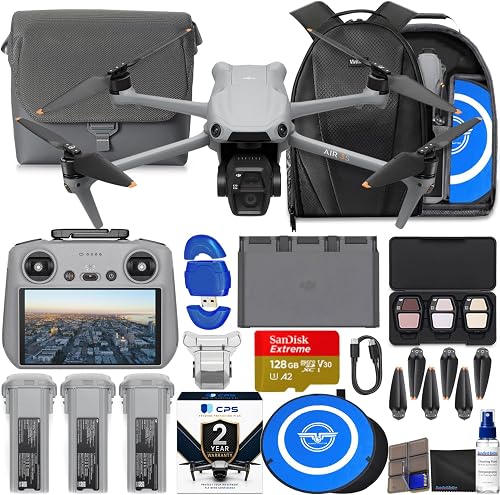
Best for: Serious pilots wanting dual lenses.
The dual-camera system gives you a large-format wide-angle lens and a 70mm medium telephoto lens, letting you shoot sweeping landscapes or tight vehicle portraits. Both cameras capture 4K/60fps HDR footage and support 48MP photos for detailed cropping. Its O4 transmission system uses six antennas to keep a clear 1080p live feed running at distances up to 20 kilometers.
Safety features include omnidirectional obstacle sensing, a night LiDAR sensor, and a Non-GPS return mode that remembers the flight path if satellite reception drops. The listing doesn’t mention a backpack or ND filters in the Air 3S bundle. Because of its larger footprint and dual lenses, this package isn’t suitable for hikers who need a pocket-sized, ultralight flyer.
Pros
- Dual focal-length camera system
- Stable 20-kilometer video transmission
- Forward LiDAR obstacle sensing
Cons
- Heavy bundle with large backpack
- Needs external app download
3. DJI Mini 4K

Best for: Beginners wanting an easy start.
Weighing under 249 grams, this small flyer lets recreational pilots take off without FAA registration or Remote ID setup. The 3-axis mechanical gimbal stabilizes a 4K camera to record clean sunrises, sunsets, and midday scenes. Brushless motors keep the aircraft steady against Level 5 winds reaching up to 38 kilometers per hour.
Its remote uses your smartphone screen, while the built-in QuickShots feature automates flight paths like Helix, Rocket, and Boomerang with a single tap. A single battery provides up to 31 minutes in the air, giving novices plenty of time to learn basic controls. Because it lacks obstacle detection sensors, this drone isn’t made for people who want automated collision avoidance in tight, wooded areas.
Pros
- Weighs under 249 grams
- Level 5 wind resistance
- Stable 3-axis mechanical gimbal
Cons
- Only one battery included
- Lacks directional obstacle sensing
4. HOVERAir X1 Drone with Camera

Best for: Solo vloggers and outdoor action.
This compact camera drone operates without a remote controller, taking off straight from your palm in seconds. Advanced tracking algorithms keep you centered in the frame at speeds up to 15 mph, making it a great tool for cycling and skateboarding. Fully enclosed cages surround the propellers, guarding fingers and nearby objects against accidental bumps.
It captures 2.7K video and 1080p HDR footage using a triple stabilization system to smooth out fast motion. With 32GB of internal memory, you don’t have to carry extra memory cards, and files download quickly via the mobile app. Each battery runs for roughly 11 minutes or about 20 automatic flight paths. It isn’t designed for users wanting long-distance landscape photography or high-altitude flights.
Pros
- Fully enclosed protective cages
- Fast 15 mph tracking
- Built-in 32GB internal storage
Cons
- Short 11-minute battery life
- Camera maxes out at 2.7K
5. DJI Neo

Best for: Ultra-portable everyday video clips.
Weighing only 135 grams, the pocket-sized craft can launch from your hand and land back on your palm at the push of a button. It shoots stabilized 4K ultra-high-definition video while using subject tracking to follow you along trails or city sidewalks. The lightweight body includes built-in propeller guards, which protect the blades if you brush against branches or indoor walls.
You can steer it controller-free, use voice commands in English or Chinese, or fly it using a phone or dedicated remote. Level-4 wind resistance helps it maintain position in mild breezes, while eight QuickShots modes handle creative aerial angles automatically. The standard package comes with a single battery and no remote. It isn’t meant for pilots who need to fly in heavy winds or across long distances.
Pros
- Ultra-lightweight 135-gram frame
- Convenient palm takeoff and landing
- Full-coverage protective guards
Cons
- Single battery in box
- Controller sold separately
6. Holy Stone GPS Drone with 4K UHD Camera

Best for: New pilots wanting GPS control.
This folding quadcopter stays below the 250-gram limit, removing the need for recreational FAA registration. A 1/3-inch GalaxyCore sensor shoots 4K photos and video, while the remote allows you to adjust the 85-degree wide lens across a 90-degree tilt. The modular battery offers up to 20 minutes of airtime per charge.
The remote controller plugs straight into your smartphone with a single data cable, which delivers a live camera stream up to 10,000 feet without needing a Wi-Fi connection. Built-in GPS enables automatic return-to-home if the signal drops or the battery runs low. Because the camera uses a single-axis tilt rather than a 3-axis mechanical gimbal, it isn’t suited for pilots who need pro-grade camera stability in gusty winds.
Pros
- Direct cable connection to phone
- 10,000-foot control range
- Automatic GPS return home
Cons
- 20-minute flight per battery
- Single battery in standard box
7. Potensic ATOM 2 Drone with Camera

Best for: High-resolution outdoor aerial photography.
A 1/2-inch Sony CMOS sensor captures 48MP photos and 4K/30fps HDR video, backed by a fast F1.8 aperture for dim lighting. The camera sits inside a 3-axis motorized gimbal that keeps horizons level during rapid maneuvers. Its PixSync 4.0 transmission system sends a 1080p live stream up to 10 kilometers away while fighting off radio interference.
The Fly More Combo includes a multi-battery kit, giving you up to 96 minutes of combined flying time. Its bundled charging hub replenishes the full set of power packs simultaneously in about 1.3 hours, reducing your wait between trips. The airframe weighs under 249 grams, skipping registration rules. Lacking full obstacle sensors, it isn’t built for pilots who want automatic collision protection around trees.
Pros
- Detailed 48MP Sony sensor
- 3-battery charging hub included
- Up to 10-kilometer transmission
Cons
- No directional obstacle avoidance
- App setup required before flying
8. Bwine F7GB2 Pro Drones with Camera

Best for: Flying in challenging wind conditions.
Built with 1806 brushless motors, this heavier drone carries a Level 6 wind resistance rating to handle high-altitude breezes up to 2,000 meters. Its 4K camera detaches with a single click, features a 120-degree field of view, and rests on a 3-axis mechanical gimbal with 5x digital zoom. The included power supply provides a total flight time of 75 minutes.
The aircraft meets FAA Remote ID requirements, featuring a physical compliance code and QR sticker on the arm. Built-in GPS delivers automatic return modes alongside custom route mapping and follow-me tracking. However, because it’s heavier than 249 grams, pilots must follow FAA registration rules before flying outdoors. It isn’t suitable for travelers wanting a sub-249g pocket drone.
Pros
- Strong Level 6 wind resistance
- 3-axis mechanical camera gimbal
- Three batteries and case included
Cons
- Requires FAA recreational registration
- Bulkier frame than mini drones
9. GPS Drone with 4K Camera

Best for: Pilots avoiding smartphone screen apps.
This folding quadcopter includes a remote controller with a built-in 4.5-inch high-definition screen. You don’t need to download an app, pair a phone, or worry about incoming calls interrupting your live camera view.
The 4K camera tilts 90 degrees and works with an optical flow sensor for indoor hovering, switching to GPS mode for reliable outdoor flights. Weighing under 249 grams, the airframe stays exempt from standard recreational FAA registration. The GPS 4K Drone includes a 4GB SD card. Since the screen is permanently built into the transmitter, you can’t upgrade to a larger tablet view.
Pros
- Dedicated 4.5-inch controller screen
- Weighs under 249 grams
- Includes two flight batteries
Cons
- Small 4GB memory card
- Camera tilts on single axis
10. Ruko Drone with Camera

Best for: Long shooting sessions away from power.
Carrying three modular batteries, this package delivers up to 96 minutes of total flying time, with each pack running for roughly 32 minutes. A 1/2-inch 48MP CMOS sensor takes 8K still photos and records 4K video at 30 frames per second. Electronic image stabilization teams up with a 3-axis brushless gimbal to steady footage during turns.
Quadruple positioning sensors—GPS, time-of-flight, optical flow, and a barometer—keep the aircraft locked in place while hovering. The R2 transmission system sends video up to 20,000 feet away, and the sub-249g weight avoids FAA registration steps. The included hard carrying case holds the drone and all accessories neatly. Without active obstacle sensors, it isn’t suited for flying close to tree branches or through narrow indoor spaces.
Pros
- 96 minutes across three batteries
- 3-axis gimbal with EIS
- Long 20,000-foot control range
Cons
- Lacks automated obstacle sensors
- App required for camera features
How to Choose the Best Rated Camera Drone
Does the sub-249-gram weight limit matter for your flying?
Choosing a craft that is ultra-light saves you from standard paperwork if you fly purely for fun. The Federal Aviation Administration drone registration rules require recreation pilots to register any aircraft weighing above the micro-drone threshold before outdoor flight. Drones like the DJI Mini 4K and Potensic ATOM 2 slip below this threshold, letting you fly without extra fees or Remote ID hardware. However, heavier quadcopters like the Bwine F7GB2 Pro handle stiff breezes better, trading simple registration freedom for stronger wind resistance.
What camera mount provides the smoothest video?
A 3-axis mechanical gimbal is essential if you want cinematic, level footage. While basic electronic image stabilization crops into the sensor to reduce shakes, a motorized 3-axis gimbal physically counteracts tilt, roll, and pan motions. If you fly in breezy areas, drones with single-axis motorized cameras will often show visible shaking in the recorded video. For professional clips, prioritize models with 3-axis hardware like the DJI Mini 5 Pro or Ruko 4K Drone, while palm-sized follow drones work fine with electronic stabilization.
Do you need directional obstacle sensors on your drone?
Obstacle avoidance sensors prevent crashes, but they aren’t included on every model. Systems with forward-facing LiDAR or omnidirectional vision can stop the aircraft before it hits walls, branches, or fences, which helps during automated return-to-home paths. If you plan to fly in open fields, you can safely skip these sensors to keep things simple.
DJI Mini 5 Pro remains the top recommendation for its balanced size, high-performance camera sensor, and night obstacle sensing. If you need dual focal lengths for creative telephoto framing, DJI Air 3S is the next best pick. Before ordering your new aircraft, check what accessories come inside the package so you have extra batteries, a proper charging hub, and the right mobile cable ready for your first afternoon of flying.
Frequently Asked Questions
What kind of smartphone or device do I need to fly?
Most camera drones require a smartphone for live video and telemetry, typically running Android 10 or iOS 12 or higher. However, some models like the GPS 4K Drone and DJI Mini 5 Pro Fly More Combo include built-in displays on their transmitters. Always verify your device’s operating system compatibility before opening your package.
What maintenance does a camera drone require after flying?
Routine care involves inspecting propellers for nicks or warping and storing lithium batteries at partial charge. Check rotor blades regularly, as bent edges reduce stability and increase power consumption. Keep sand and moisture away from brushless motors and gimbal bearings, and clean the camera lens only with dedicated microfiber cloths.
What part usually breaks or wears out first?
Propeller blades are the most frequently replaced part because even minor contact with obstacles can chip the plastic and cause motor vibration. Many kits include spare blades and screws to address this common wear. Beyond the blades, handle the gimbal ribbon cables and motorized joints carefully, as hard impacts can damage the camera mechanism.
Is an entry-level drone good enough for vacation travel?
A simple beginner quadcopter is sufficient for capturing vacation views, family gatherings, and scenic landscapes. Models like the DJI Mini 4K offer stabilized 4K video, GPS return functions, and a sub-249g weight that avoids registration in many areas. You only need larger gear if you require optical zoom, omnidirectional sensors, or advanced color profiles.
Also Worth Considering
The DJI Mini 3 features a 3-axis mechanical gimbal and a lightweight folding body, serving as a solid option for smooth aerial video. Finally, the Skyrover S1 Mini Drone Camera records 4K/60fps video and captures 48MP photos for pilots who want high-resolution captures in a compact frame.