
Finding the right drone requires balancing portability, flight time, and stable footage, as seen in our Potensic Atom review. Every pick is evaluated on its specific strengths, trade-offs, and daily usability. We focus on camera technology, stabilization methods, and controller features to help you choose the best model for your needs.
As an Amazon Associate, we earn from qualifying purchases. This post contains affiliate links – if you buy through them, we may earn a commission at no extra cost to you.
1. Potensic Atom 3

Best for: Creators needing professional-grade video and long flight endurance.
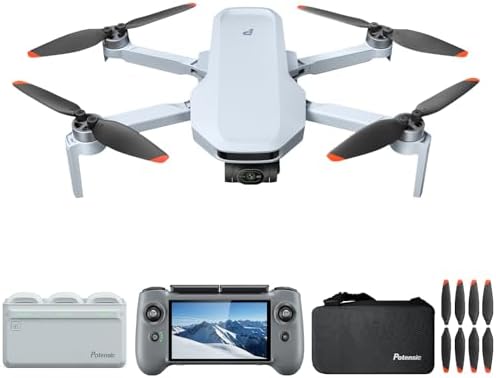
The Potensic Atom 3 features a 1/1.3” CMOS sensor capable of 4K 60fps HDR video. It includes a PTD 2 remote controller with a built-in 5.5-inch touchscreen that stays bright in daylight. The system supports a 16km transmission range and a 150-minute total flight time using the three included batteries.
Strengths:
- Large 1/1.3-inch CMOS sensor for clear details.
- PTD 2 remote with integrated high-brightness display.
- Impressive 16km Tri-band transmission range.
- 150-minute total flight time with three batteries.
- P-Log mode for professional color grading options.
Trade-offs:
- Propeller guards required for low-altitude AI tracking.
- Heavier battery management for 150-minute sessions.
The parallel charging hub simplifies your workflow by charging all three batteries in about 130 minutes. This ensures you have a consistent power supply for long shooting days in the field. You will also benefit from the Tri-band transmission, which provides a reliable signal for extended flight sessions.
| Best for | Why |
|---|---|
| Road trippers | Long flight time per charge |
| Professional editors | P-Log raw footage capture |
| Sunny day shooters | High brightness integrated display |
2. ATOM 2 Drones with Camera for Adults 4K

Best for: Advanced users who want precise control over light.
The Potensic Atom 2 is designed for those who want cinematic control, provided by its multi-directional stabilization and 1/2-inch Sony CMOS sensor. It comes with ND and CPL filters to manage exposure and reflections, which helps in varying lighting conditions. The drone supports 4K HDR video and 8K photos, balanced by a 10km transmission range.
Strengths:
- Includes both ND and CPL lens filters.
- 3-axis gimbal for stable 4K HDR video.
- 1/2-inch Sony CMOS sensor for low light.
- 10km transmission with PixSync 4.0 technology.
- Fast charging hub for three batteries.
Trade-offs:
- Requires manual filter changes for specific light.
- Limited to 96 minutes total flight time.
Owning this drone requires keeping track of the small ND and CPL filters, as they’re essential for achieving the cinematic look the listing promises. You’ll spend your weekends swapping these filters depending on the sun, but the improved image saturation and exposure control reward the effort. The fast charging hub keeps you ready to fly with a full set of batteries in just over an hour.
| Best for | Why |
|---|---|
| Cinematic filmmakers | Included ND/CPL filter kit |
| Low-light shooters | Large F1.8 aperture sensor |
| Social media creators | Quick 25 MB/s file transfer |
3. ATOM SE GPS Drone with 4K EIS Camera

Best for: Travelers who need a lightweight, wind-resistant drone.
The Potensic Atom SE focuses on portability and durability, using a brushless motor to maintain stability in level-5 wind conditions. It features a 1/3-inch Sony CMOS sensor that records 4K video at 30fps. The drone is foldable, fitting easily into a jacket pocket for spontaneous travel. Because it weighs less than 249g, you don’t need to worry about FAA or Remote ID registration.
Strengths:
- Brushless motor handles level-5 wind conditions.
- Foldable design fits in a jacket pocket.
- 62 minutes of flight total with two 2500mAh batteries.
- PixSync 2.0 ensures stable 4km transmission.
- Beginner Mode simplifies the early learning curve.
Trade-offs:
- EIS stabilization instead of a mechanical gimbal.
Living with the Atom SE is straightforward because it’s designed for speed and convenience. In Sport Mode, the drone reaches its max speed of 16m/s in just 2.8 seconds. You’ll appreciate the foldable frame when hiking, as it adds almost no bulk to your gear. While it uses ShakeVanish EIS for stabilization rather than a mechanical gimbal, it’s ideal for beginners who want a reliable, wind-resistant machine that gets into the air in seconds.
If you’re flying in low power or lose signal, the GPS system triggers an auto-return to your take-off point. Always check that your smartphone runs at least iOS 11 or Android 7.0 to ensure compatibility with the remote. Remember that the micro SD card isn’t included, and you must insert one before updating camera firmware.
| Best for | Why |
|---|---|
| Hikers | Extremely compact, foldable design |
| Windy locations | Sturdy level-5 wind resistance |
| Beginners | Simple, intuitive flight control system |
4. ATOM LT GPS Drone Under 249g

Best for: Entry-level pilots starting their first drone journey.
The Potensic Atom LT is an entry-level GPS drone that offers an 80-minute flight time using a multi-battery kit. It features a 2.5K camera with ShakeVanish 2.0 stabilization and a 118-degree field of view. The drone is built for beginners, emphasizing easy GPS-based flight modes and simple controls.
Strengths:
- Long 80-minute flight time with a multi-battery pack.
- Lightweight, under 249g for no registration.
- ShakeVanish 2.0 stabilization for smooth footage.
- Dedicated remote with 4km transmission range.
- Four GNSS systems for high-accuracy positioning.
Trade-offs:
- 2.5K camera resolution is lower than 4K.
- GPS mode is required for all flights.
You’ll find this drone very easy to manage, but you must remember to start your flights in open, outdoor areas because it relies entirely on GPS. It’s a great practice tool for learning how to cruise over longer distances without the pressure of complex settings. The SurgeFly 2.0 system provides flight control.
| Best for | Why |
|---|---|
| New pilots | Simple, forgiving flight modes |
| Distance practice | Extended flight time per battery |
| Budget-conscious users | High-accuracy GPS features |
5. ATOM 3-Axis Gimbal 4K GPS Drone

Best for: Those wanting mechanical gimbal stability in a small frame.
The Potensic Atom combines a brushless motorized gimbal with a 4K camera in a very compact, foldable body. It offers a 6km transmission range and includes visual tracking features like Rocket and Boomerang. It’s a balanced option for those who prioritize steady footage above all else.
Strengths:
- 3-axis mechanical gimbal for rock-steady footage.
- 6km transmission range with PixSync 3.0.
- Visual tracking for automated cinematic shots.
- Foldable, compact design under 249g.
- Easy auto-return features for safe landings.
Trade-offs:
- Single battery included in the standard kit.
- 32-minute flight time is shorter than bundles.
Living with this drone is about simplicity and high-quality stabilization. The motorized stabilization ensures smooth footage in level-5 windy conditions. You’ll have to manage your flight time more carefully than with the multi-battery combos, but the ease of the QuickShots makes it simple to produce professional-looking videos with just a few taps.
| Best for | Why |
|---|---|
| Video quality seekers | Mechanical 3-axis gimbal stability |
| Solo creators | Automated visual tracking modes |
| Compact travelers | Small, lightweight, foldable frame |
Side by Side
The table below compares the core technical specifications and flight capabilities of these models to help you identify which drone aligns best with your specific requirements for range, camera performance, and battery life.


How to Judge One of These
Camera Sensor Size
The sensor size is the most important factor for image quality. A larger sensor, like the 1/1.3-inch CMOS found in top-tier models, captures more light and detail than smaller sensors. This directly changes how your footage looks in low-light environments, such as during sunset or in shaded areas. When comparing models, look for the sensor dimensions in the specifications. A larger sensor will generally provide better dynamic range and less noise in your videos. You can confirm the sensor size by checking the manufacturer’s official product specification page before you buy. The listing doesn’t mention entry-level cameras or performance in challenging lighting.
Mechanical Gimbal vs. EIS
A 3-axis mechanical gimbal is a set of motors that physically levels the camera, while Electronic Image Stabilization (EIS) uses software to crop and steady your video. A mechanical gimbal is far superior for smooth, cinematic movement because it handles tilt and roll adjustments in real-time. EIS is lighter and more compact, which is why it appears in entry-level models, but it cannot match the fluid motion of a mechanical system.
Flight Time and Batteries
Battery life is a common point of confusion. Total flight time is often marketed as the sum of all batteries in a “Fly More” kit, not the time of a single battery. For a true sense of how long you can fly, divide the total time by the number of batteries provided. This helps you understand how often you’ll need to land and swap packs. Beginners often underestimate the time required to land, recover, and swap a battery, so choosing a model with a fast-charging hub is a major advantage. You can verify the individual battery capacity in the product data to see if it suits your typical session length.
Frequently Asked Questions
Does the drone require FAA registration?
None of these drones require FAA or Remote ID registration because they all weigh under 249 grams. This weight threshold is the standard set by aviation authorities for recreational drones in many regions. You must still follow local flight rules, such as staying away from airports and respecting privacy.
What is the first week with a new drone like?
Spend your first week practicing flight controls and auto-takeoff in a wide-open space to build confidence. Most models include a Beginner Mode that limits speed and distance to help you adjust to stick sensitivity. Always update your firmware via the app before attempting complex shots.
What has to be renewed or replaced?
You should keep spare propellers in your bag because they are the most common parts to chip or bend. Damaged propellers cause the drone to fly unsteadily or vibrate during operation. Monitor your batteries for physical swelling or reduced flight times after a year or two of regular use.
What will these drones not do?
These drones are designed for stable, cinematic aerial photography rather than high-speed racing or extreme maneuvers. They prioritize GPS stability and image quality over the agility required for stunt flying. Stick to open, clear environments to ensure the best performance from your transmission and GPS systems.
Is the simplest pick here enough?
Entry-level models are ideal for learning the basics of flight and capturing clear aerial photos for fun. They provide the same GPS stability as advanced drones, though they feature smaller camera sensors and fewer creative modes. These models are perfect for beginners who do not require professional-grade low-light performance.
Conclusion
Choosing this drone makes capturing your favorite landscapes feel effortless and fun. It’s a reliable companion for your upcoming travels, so don’t hesitate to take it out for a test flight this weekend. You’ll quickly see how much it adds to your creative projects once you’re comfortable in the air.