
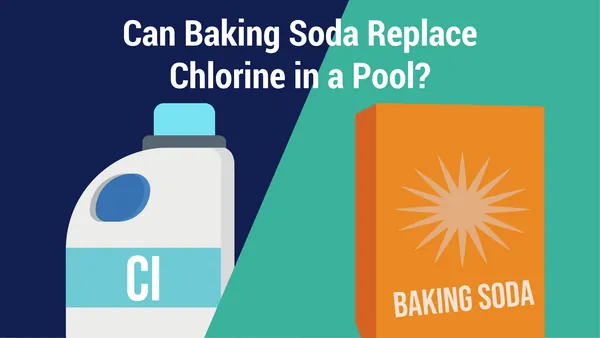
No, adding baking soda won’t lower chlorine level in pool water. The idea that baking soda lowers chlorine is a myth you’ll see repeated on forums, but sodium bicarbonate has no chemical ability to destroy or neutralize free chlorine. It only raises total alkalinity and slightly lifts pH.
Three things actually change how fast your pool loses its chlorine: sunlight breaking it down, the water’s current pH shifting how well that chlorine sanitizes, and the amount of organic waste swimmers leave behind. The rest of this page covers exactly what each one does to your readings.
Who needs baking soda for their pool
Someone with cloudy water and a low alkalinity test result types this question because they’ve heard baking soda clears things up. They already own test strips, know their pool’s rough gallon count, and need to fix a specific number before the weekend swim. They don’t want a chemistry lecture; they want to know if the white powder in their kitchen fixes their green water.
A second reader just shocked their pool heavily and now smells bleach near the skimmer. They’re looking for a fast way to bring that harsh reading down so their kids can swim safely today. They have high chlorine, normal alkalinity, and zero interest in raising any other number on their test kit.
A third person read an old forum post claiming baking soda “eats” chlorine over time. They’re trying to balance a saltwater system or a tablet-fed pool without buying branded chemicals from the supply store. They have basic testing tools but mix up alkalinity with sanitizer strength.
This page serves the first reader—the one who actually needs baking soda to fix low alkalinity while keeping their sanitizer intact. If you’re the second reader trying to drop a dangerously high chlorine reading quickly, baking soda won’t help you at all.
You need sodium thiosulfate, sold specifically as a chlorine neutralizer, or you simply wait for the sun to do its work. The steps below assume you’re correcting low total alkalinity in a standard residential pool using a liquid test kit or reliable strips, not fighting a sanitizer overdose.
What changes your chlorine reading
Your starting pH matters more than anything else here. Chlorine works best when pH stays between 7.2 and 7.8, according to the CDC’s pool operation guidance. Below 7.2, it burns off faster; above 7.8, it stops killing bacteria effectively even if your test strip shows a high number. Baking soda pushes pH toward the top of that safe window.
Total alkalinity acts as a buffer for your pH. If it sits below 80 parts per million, your pH bounces wildly every time someone swims or rain falls in. That bouncing makes your chlorine disappear unevenly. Raising alkalinity with baking soda stabilizes the pH, which indirectly keeps your chlorine where you put it instead of letting it spike and crash.
Cyanuric acid, often called stabilizer, blocks ultraviolet light from destroying free chlorine. Without it, an outdoor pool loses most of its sanitizer in a few hours of direct sun. Baking soda doesn’t touch cyanuric acid levels. If your stabilizer is too low, no amount of alkalinity adjustment saves your chlorine from the afternoon sun.
Water temperature speeds up chemical reactions. A pool sitting at 90°F burns through chlorine much faster than one resting at 75°F. Baking soda dissolves quicker in warm water, but it still doesn’t alter the rate at which heat consumes your sanitizer.
The mistake people make here is confusing total alkalinity with free chlorine. They see a low number on one side of the test strip, dump in baking soda, and expect the other side to change. Alkalinity and sanitizer are separate measurements.
Fixing one never automatically fixes the other. Your actual free chlorine level depends entirely on your pump run time, stabilizer level, and swimmer load—read those numbers directly off your test kit’s color chart under natural light to know where you stand.
How to add baking soda to pool water
These steps assume you’re raising total alkalinity in a standard 10,000-gallon residential pool using a pump running on its normal filter cycle. For a larger pool, scale the amounts up proportionally; for a smaller one, cut them in half.
- Test your water with a liquid kit or fresh strips. Write down the exact total alkalinity and pH readings before opening any bags.
- Calculate the dose. Add 1.5 pounds of baking soda per 10,000 gallons of water to raise total alkalinity by roughly 10 parts per million. Don’t guess your pool’s volume—check the manufacturer’s spec sheet or use a tape measure on the length, width, and average depth.
- Turn on your pool pump. Leave it running on the standard circulation setting so the water moves while you work.
- Walk around the perimeter of the deep end. Sprinkle the measured baking soda evenly across the surface in a wide arc. Never dump the whole bag into the skimmer basket at once; it clumps and blocks the flow.
- Let the pump run for at least six full hours. This gives the powder enough time to dissolve completely and mix through the entire plumbing loop.
- Retest the water the next morning. Check both total alkalinity and pH again. If alkalinity is still below 80 parts per million, repeat the process with another calculated dose.
- Stop adding powder once total alkalinity hits the 80 to 120 range. Going higher pushes your pH past 7.8, which clouds the water and scales the tile line.
The single judgment call that separates a balanced pool from a cloudy mess is knowing when to stop. If your alkalinity reaches 100 parts per million but your pH creeps to 7.9, don’t add more baking soda just because the target says 120. Leave it alone. Adjusting pH downward requires muriatic acid or dry acid, which is a separate chemical handling task—if you aren’t comfortable measuring and pouring pool-grade acids safely, hire a licensed pool service technician to do it.
Situations that change the dose
Different pool conditions require different approaches to keep your water clear and balanced. Here is how the main variables shift what you should do.
| Situation | Action needed | Time or effort | Warning sign |
|---|---|---|---|
| Heavy rain flooded pool | Retest alkalinity fully | Ten minutes testing | Cloudy water returns |
| Saltwater generator cell scaling | Lower pH first | One hour labor | White crust on plates |
| Fresh plaster finish curing | Add small daily doses | Five minutes daily | pH climbs past eight |
| High bather load weekends | Shock after swimming | Thirty minutes mixing | Combined chlorine rises |
| Winter closing preparation | Balance then cover | Two hours total | Algae blooms under tarp |
| Vinyl liner wrinkling | Check alkalinity immediately | Five minutes testing | Liner feels loose |
Rain dilutes everything in your pool, dropping alkalinity fast. A saltwater system constantly drives pH upward, requiring regular acid additions to keep it within the proper range and prevent scaling on the generator cell. Fresh plaster constantly leaches calcium hydroxide, pushing pH up, so you must add acid in small doses rather than large dumps.
Weekends with heavy swimming introduce sweat and oils that eat chlorine, requiring a shock treatment afterward regardless of your alkalinity level. Closing a pool for winter demands perfect balance before the cover goes on, or you open it to green water in spring. Vinyl liners wrinkle when the water chemistry shifts drastically, signaling an immediate need to test.
Details that keep pool water balanced
Testing before you pour anything
Test your water at elbow depth, away from the return jets. Surface water gets diluted by rain and splashed out by swimmers, giving you a falsely low reading. Water straight from the return jet carries concentrated chemicals that haven’t mixed yet, giving you a falsely high one. Pull your sample from the middle of the pool where people actually swim.
Use a liquid drop test kit instead of paper strips when adjusting chemistry. Strips fade in the bottle and give you a color range spanning twenty parts per million. Liquid reagents show a sharp color change at a specific number. That precision stops you from adding three pounds of powder when you only needed one.
What to leave alone
Don’t chase a perfect number on your test kit. Total alkalinity anywhere between 80 and 120 parts per million works fine for a standard chlorine pool. Trying to hold it exactly at 100 means you’re adding chemicals every single day, which destabilizes the water rather than fixing it.
Leave your free chlorine alone while you adjust alkalinity. Baking soda doesn’t destroy chlorine, but dumping large amounts of any powder stirs up sediment from the floor. That stirred-up debris temporarily increases chlorine demand.
Wait until the water clears and the pump finishes its cycle before you judge whether your sanitizer level dropped. If you add baking soda and shock the pool on the same afternoon, you won’t know which chemical caused the reaction you see tomorrow. Keep adjustments separated by at least twelve hours.
When your pool turns cloudy
Every symptom in your water points back to a specific imbalance you can trace. Match what you see to the right fix instead of guessing.
| What you notice | What it usually means | What to do first | How to stop it happening again |
|---|---|---|---|
| Milky white water | Alkalinity far too high | Stop adding baking soda | Test weekly with drops |
| Green tint appears | Free chlorine dropped low | Shock the pool immediately | Run pump longer daily |
| Scale on tiles | pH pushed past eight | Add muriatic acid carefully | Keep alkalinity under 120 |
| Eye irritation while swimming | Combined chlorine built up | Shock to break chloramines | Ask swimmers to shower |
| Powder settles on bottom | Pump turned off early | Brush floor and restart | Run pump six hours minimum |
| Test strip colors bleed | Strips expired or wet | Buy fresh sealed strips | Store bottle indoors tightly |
Milky water happens when you overshoot the alkalinity target. The resulting high pH forces dissolved calcium to precipitate out of solution as fine particles that catch the light. Green water isn’t an alkalinity problem—it’s a sanitizer failure that needs immediate shocking. Tile scale forms when high alkalinity drags your pH upward, forcing calcium out of solution.
Eye irritation comes from chloramines, which form when chlorine reacts with sweat, urine, and other nitrogen-containing contaminants introduced by swimmers. Settled powder means you killed the pump before the water finished moving. Bleeding test strips are ruined by humidity—keep the cap tight.
Rules for pool chemical safety
Baking soda sold for baking is food-grade sodium bicarbonate, but pool supply stores sell the exact same compound in bulk bags labeled for water treatment. Both work identically. There’s no legal requirement to buy the branded pool version, though the bulk bags are cheaper per pound.
Handling pool chemicals falls under general consumer safety rules. The U.S. Consumer Product Safety Commission warns against mixing different pool chemicals together in a bucket before adding them to water. Always add chemicals directly to the pool water separately.
Storage matters. Keep baking soda dry. Moisture causes it to clump into hard bricks that won’t dissolve properly when thrown into the skimmer. Store it in a sealed plastic bin off the concrete floor of your garage, where condensation gathers overnight.
If your pool uses a commercial automated chemical controller, check the manufacturer’s manual before manually dumping powder into the water. Automated systems read sensors continuously; a sudden manual spike in alkalinity can confuse the dosing pumps and cause them to over-correct with acid. For public or commercial pools, local health departments set strict limits on chemical ranges, and operators must log every addition. Residential pools follow no such reporting rule, but the physical chemistry remains identical.
What balancing your water costs
The cost of fixing low alkalinity depends entirely on your pool’s volume and how far the number has dropped. Pool-grade sodium bicarbonate is inexpensive relative to hiring a professional service to handle the adjustment for you. You can check current availability at your local supplier or on their official website.
For a 10,000-gallon pool needing a 20-part-per-million increase, you’ll use about 3 pounds of powder. That single adjustment is inexpensive relative to buying small boxes from the grocery baking aisle, which costs significantly more per ounce.
The hidden cost is time and electricity. Running your pump for six extra hours to dissolve the powder adds to your monthly electric bill. If your pump draws 1,500 watts, six hours of runtime uses 9 kilowatt-hours. Multiply that by your local utility rate to find the real expense.
Testing supplies cost money too. A quality liquid drop test kit lasts an entire season and prevents you from wasting chemicals on wrong guesses. Cheap paper strips seem free until they give you a bad reading that forces you to drain and refill part of the pool. Water replacement carries its own bill from the municipal meter. Spending more upfront on accurate testing always costs less than replacing thousands of gallons later.
Keeping the balance after you finish
Once your total alkalinity sits between 80 and 120 parts per million, your job shifts from fixing to watching. Baking soda doesn’t evaporate like chlorine does. It stays dissolved until something physically removes the water—backwashing your sand filter, heavy rain overflowing the deck, or swimmers splashing it out onto the concrete.
Test your water once a week during summer. In cooler months when the pool sits covered and unused, testing once every two weeks is enough. Write the numbers down in a logbook or a phone note. A single reading tells you nothing; a month of readings shows you the trend.
If your alkalinity starts creeping back down toward 70, add a half-dose of baking soda rather than waiting for it to hit 50. Small corrections keep the pH stable. Large corrections shock the system and cloud the water.
Watch your pH alongside alkalinity. If pH drifts above 7.8 consistently despite normal alkalinity, you likely have a different issue—perhaps a saltwater generator running too long or new plaster curing. Don’t just keep throwing baking soda at a rising pH. Find the source pushing it up, or you’ll spend all season chasing numbers that refuse to stay put.
When baking soda is the wrong choice
If your goal is lowering a high chlorine reading after accidentally over-shocking the pool, baking soda won’t do it. You need sodium thiosulfate, sold specifically as a chlorine reducer at pool supply stores. Alternatively, leave the pool uncovered in direct sunlight for two days and let UV rays break the sanitizer down naturally. Adding baking soda here only raises your alkalinity while the chlorine stays stubbornly high.
If your pH is already 8.0 or higher, don’t add sodium bicarbonate. It will push the pH further out of range, causing cloudy water and calcium scaling on your heater elements. You need muriatic acid or sodium bisulfate to bring the pH down first. Only address alkalinity after the pH sits safely below 7.8.
If your pool uses a biguanide sanitizer system instead of chlorine or bromine, the chemistry rules change entirely. Biguanide systems rely on hydrogen peroxide as a shock oxidizer, and altering the alkalinity blindly can interfere with how the peroxide breaks down organic waste.
Read the specific manufacturer’s manual for your biguanide brand before adding any buffering agent. If you’re unsure whether your system tolerates sodium bicarbonate, contact a certified pool operator who services alternative sanitation systems—they handle the liability of chemical interactions that fall outside standard chlorine guidelines.
Related guides
Frequently asked questions
Can baking soda clear up a cloudy pool?
Yes, but only if the cloudiness stems from low total alkalinity causing pH swings. If your water is cloudy because of dead algae, poor filtration, or high calcium hardness, baking soda won’t clear it. Test your alkalinity first. If it reads below 80 parts per million, adding the correct dose helps stabilize the water so your filter can catch suspended particles.
Why did my chlorine drop after adding baking soda?
Baking soda doesn’t chemically destroy chlorine. If your free chlorine dropped after adding it, the powder likely stirred up organic debris from the pool floor that consumed the sanitizer. Another possibility is that raising the pH shifted your test kit’s color reading, making the chlorine appear lower than it actually is. Retest after the water settles for six hours.
How long does baking soda take to dissolve in a pool?
It takes about six hours of continuous pump circulation to fully dissolve and distribute baking soda through a 10,000-gallon pool. Warmer water speeds this up slightly; cold water slows it down. Don’t retest your water until the pump has completed a full turnover cycle, or you’ll get a falsely high reading from undissolved powder near the surface.
Is it safe to swim after adding baking soda?
Yes, you can swim immediately after broadcasting baking soda across the surface. Sodium bicarbonate is non-toxic and used in food preparation. However, avoid swimming while the pump is off, as undissolved powder settling on the floor creates a slippery surface. Wait until the water looks perfectly clear before diving in.
What happens if I add too much baking soda?
Adding too much raises your total alkalinity past 120 parts per million, which drags your pH upward. High pH causes cloudy water, reduces chlorine effectiveness, and leaves white calcium scale on your tile line and inside your heater. To fix it, you must partially drain the pool and refill it with fresh water, or carefully add muriatic acid to lower the pH.
Does baking soda kill algae in a pool?
No. Baking soda has no sanitizing properties and can’t kill algae. You need adequate free chlorine levels—typically raised to 10 parts per million or higher during a shock treatment—to destroy algae blooms. Baking soda only supports the process by keeping the pH in the ideal range where chlorine works most efficiently against organic growth.
How often should I add baking soda to my pool?
You shouldn’t add it on a schedule. Only add baking soda when a test confirms your total alkalinity has dropped below 80 parts per million. For most outdoor pools, this happens after heavy rainfall, frequent backwashing, or significant water splashing. Testing weekly prevents you from adding chemicals unnecessarily and keeps the water balanced naturally.
Start testing your pool water
Grab your liquid test kit and measure your total alkalinity right now. If it reads below 80 parts per million, calculate your dose based on your pool’s exact gallon count and broadcast the powder evenly while the pump runs. Expect clearer water within twenty-four hours, then schedule a full chemical balance check to keep your pH stable long term.