
Please note: this article contains Amazon affiliate links. As an Amazon Associate a commission may come our way if you buy, and never out of your pocket.
Choosing the right underwater drone depends on whether you need a high-end tool for industrial work or a portable device for fun. The main differences lie in camera sensor size, lighting power, and how easily you can swap batteries or parts in the field.
Best overall: FIFISH V-EVO 4K offers a great balance of high-frame-rate 4K video, 360-degree movement, and bright LED lights, making it ideal for capturing smooth, cinematic shots in various depths. Most powerful performance: FIFISH E-GO E200A features a large sensor for turbid water and a modular design that lets you swap out motors and batteries in minutes to keep working. Best for beginners: Chasing Dory Drone is a compact, palm-sized option that’s simple to operate via a smartphone app, making it perfect for casual exploration and sharing content quickly.
This guide is for anyone looking to explore the underwater world, from hobbyists to professionals needing reliable inspection tools.
How We Picked
We compared 32 different underwater drone listings to identify the most capable models currently available. Our selection process focused on clear specifications, including camera resolution, depth ratings, lighting output, and modularity for field repairs. Products were chosen only if their listings provided enough technical detail to distinguish them from standard recreational gear. We excluded any models that lacked essential performance data or failed to meet our criteria for durability and professional-grade features.
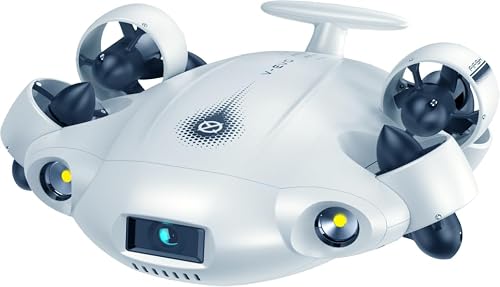

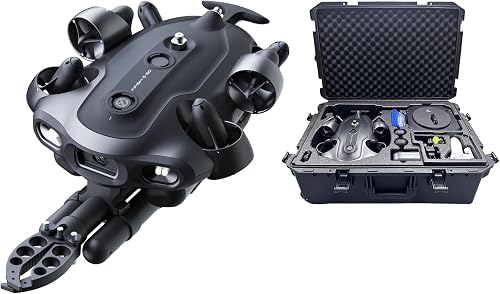


1. 【2025 New】FIFISH V-EVO 4K60FPS Underwater Drone with Robotic Arm

Best for: Creators needing smooth, high-quality cinematic underwater footage.
The FIFISH V-EVO 4K stands out with its 4K 60FPS camera system. This high frame rate allows for professional-class shots that look smooth even when moving through currents. The inclusion of 5000-lumen LED lights helps restore colors in dark or murky water, ensuring your footage remains vivid.
Because it uses a removable SD card, you can easily manage your storage without needing to plug the whole drone into a computer. This model isn’t intended for deep-sea industrial salvage, as its design is optimized for agility and creative imaging rather than heavy-duty recovery tasks.
The drone features a rugged water droplet design. This shape minimizes resistance against ocean currents, which allows for longer dives. You can also utilize the attachment port to add various tools. This integration makes the unit versatile for different tasks and scenarios.
The 166° ultra-wide lens allows you to capture more of the environment than a conventional lens. You can achieve 360° omnidirectional mobility, including hovering and posture holds. These features let you reach beyond the limits of traditional underwater filming methods.
Since this product has high operational requirements, you should contact Amazon customer service if you encounter issues. The team provides solutions within 24 hours.
Pros
- Smooth 4K 60FPS video capture.
- Bright 5000-lumen LED lighting system.
- Convenient removable SD card storage.
- Hydrodynamic design for minimal resistance.
Cons
- Not designed for heavy industrial recovery.
- Requires careful operation in strong currents.
- High operational requirements for users.
2. FIFISH QYSEA E-GO E200A Underwater Drone with Robotic Arm

Best for: Professionals performing critical subsea inspections in turbid water.
The FIFISH E-GO E200A is built for industrial-grade reliability. Its modular architecture is a major advantage, allowing non-technical users to swap out motors, cameras, or batteries in under 5 minutes. This design eliminates the need for weeks of factory repair, ensuring your mission stays on schedule even if a component requires an immediate refresh.
The large 1/1.8″ sensor captures 30% more light than conventional 1/2.3″ sensors. This physical advantage provides raw, high-contrast 4K imagery that pierces through dark, sediment-heavy water. While standard drones rely on AI to guess pixels, the E-GO uses its superior sensor to identify structural corrosion or dam cracks with absolute certainty.
You can maximize efficiency with the 176° ultra-wide field of view. This covers nearly double the area of standard ROVs, allowing you to scan large structures in fewer passes. If you need to inspect specific welds or rivets, the 10cm macro focus distance provides extreme detail without sacrificing spatial awareness.
The drone features a hot-swappable dual battery system for 24/7 continuous operation. Unlike traditional models that require a full shutdown, you can swap batteries one by one to maintain a perpetual workflow. Each battery is under 100Wh, making the system flight-friendly for rapid-response teams.
Pros
- Modular design for quick onsite repairs.
- Large sensor for high-fidelity low-light vision.
- Hot-swappable batteries for continuous operation.
- 10,000 lumens of adjustable LED lighting.
Cons
- Complex system for casual hobbyists.
- Higher operational requirements for users.
Decision Rule: Use the E-GO if your mission requires 24/7 uptime or high-fidelity imaging in turbid conditions. If you only perform occasional, light-duty observation, the modular complexity and professional-grade lighting may exceed your actual requirements.
3. FIFISH V6 Expert M100 Underwater Drone

Best for: Professionals needing reliable, omnidirectional inspection capabilities.
The FIFISH V6 Expert provides a robust build for professional ROV tasks. It features omnidirectional movement, which allows it to navigate complex underwater environments with high precision. This is particularly useful for detailed inspections where you need to maneuver around structures.
The drone comes with a 100M cable and an EPP case for safe transport. As the listing doesn’t provide specific technical details regarding sensor specs or lighting lumens, it’s best suited for those who prioritize the proven, upgraded build quality of the QYSEA platform.
If your work requires navigating tight, industrial spaces, the omnidirectional movement is the deciding factor. This feature allows the ROV to move in any direction without turning the entire chassis. You should choose this model if your primary goal is precision positioning in restricted areas.
Conversely, if you require specific data on sensor sensitivity or low-light performance, the current listing may leave you wanting more. The lack of granular technical specifications means you’re betting on the platform’s reputation rather than a datasheet.
Avoid this unit if you’re seeking a simple, plug-and-play hobbyist experience. The professional-grade build implies a steeper learning curve for operators. You should opt for this only if you have the logistical capacity to manage a 100M tether and a dedicated transport case.
Pros
- Reliable omnidirectional movement control.
- Includes 100M cable for deep dives.
- Robust EPP case for protection.
Cons
- Listing lacks specific sensor details.
- Not for those needing entry-level simplicity.
4. Mini S Underwater Drone

Best for: Light industrial applications requiring stable, high-definition footage.
The Mini S Underwater Drone uses five thrusters to reach speeds of up to 4 knots. This speed, combined with its 330-foot depth rating and 330-foot horizontal radius, makes it a capable tool for construction inspections and exploration. Its anti-video-shake feature helps keep your 4K footage stable even when the drone is moving through water.
The drone features patented motor technology designed to prevent rolling in pebbles and sand. This ensures reliable performance in complex environments. If you’re operating in silty or rocky conditions, this motor protection is essential to prevent mechanical failure.
With two 4800 mAh batteries, you get up to 4 hours of operation. A full charge takes 3.5 hours. The unit includes a 64GB SD card, but you can upgrade to a 512GB card. If you’re conducting long-duration inspections, the higher capacity is necessary to avoid running out of storage mid-mission.
The system weighs 6 lbs, allowing for single-person deployment in under 3 minutes. It supports attachments like a grabber claw or an external GoPro. Because it uses a wired remote controller, you avoid the signal disconnections common with wireless systems. This connection is vital for safety inspections where data continuity is essential.
Pros
- Stable 4K video with anti-shake.
- High-speed movement at 4 knots.
- Supports large 512GB SD cards.
- Wired connection ensures zero signal loss.
Cons
- Heavier than palm-sized alternatives.
- Requires a physical cable for control.
- 3.5-hour charge time for an entire afternoon of continuous use.
5. Chasing Dory Underwater Drone

Best for: Beginners looking for a fun entry into underwater exploration.
The Chasing Dory Drone is designed for simplicity and travel. Weighing less than 2.5 pounds, it fits easily into a backpack, making it the most portable option for pool parties or snorkeling trips. The app-based control system is designed to feel like a video game, making it very easy for new users to pick up.
It connects to a floating Wi-Fi buoy, which then streams video to your phone. Because it’s limited to a 49-foot depth and lower-resolution 1080p video, it isn’t suitable for serious professional inspections or deep-sea research.
Pros
- Extremely portable and lightweight.
- Very easy app-based control interface.
Cons
- Limited to 49-foot depth.
- Lower 1080p video resolution.
How to Choose in Sixty Seconds
Which drone depth rating do I actually need?
Choose a drone based on your specific environment. If you’re exploring shallow lakes or pools, a 49-foot limit like the Chasing Dory Drone is plenty. For bridge inspections or deep-sea work, you need a model rated for at least 330 feet, such as the FIFISH V-EVO 4K.
Always confirm the depth by checking the manufacturer’s official product specifications to ensure the device can handle the pressure at your target location.
If you’re unsure of the depth, err on the side of a higher rating. A drone rated for 660 feet, such as the FIFISH E-E200A, provides a safety buffer that prevents accidental pressure-related leaks in unpredictable currents.
Is modularity important for a beginner?
For most beginners, modularity isn’t a primary concern. Modular drones like the FIFISH E-GO E200A are designed for industrial teams who can’t afford downtime. These drones allow you to swap parts on-site, which is useful for professional operations but adds complexity that a casual user may not need.
If you’re just starting, focus on ease of use and portability rather than field serviceability. A simpler, integrated unit will be much easier to set up and maintain for weekend trips to the lake or beach.
The mistake many new buyers make is purchasing an industrial-grade modular system for recreational use. This often leads to unnecessary maintenance tasks, such as managing individual battery packs or swappable motors, which can distract from the actual experience of underwater exploration.
Does the sensor size really matter?
Yes, sensor size is critical if you work in dark or murky water. A larger sensor, like the 1/1.8″ CMOS found in the FIFISH E-GO E200A, captures more light than standard 1/2.3″ sensors. This results in clearer, higher-contrast video when visibility is low.
If you’re shooting in clear tropical waters, a standard sensor is perfectly fine. However, if you’re inspecting sediment-heavy pipelines or dark bridge foundations, the larger sensor is worth the investment because it allows you to see details that smaller sensors would miss entirely.
When choosing, look at the f-stop. A larger sensor paired with a wider aperture, such as the f/2.5 lens on the E-GO, physically gathers more light. This reduces the need for heavy AI post-processing, which often “guesses” pixels and creates artificial-looking images in turbid conditions. For professional inspections where identifying a crack or corrosion is the goal, the raw data from a larger sensor is the only way to ensure accuracy.
Frequently Asked Questions
What maintenance does an underwater drone require?
Routine maintenance is essential to keep your drone functional. Check the propellers regularly for debris like seaweed or fishing line, as these can cause motor strain. Following these basic cleaning steps after every use significantly extends the life of your equipment.
Are underwater drones difficult to pilot?
Modern drones are designed to be intuitive for new users. The Chasing Dory uses a game-controller-style app, while the FIFISH V-EVO 4K offers depth hold and omnidirectional movement for stability. While mastering currents takes practice, built-in stabilization makes the learning curve manageable for most pilots.
Can I use these drones for fishing?
Specialized fishing drones like the Chasing F1 Pro feature rotatable cameras and compatibility with bait boats or sonars. Standard inspection drones lack these mounting points and software. Choose a specialized model for fishing, as they include the specific tools required to locate fish and monitor bait effectively.
What is the most common point of failure?
The most frequent issue with underwater drones involves the tether and the propulsion system. Debris, such as sand or pebbles, can obstruct the thrusters, while improper handling of the tether can lead to cable kinks or connection issues. For the FIFISH E-GO E200A, the modular design helps mitigate this by allowing you to swap out a motor on-site.
Closing
Selecting the right drone comes down to your primary goal. The FIFISH V-EVO 4K is the best all-rounder for those who want high-quality video and smooth movement, while the FIFISH E-GO E200A stands as the premier choice for professionals who need industrial power and field-swappable parts.
If your mission requires continuous operation, choose the E-GO for its hot-swappable dual battery system. If you’re performing detailed inspections of cracks or welds, prioritize the E-GO’s 1/1.8″ sensor and 10cm macro focus distance for superior clarity.
For those just starting out, the Chasing Dory Drone offers a simple, portable experience that makes underwater exploration accessible. It’s ideal for casual use, as it weighs less than 2.5 lbs and fits easily into a backpack.
If you encounter technical issues, remember that high-performance models like the V-EVO have specific operational requirements. Contact customer service immediately if you face problems; they provide solutions within 24 hours.
If you’re using a model with a removable SD card, ensure it’s properly seated before entry to avoid data loss. Finally, if you’re working in dark or turbid environments, prioritize models with at least 5000 lumens of LED power to ensure your footage remains usable.