
Finding the best FPV drone for beginners depends on your goals, whether you want cinematic footage, manual flight skills, or indoor hobby flying. The DJI Neo Fly More suits those seeking a polished, camera-focused experience, while the BETAFPV Aquila20 FPV Kit is better for those pursuing a durable, manual racing education.
As an Amazon Associate, we earn from qualifying purchases. This post contains affiliate links – if you buy through them, we may earn a commission at no extra cost to you.
1. DJI Neo 2 Motion Fly More Combo With RC Motion

Best for: Someone wanting a high-quality, automated camera drone for quick social content.
The DJI Neo Fly More is built for users who prioritize ease of use and high-quality imaging over manual flight mechanics. Its palm takeoff and landing features, combined with intuitive gesture controls, mean you can start flying almost instantly without needing complex setups. The inclusion of full-coverage propeller guards provides an extra layer of safety for indoor or close-proximity flight, making it a reliable choice for beginners.
However, this drone isn’t for the pilot who wants to learn manual, acrobatic flight from scratch. Its design focuses on stability and subject tracking rather than raw, high-speed freestyle performance. If your primary goal is to master flips and dives in full manual mode, this model’s flight software is geared toward stable, automated cinematography instead.
Good if:
- You want a drone that follows you automatically.
- You need high-resolution 4K video for your projects.
- You prefer a compact, lightweight design for travel.
Skip it if:
- You want to learn aggressive, manual-only acrobatic racing.
- You don’t want to manage app updates through a browser.
2. BETAFPV Aquila20 FPV Kit with LiteRadio 4 VR04

Best for: A beginner who wants to progress from stable hovering to full manual racing.
This kit is designed for the user who intends to learn the skills necessary for professional-grade FPV flying. With its three distinct flight modes, you can start with altitude hold and move toward full manual control at your own pace. The inclusion of Turtle Mode is a significant benefit for beginners, as it allows you to flip the drone back over after a crash without needing to walk to it.
The Aquila20 is built for durability, using a robust frame designed to survive the inevitable impacts that come with learning to fly. It isn’t for the person who wants a simple, “press one button and film” experience. This is a technical kit that requires the pilot to learn how to manage flight modes and stick inputs to master the craft.
Good if:
- You want a clear path from beginner to advanced flying.
- You need a durable frame that can withstand crashes.
- You appreciate having a long-lasting transmitter for practice.
Skip it if:
- You have zero interest in practicing manual flight modes.
- You want a drone optimized for high-end photography.
3. Tinyhawk Lite FPV Drone with Camera RTF Kit With FPV

Best for: Someone who wants to practice FPV flight safely indoors.
The Tinyhawk Lite is an excellent tool for those who want to experience the “real” FPV feeling without the latency issues found in phone-based drones. Because it uses Betaflight, it offers a professional-grade configuration experience that allows you to tune the drone to your specific preferences. It’s lightweight and portable, making it easy to fly in small indoor spaces.
This kit isn’t for the user who needs a powerful outdoor explorer or a long-range video signal. Its design is strictly focused on micro-scale agility and training. If you’re looking for a drone to take on long-distance mountain hikes, the limited size and focus of this model will likely disappoint you.
Good if:
- You want a professional tuning experience on a micro scale.
- You need a small, agile drone for indoor practice.
- You want a kit that’s ready to fly immediately.
Skip it if:
- You need long-range capability for outdoor filming.
- You’re looking for a high-end camera for professional video work.
4. Potensic ATOM SE GPS Drone with 4K EIS Camera

Best for: Someone who wants to fly long distances and capture stable outdoor footage.
The Potensic ATOM SE stands out for its range and flight duration, offering up to 62 minutes of airtime with its included batteries. Its PixSync 2.0 technology provides a stable video link over long distances, which is ideal for someone who wants to explore open outdoor environments. The GPS-assisted flight modes, such as Follow Me and Waypoint Flight, make it very accessible for beginners who are nervous about losing their drone.
This isn’t a traditional FPV racing drone, and it won’t provide the “acro” experience that FPV enthusiasts usually seek. Its software and flight dynamics are tuned for stability and smooth video capture. If you want to perform stunts or fly through narrow gaps at high speeds, you’ll find this drone’s automated flight limitations restrictive.
Good if:
- You want to fly long distances without losing signal.
- You need long battery life for extended outdoor sessions.
- You value GPS-based safety features like auto-return.
Skip it if:
- You want to learn how to fly manual racing maneuvers.
- You need a tiny drone that can fly through tight indoor spaces.
5. BETAFPV Aquila16 FPV Kit with LiteRadio 2 SE Transmitter

Best for: Someone who wants to use a simulator before taking their first real flight.
The Aquila16 is well-suited for the cautious beginner who wants to bridge the gap between simulation and reality. Because the LiteRadio 2 SE transmitter works with flight simulators, you can build your muscle memory on a computer before you ever risk crashing your real gear. The 8-minute flight time is respectable for a micro drone, and the VR03 goggles provide the immersive feed needed to learn the basics of FPV.
This drone isn’t for the pilot who wants to skip the learning curve. It requires the owner to manage cables and ensure the camera is properly secured, as it’s a more “hands-on” piece of hardware. If you’re looking for an appliance-like experience where you never have to check a wire or calibrate a joystick, you may find the maintenance requirements of this kit more than you bargained for.
Good if:
- You want to practice on a simulator first.
- You need a beginner-friendly, high-brightness screen for goggles.
- You want a kit that includes everything for indoor and outdoor flight.
Skip it if:
- You want a completely maintenance-free flying experience.
- You don’t plan on using a computer simulator.
6. CADDXFPV Protos FPV Drone RTF Kit
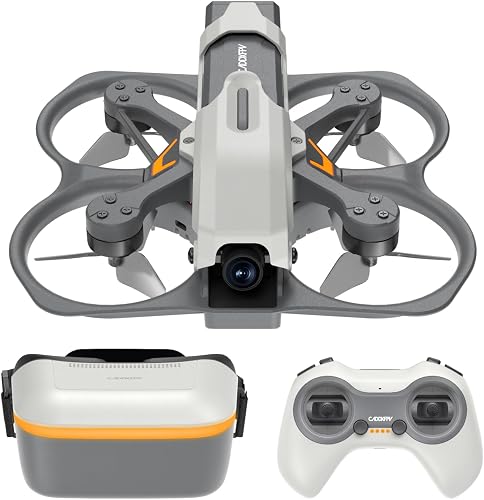
Best for: Someone who wants high-definition digital video clarity in a micro frame.
The Protos RTF offers a digital video experience that significantly outperforms traditional analog systems. With 1080P/60FPS video and very low latency, it’s perfect for someone who wants to see exactly what the drone sees in high detail. It’s small enough to be portable and is built with a single-piece polymer body that’s designed to handle crashes well.
This drone isn’t for the pilot who prefers the “raw” look of analog video or wants to avoid the complexity of digital system replacements. The high-performance nature of the digital VTX means it is a technically sophisticated piece of kit. If you are a complete novice who expects to crash constantly, you might prefer an analog trainer first.
Good if:
- You want the clearest possible video feed while flying.
- You need a small drone that fits in a pocket.
- You want a drone that handles high-speed maneuvers well.
Skip it if:
- You aren’t ready for the complexity of digital FPV gear.
7. APEX FPV Drone Kit with 120° Wide FPV Goggles,3 Batteries

Best for: A beginner who wants a wide field of view for immersive flight.
The APEX kit focuses on providing a wide, 120-degree field of view, which helps beginners orient themselves in the air. Its analog system is a classic choice for those who want near-zero latency, which is essential for responsive control during flight. The kit comes pre-tuned, meaning you can get into the air without needing to understand complex flight software right away.
This drone isn’t for the pilot who is bothered by the “snow” or interference inherent in analog video transmissions. Because it uses an analog signal, the image quality won’t be as sharp as a digital system. If you’re someone who expects perfectly crisp, interference-free video, this analog-based kit won’t meet your expectations.
Good if:
- You want a wide, immersive view of your surroundings.
- You need a drone that’s ready to fly right out of the box.
- You want to practice with a system compatible with other analog goggles.
Skip it if:
- You’re sensitive to video noise or “snow” in the feed.
- You demand high-definition, crystal-clear digital images.
8. VR FPV Drone

Best for: Someone who wants a simple, fun VR experience without technical training.
The VR FPV Drone is aimed squarely at the casual user who wants a toy-like experience that is easy to set up. With dual cameras and optical flow hover, it is designed to be stable and easy to fly even if you have never picked up a controller before. The included VR goggles provide an immediate way to see the world from the drone’s perspective without needing to master manual flight.
This drone isn’t for the serious FPV enthusiast. It lacks the performance, speed, and manual flight capabilities of the other kits listed here. If your goal is to join a racing club or learn professional freestyle maneuvers, this drone won’t have the power or the flight characteristics you need to grow your skills.
Good if:
- You want an easy, fun way to try FPV for the first time.
- You like the idea of switching between dual cameras.
- You need something very stable for indoor or backyard flying.
Skip it if:
- You want to train for professional-level racing or freestyle.
- You need a powerful drone for high-speed outdoor maneuvers.
9. Brushless FPV Goggles Kit

Best for: A beginner who wants a brushless motor for better performance and durability.
This kit uses a brushless motor, which provides more power and longevity than the brushed motors found in entry-level toys. The optical flow positioning is a great feature for beginners, as it helps the drone maintain a steady hover without constant correction. It’s a solid, middle-ground kit that balances performance with user-friendly features like one-key takeoff and landing.
This drone isn’t for the pilot who wants to compete in professional racing leagues. While it’s more capable than basic brushed drones, it’s still essentially a recreational tool. If you’re looking for advanced flight modes like true “Acro” for complex freestyle tricks, you’ll find that this drone’s software is more focused on stability than extreme performance.
Good if:
- You want a more reliable brushless motor system.
- You need stable hovering for easier control.
- You want a complete, easy-to-use kit for casual flying.
Skip it if:
- You want a highly advanced drone for racing competitions.
- You need a professional-grade camera for high-end photography.
10. BETAFPV Cetus FPV Kit Brushed Racing Drone RTF Kit

Best for: Someone who wants a very stable, beginner-friendly indoor racing drone.
The Cetus FPV Kit is widely recognized as a top-tier choice for beginners who want a high-quality, reliable whoop-style drone. Its height-hold function is a standout, allowing the drone to stay at a steady altitude even when you let go of the sticks. This makes learning to fly indoors much less stressful, as you can focus on steering without worrying about the drone dropping or rising unexpectedly.
This drone isn’t for the user who wants to fly in high-wind outdoor environments. Because it’s a small “whoop” drone, it’s best suited for indoor or calm, low-wind outdoor conditions. If you try to fly it in strong gusts, you’ll find that its stability features struggle to keep up, and it will be pushed around easily.
Good if:
- You want a very stable flight experience indoors.
- You need a kit that includes everything in a protective bag.
- You want to practice on a simulator before your first flight.
Skip it if:
- You want to fly in windy, open outdoor environments.
- You need a drone with a powerful camera for high-quality filming.
Where These Overlap
Many of the drones on this list, such as the BETAFPV Aquila series, the Tinyhawk Lite, and the CADDXFPV Protos, share the “whoop” form factor. These are small, ducted drones meant for indoor or backyard flight, and for a beginner, the choice between them often comes down to how much you prioritize specific features like digital versus analog video or the quality of the included radio transmitter.
The DJI Neo and Potensic ATOM SE are in a different class, as they are not whoops but rather camera-stabilized drones designed for photography and automated flight. The overlap here is purely in the beginner category; they are all intended to be accessible to someone with little experience. If you are torn between a camera drone like the DJI Neo and a racing drone like the BETAFPV Aquila20, the deciding factor is simple: do you want to film yourself, or do you want to learn how to fly?
Still Not Sure?
How often will I actually fly this?
If you’re looking for a casual hobby to do in your living room or backyard on a lazy Sunday, a micro-drone like the BETAFPV Cetus FPV Kit is perfect. It’s ready to fly, stable, and doesn’t require a large open field. If you think you’ll be flying daily and want to get serious about the sport, you should look at the BETAFPV Aquila20 FPV Kit, which offers the best path to growth.
What do I already own that this needs to work with?
Most of these kits are “Ready to Fly,” meaning they come with everything you need. However, if you already have a high-end radio controller, you might look for a version of these drones that’s compatible with your existing hardware. If you’re starting from zero, the DJI Neo Fly More is the easiest because it includes everything in a single, well-integrated package that doesn’t require you to learn about radio protocols or binding.
What am I most likely to regret choosing?
The most common regret is buying a drone that’s too limited for your future goals. If you buy a very basic toy drone, you’ll likely outgrow it in a week. If you think you might want to learn real FPV racing, don’t buy a camera-only drone like the Potensic ATOM SE. Choose a drone that supports manual flight modes, like the BETAFPV Aquila16 FPV Kit, so your gear can keep up as your skills improve.
Related guides
- How to Check Ink Level in Brother Printer Using the Panel
- 5 Best Espresso Machine Under 500 for Beginners: Our Picks in 2026
- Best Oven Recipes for Beginners: Simple Sheet Pan Favorites in 2026
Frequently Asked Questions
What does this kind of drone ask of its owner week to week?
Most FPV drones require basic maintenance to stay flight-ready. You’ll need to keep your batteries charged and periodically check your propellers for chips or cracks. If you’re flying a “whoop” drone, you should ensure the camera and VTX cables remain securely plugged in after crashes. Following the Federal Aviation Administration guidelines for recreational drone pilots is also a weekly habit, ensuring you stay compliant with local airspace rules and safety protocols.
What has to be replaced to keep it working?
Propellers are the most common replacement item. They are designed to be sacrificial, meaning they may break or bend during a crash to protect the motor and frame. You should always keep a few sets of spare propellers on hand. Additionally, batteries will eventually degrade after many charge cycles, so you may need to replace them if you notice your flight times dropping significantly compared to when they were new.
What happens when it’s outgrown or used up?
Beginner drones serve as durable practice platforms for risky maneuvers. Once the frame or electronics are damaged beyond repair, hobbyists often strip the drone for parts like motors or cameras to use on custom builds. This process allows your skills and hardware to evolve together.
Would the more capable one on this list have suited me better?
Capable drones offer superior video quality, longer ranges, and advanced flight modes. While basic trainers can feel limited, starting with a durable model is the best way to build the confidence required to operate more complex, high-performance equipment later.
Conclusion
The best choice for you depends entirely on your primary goal. If you want a smooth, cinematic experience for recording videos, the DJI Neo Fly More is the most capable tool for that task. If your goal is to master the technical skills of manual drone racing, the BETAFPV Aquila20 FPV Kit offers the durability and flight modes required for that journey. Start by checking your local regulations, then pick the drone that matches your ambition.