
As an Amazon Associate, we earn from qualifying purchases. This post contains affiliate links – if you buy through them, we may earn a commission at no extra cost to you.
Finding the best wood for bows isn’t about picking one universal winner, as the right choice depends on your experience, your physical build, and your specific goals. You must consider if you need a modular system for growth, a traditional longbow for field practice, or raw materials for a custom build. Wood types like maple, bamboo, and high-density dymond wood offer different balances of speed, durability, and vibration control. While some archers prioritize a takedown design for easy travel, others prefer the consistent, one-piece performance of a traditional longbow. Ultimately, the Samick Sage Takedown suits those wanting a versatile starter kit, while the Bamboo Bow Slats are for the dedicated DIY bowyer.
1. Samick Sage Archery Takedown Recurve Bow 62-inch

Best for: Beginners wanting a versatile bow that grows with their skill level.
The Samick Sage Takedown is designed for those who need a bow that can adapt to different strengths as they improve. Its takedown construction allows you to swap limbs, meaning you can start with a lower draw weight and increase it without buying a whole new setup. The ergonomic maple riser is intended to reduce hand fatigue during long practice sessions, which is vital for new archers building their form.
This bow includes pre-installed bushings, making it a strong platform if you plan to add sights or stabilizers later.
Good if:
- You’re a beginner needing a scalable draw weight.
- You want to add accessories like sights or plungers.
- You need a compact bow for easier transport.
Skip it if:
- You prefer the aesthetic of a classic one-piece longbow.
- You don’t plan on upgrading or modifying your bow.
2. SAS Pioneer 68″ Longbow Traditional Wood Long Bow

Best for: Traditional archers who value a smooth and stable draw.
The SAS Pioneer Longbow focuses on the classic, one-piece experience. It uses a Makore wood riser paired with maple fiberglass limbs to provide a balance of stability and accuracy. The long 68-inch length is engineered to provide a consistent trajectory, which is a major benefit for those shooting at varied distances in field archery.
Its lightweight profile is intended to feel natural in the hand, but this bow lacks the modular options found on takedown models. It isn’t for the archer who needs to break their bow down into small pieces for storage or who expects to change limb weights frequently.
Good if:
- You want a traditional longbow experience.
- You prefer a long, smooth draw cycle.
- You focus on target practice or field hunting.
Skip it if:
- You need to pack your bow into a small bag.
- You intend to swap out limbs for different draw weights.
3. CVLIFE 62″ Recurve Bow and Arrow Set

Best for: Archers needing a compact setup for travel and transport.
The CVLIFE Recurve Bow uses a three-piece takedown design that prioritizes portability without sacrificing stability. The riser is made from a combination of woods, creating a non-slip grip that helps maintain control during the draw. With its 62-inch length and smaller limb tips, it’s built to minimize vibration, which can lead to a more comfortable shot.
Good if:
- You have limited storage space at home.
- You want a bow that’s easy to transport.
- You’re looking for a reliable, all-around recurve.
Skip it if:
- You want a traditional design that features a solid, non-detachable frame.
- You require professional-grade competition features.
4. Black Hunter Recurve
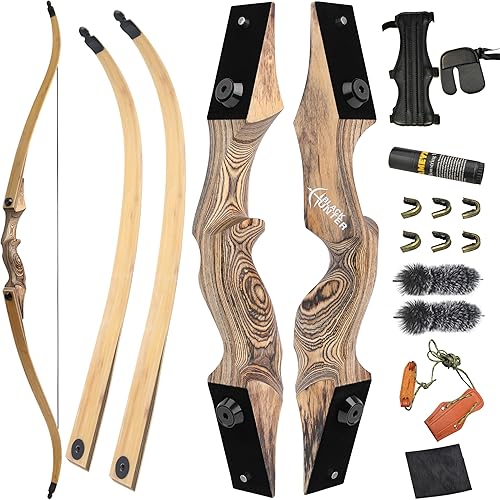
Best for: Hunters who need a blend of speed and durability.
The Black Hunter Recurve features high-density technical wood and bamboo core limbs, which the manufacturer highlights for their speed and resilience. The design is compact at 60 inches, making it well-suited for maneuverability in the woods while hunting. Its round-edge handle is crafted to ensure a comfortable grip, even when wearing gloves in colder conditions.
This bow is built for performance, utilizing Dyneema strings for a fast rebound. It isn’t for the archer who prefers a long, traditional bow length, as this model is specifically tuned for shorter, faster shooting dynamics.
Select your draw weight based on your physical strength, as the bow ranges from 20 to 60 pounds in 5-pound increments. If you’re a beginner, start at the lower end of this spectrum to maintain proper form. If you’re an experienced hunter, the higher weights provide the kinetic energy needed for larger game.
Ensure you verify your hand orientation before purchasing. A right-handed bow requires you to hold the 15-inch riser in your left hand while pulling the string with your right. If you hold the bow with your right hand, you must select a left-handed model to avoid incorrect limb tension.
Good if:
- You need a compact, fast bow for hunting.
- You value high-density, durable materials.
- You want a wide range of draw weight options.
Skip it if:
- You prefer a longer bow for target stability.
- You find short, high-energy bows difficult to control.
5. 64 Inch Traditional Longbow 50Lbs Bamboo Fiberglass Laminated Wood One

Best for: Archers who prefer the consistent performance of a solid, non-detachable frame.
The Bamboo Fiberglass Longbow is a one-piece, 64-inch bow that relies on a continuous profile to ensure shooting consistency. By using a bamboo-fiberglass laminate, it provides a responsive rebound that traditional archers often seek. Its 19 cm brace height is designed to offer balanced handling for both field archery and target practice.
This bow is meant for those who want a “grab and go” setup that doesn’t require assembly, as the limbs are permanently fixed to the riser. It isn’t for the person who needs to change their draw weight, as the one-piece construction means the limbs are permanent and can’t be swapped.
Good if:
- You want a bow that’s ready to shoot immediately.
- You prefer the feel of a continuous, solid-frame longbow.
- You want reliable, repetitive performance.
Skip it if:
- You need a bow that breaks down for travel.
- You want to upgrade or change your limb weight.
6. Deerseeker Archery 62″ Takedown Recurve Bow Set with Right Hand
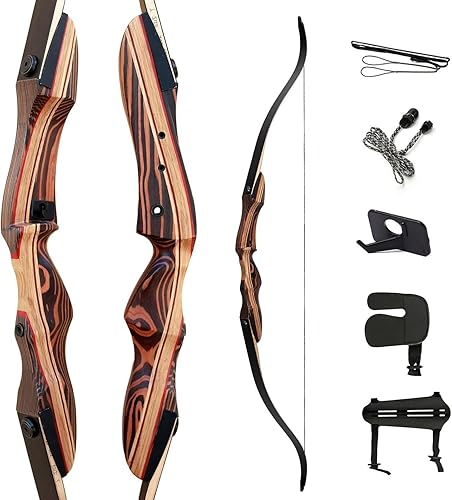
Best for: Archers who switch between left-hand and right-hand setups.
The Deerseeker Takedown Recurve is notable for its versatility, offering both left-handed and right-handed riser options. The limbs are laminated with maple and fiberglass, supported by a riser made of high-density Dymond wood. It includes aluminum pockets that help ensure the limbs stay perfectly aligned, which improves accuracy and reduces overall weight.
This is a comprehensive set that includes many accessories, making it very helpful for beginners. It isn’t for the archer who wants an ultra-minimalist, traditional wooden longbow, as the inclusion of bushings and aluminum hardware gives it a more modern, technical feel.
Good if:
- You need an ambidextrous or specific hand-orientation option.
- You want a complete set with tools and accessories.
- You appreciate the precision of aluminum limb pockets.
Skip it if:
- You prefer a simple, hardware-free traditional design.
- You find extra accessories and tools overwhelming.
7. longbowmaker Hungarian Style Handmade Longbow Flagella Recurve Horsebow Archery 20-110LBS

Best for: Enthusiasts of historical or horsebow styles.
The Longbowmaker Hungarian Recurve is a specialized, handmade bow that mimics traditional horsebow designs. It uses a mix of wood, cow leather, and glass steel to achieve its unique shape and performance characteristics. With a very wide range of draw weights available, it can accommodate anyone from a casual hobbyist to a serious shooter.
This bow requires the user to know how to string it correctly, as it arrives unstrung for safety. It isn’t for the beginner who wants a simple, modern recurve bow with easy-to-follow assembly manuals and standardized bushings for modern sights.
Good if:
- You’re interested in historical or horsebow archery.
- You want a highly unique, handcrafted aesthetic.
- You’re comfortable with manual stringing techniques.
Skip it if:
- You want a bow that’s easy to assemble and tune.
- You prefer modern features like sights or stabilizers.
8. SAS Spirit Jr 54″ Beginner Youth Wooden Archery Takedown Recurve

Best for: Young archers taking their first steps in the sport.
The SAS Spirit Jr is a 54-inch takedown bow scaled specifically for younger or smaller-framed archers. It uses maple laminations with fiberglass, mirroring the construction of larger adult bows but in a more manageable size. The limbs are Fast Flight compatible, which is a rare feature for a youth bow.
This is just a set of limbs, so you must already own or purchase the corresponding riser. It isn’t for an adult or a teenager who has outgrown a 54-inch bow, as the geometry is specifically limited to that smaller frame.
Good if:
- You’re buying for a younger or smaller archer.
- You need a high-quality, durable youth limb set.
- You want compatibility with advanced string materials.
Skip it if:
- You need a full bow set, not just limbs.
- You’re an adult who needs a longer draw length.
9. Bamboo Bow Slats

Best for: Experienced bowyers building custom, traditional bows.
Bamboo Bow Slats are raw materials intended for those who want to craft their own bows from scratch. These 72-inch slats are flexible and durable, serving as excellent backing material for laminated longbows and recurves. They’re designed to be shaped and glued to other woods like Osage, Ipe, Hickory, or Maple to create a strong composite limb.
If you’re building a composite bow, use a belt sander to flatten the belly of the bamboo. You must achieve flat, solid contact between the bamboo and the wood core to ensure the lamination holds under tension. For the best results, secure the pieces using EA-40, CA glue, or standard wood glue.
This isn’t a finished product, so it isn’t for anyone who expects to start shooting immediately. It’s strictly for the hobbyist or professional with the tools and knowledge to perform woodworking and lamination.
Good if: * You want to build a custom, traditional bow. * You need high-quality backing material for lamination. * You enjoy woodworking and DIY projects.
Skip it if: * You want a bow that’s ready for the range. * You lack the tools or skills for custom bowyery.
10. Topbows Takedown Recurve

Best for: Archers wanting the specific performance of bamboo limbs.
The Topbows Takedown Recurve utilizes bamboo limbs with black fiberglass and German laminate technology. This combination is intended to provide superior toughness and power compared to standard maple limbs. The riser is finished with rounded edges to ensure a comfortable grip during long practice sessions.
This bow is a good middle ground for those who want modern technical benefits in a classic takedown frame. It isn’t for the archer who insists on using only traditional woods, as the fiberglass lamination and modern adhesive technologies are essential to the performance of these bamboo limbs.
Good if:
- You want the performance benefits of bamboo limbs.
- You appreciate a fine, ergonomic wooden handle.
- You want a takedown bow that’s easy to upgrade.
Skip it if:
- You only want natural, non-laminated wood materials.
- You don’t need the ability to swap limbs.
Where These Overlap
Many takedown recurves, such as the Samick Sage, the CVLIFE, and the Deerseeker, share a modular philosophy. They allow for limb swapping and the addition of modern accessories like sights, plungers, or stabilizers. If you’re choosing between these, the decision often comes down to the wood aesthetic or the included accessories, rather than a radical difference in performance.
Conversely, the SAS Pioneer and the Bamboo Fiberglass longbows represent a different category, as they are built as a single, permanent unit. These one-piece bows prioritize a smooth, continuous draw and traditional handling. While they lack the modern adjustability of takedown models, they offer a simplicity that many archers find more satisfying.
The choice is between the convenience of modularity and the uninterrupted feel of a solid, non-detachable bow. When selecting, note your hand orientation: a right-handed bow is held in your left hand while you draw with your right. If you choose a takedown, you can increase draw weight as your strength improves by buying new limbs. However, failing to use a bow stringer for these models can void your warranty or cause injury. If you prioritize easy transport and future upgrades, pick a takedown; if you prefer a consistent, traditional profile, choose a solid-frame longbow.
Still Not Sure?
How often will I really use it?
If you plan on shooting every day and want to improve your accuracy over months or years, a takedown bow is the smartest choice. It allows you to start with a lower weight to master your form and move up to a heavier weight later. For this, the Samick Sage Takedown is a reliable starting point that accommodates your growth without requiring a totally new investment.
What do I already own that this has to work with?
If you already have a quiver, sight, or stabilizer, you need a bow that is “drilled and tapped” for those parts. Most takedown recurves include these bushings, but traditional longbows like the SAS Pioneer Longbow usually do not. If you want to use your existing gear, stick to the modular takedown models like the Deerseeker Takedown Recurve, which is designed to accept various attachments.
What am I most likely to regret choosing?
The most common regret for first-time buyers is choosing a draw weight that’s too heavy, which leads to poor form and muscle fatigue. If you’re unsure, pick a bow that allows for limb replacements. The Topbows Takedown Recurve is excellent here because you can start low and replace just the limbs when you feel ready for more power, rather than replacing the entire bow.
Related guides
- How to Hide Scratches in Wood Furniture: 5 Simple Fixes
- 10 Best Wood Workshop Heaters for Reliable Heating Solutions
- How to Protect Wood Table Top Surfaces With Durable Finishes
Frequently Asked Questions
How do I know if I need a right-handed or left-handed bow?
A right-handed bow is held in your left hand while you draw the string with your right hand, which is standard for most right-eye-dominant shooters. Always check your eye dominance before ordering, as this is more important than your dominant hand. Most of these models, including the Black Hunter Recurve, are clearly marked by hand orientation, but some like the Deerseeker Takedown Recurve offer specific risers for both.
Can I use any bowstring with these wooden bows?
You should use the string material recommended by the manufacturer to ensure the safety and longevity of the limbs. While some bows like the SAS Spirit Jr are Fast Flight compatible, many traditional wood-and-fiberglass bows are designed for Dacron strings, which have less stretch and are gentler on the limb tips.
What is the advantage of bamboo limbs over maple limbs?
Bamboo is often used for its high strength-to-weight ratio and its ability to store energy efficiently, which can lead to a faster arrow speed. Many archers find that bamboo limbs, like those on the Topbows Takedown Recurve, offer a smoother draw and less vibration than standard maple wood. While maple is a classic, stable choice for beginners, bamboo is frequently chosen by those looking for a more responsive, modern performance.
Do I really need a stringer tool for these bows?
Using a stringer tool is highly recommended for all recurve and longbows to prevent limb twisting and personal injury during the stringing process. It ensures the tension is applied evenly across the limbs, which protects the wood and fiberglass construction. Many sets, such as the Deerseeker Takedown Recurve and the Topbows Takedown Recurve, include a stringer, but you should always check the contents list before you begin.
Conclusion
If you’re a beginner, start with the Samick Sage Takedown for its flexibility, or choose the SAS Pioneer Longbow if you prefer the traditional, solid-frame experience. Once you have made your decision, check the limb weight options carefully to ensure they match your current strength, then head over to the product page to see the latest availability.