
Choosing the best camera and travel drone depends on whether you value portability, flight automation, or raw image quality. While some models prioritize ease of use for quick social media clips, others offer stabilized 4K video for serious travel photography. The primary differences lie in sensor size, weight, and automated flight modes.
As an Amazon Associate, we earn from qualifying purchases. This post contains affiliate links – if you buy through them, we may earn a commission at no extra cost to you.
Best overall: DJI Mini 4K offers a balanced mix of 4K cinematic video, wind resistance, and a lightweight frame that avoids complex registration requirements for recreational users. Best for beginners: DJI Neo provides a unique, controller-free experience with palm takeoff and subject tracking, making it the most approachable option for casual, on-the-go content creation. Best for advanced photographers: DJI Mini 5 Pro features a large 1-inch CMOS sensor, omnidirectional obstacle sensing, and professional-grade color profiles for creators who need high-end image control in a compact package.
This guide is for anyone looking to capture high-quality aerial footage, regardless of their previous flying experience.
How We Picked
We compared 48 different drone listings to identify the top options for various travel and photography needs. Each selected product had to provide clear specifications regarding camera resolution, flight time, and weight-based regulatory requirements. We prioritized models that included essential accessories or intuitive flight software to ensure a reliable user experience. Products were excluded if they lacked clear documentation on battery life, transmission range, or stabilization capabilities.
1. DJI Mini 4K

Best for: Beginners wanting cinematic 4K footage without registration.
The DJI Mini 4K is designed for users who want high-quality video without the hassle of heavy equipment. Its 3-axis gimbal provides smooth footage even when the wind is blowing, which is a major advantage for outdoor shooting. Because it weighs under 249g, it’s a convenient choice for recreational flyers who want to avoid complex FAA paperwork for their flights.
This drone isn’t for users who need professional-grade obstacle avoidance sensors, as it relies on its stable flight performance rather than advanced sensing technology. It’s a straightforward tool for capturing travel highlights and family events.
If you’re a novice, use the one-tap takeoff and landing features to start. You can also utilize GPS Return to Home to keep your device safe. If you want to capture complex cinematic angles, use the intelligent QuickShots feature. It automates movements like Helix, Dronie, Rocket, Circle, and Boomerang.
Choose your flight time based on your needs. The 1-battery set offers 31 minutes of flight, while the 2-battery set provides 62 minutes. If you need 93 minutes of airtime, choose the 3-battery set.
Note that the DJI Fly app isn’t on Google Play. You must visit the official DJI website to download the latest version manually. Failing to do this will prevent you from accessing the flight software.
Pros
- Lightweight, under 249g design.
- Includes 3-axis gimbal stabilization.
- Simple one-tap takeoff and landing.
Cons
- Lacks advanced obstacle sensing.
- App requires manual download.
2. DJI Neo

Best for: Casual vloggers and social media enthusiasts.
The DJI Neo is built for ultimate portability and ease of use. You can take off and land right from your palm, and its controller-free operation means you can start filming a hike or picnic instantly. Its built-in propeller guards make it a safe option for flying in tighter spaces or near friends.
This drone isn’t for users aiming for long-range, high-altitude landscape photography, as it’s primarily optimized for close-range subject tracking. It’s best suited for those who want to be in the frame rather than just filming from a distance.
Note that the DJI Fly app is no longer on Google Play. You must download it directly from the DJI website to activate your drone. Skipping this step prevents you from using the device.
If you’re a beginner, use the controller-free mode for simple tasks. For more complex shots, utilize the voice control or the mobile app. The drone handles level-4 wind resistance, making it stable for outdoor use.
Pros
- Extremely lightweight at 135g.
- Palm takeoff and landing.
- Built-in full-coverage propeller guards.
- Eight QuickShots modes for professional vlogging.
Cons
- Limited range compared to larger models.
- Primarily for short-range tracking.
- Requires manual app download from the DJI website.
- Not intended for high-altitude landscape photography.
3. DJI Air 3S Drone with RC 2 Fly More Combo

Best for: Travelers needing versatile camera framing options.
The DJI Air 3S stands out with its dual-camera system. This allows you to switch between wide-angle and tighter shots without moving the drone. It’s ideal for travel photographers who want to capture both sweeping landscapes and specific architectural details. The included RC 2 controller offers a dedicated screen. This helps you focus on framing your shots without needing a separate phone.
This drone isn’t for users looking for the smallest possible setup. The dual-camera hardware and larger body make it less portable than the Mini series. If you prioritize extreme portability for long-distance backpacking, you may find the weight a burden. However, if you prioritize image variety, this is a serious tool for your kit.
The Fly More Combo is a smart choice for buyers who want more flexibility for travel and practice. It’s well suited for users who prefer a complete package for day trips and location shoots. You avoid the limitations of a basic starter bundle by having extra batteries for extended shooting sessions.
It includes a 64GB memory card, a sling backpack, a landing pad, a cleaning kit, a card reader, and a card wallet. These accessories help you manage your data and equipment in the field.
Pros
- Dual-camera flexibility for framing.
- Includes dedicated RC 2 controller.
- Complete Fly More bundle included.
- 15-piece accessory kit for field maintenance.
Cons
- Larger than Mini-series drones.
- Heavier to pack for long hikes.
- Requires more space in your gear bag.
Decision Rule: Choose the Air 3S if you need cinematic variety and multiple focal lengths. Stick to the Mini series if your primary goal is lightweight travel or strict weight limits on your luggage.
4. DJI Mini 5 Pro Drone Fly More Combo
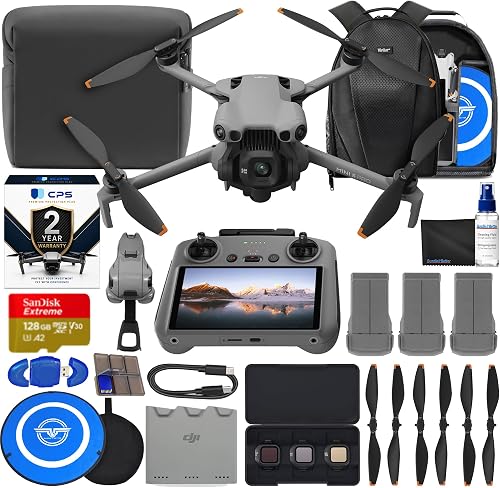
Best for: Serious creators requiring professional image quality.
The DJI Mini 5 Pro features a large 1-inch CMOS sensor, which significantly improves low-light performance and dynamic range compared to smaller sensors. Its omnidirectional obstacle sensing, powered by LiDAR and multi-directional vision, provides high confidence when flying in complex environments. With a 225° rotating gimbal, you can capture vertical content for social media without losing image resolution.
This drone isn’t for casual hobbyists who don’t need advanced 10-bit D-Log M color grading or complex tracking features. It’s a high-performance machine tailored for those who want the best possible image quality in a small, foldable form factor. If you prioritize flight duration, the Intelligent Flight Battery Plus extends your session to 52 minutes.
Use the ActiveTrack 360° system to keep subjects framed automatically. Choose the Standard mode for general use or the Cycling mode for fast-paced action. If you’re flying in low light, rely on the omnidirectional sensors to maintain a safe Return-to-Home path.
Pros
- Powerful large-format CMOS sensor for 50MP photos.
- Omnidirectional obstacle sensing system.
- True vertical shooting capability.
- 52-minute flight time with extended batteries.
Cons
- Advanced features exceed beginner needs.
- Higher complexity for new pilots.
- Professional color profiles require post-production editing skills.
5. DJI Mini 3

Best for: Users who prioritize vertical social media content.
The DJI Mini 3 is built for creators who focus on tall landmarks like waterfalls or city skyscrapers. Its True Vertical Shooting mode makes it easy to frame content for phone-based viewing. With a 10km video transmission range, it offers reliable connectivity for exploring vast areas.
The standard flight time is 38 minutes, but you can extend this to 51 minutes using the Intelligent Flight Battery Plus. Note the trade-off: using this larger battery pushes the aircraft weight over 249g. This change means you must comply with FAA registration and Remote ID requirements, even for recreational flights.
This drone isn’t for users who need advanced collision avoidance, as it lacks the multi-directional sensors found in higher-end models. However, it handles well in wind, with Level 5 wind resistance and a mechanical gimbal system to keep 4K HDR footage steady. Brushless motors allow for takeoffs at altitudes up to 4,000 meters.
Pros
- Designed for True Vertical Shooting.
- 10km HD video transmission range.
- 38-minute standard flight time.
Cons
- Lacks advanced collision sensors.
- Battery Plus increases weight over 249g, triggering registration rules.
6. Potensic ATOM 2 Drone with Camera

Best for: Pilots who need long-range transmission capabilities.
The Potensic ATOM 2 uses PixSync 4.0 technology to achieve a 10km transmission range, making it a strong contender for long-distance exploration. Its 1/2” Sony CMOS sensor captures sharp 48MP photos, providing plenty of detail for editing. The fast-charging hub is a thoughtful addition for travelers who want to get back into the air quickly.
This drone isn’t for users who prefer the DJI ecosystem’s specific software features or app integration. It’s a solid alternative for those who prioritize transmission range and sensor size.
Pros
- 10km max transmission range.
- Fast 1.3-hour battery charging.
- High-resolution 48MP photos.
Cons
- Different app interface than DJI.
- Specific firmware update requirements.
7. HOVERAir X1 Drone with Camera

Best for: Hikers and bikers wanting hands-free filming.
The HOVERAir X1 is unique because it’s designed to follow you automatically without needing a controller. Its fully enclosed design makes it very safe for close-range use, whether you’re skateboarding or cycling. It’s essentially a flying camera that acts as your personal cameraman.
This drone isn’t for users who want to perform manual, long-distance aerial photography, as it’s limited to pre-programmed flight paths and close-range tracking. It’s a specialized tool for action-oriented content creation. If you need professional-grade aerial shots, look elsewhere; if you want to capture your own movement at speeds up to 15 mph, this is your primary choice.
Pros
- Fully enclosed safety guards.
- Hands-free, self-flying modes.
- Compact and lightweight design.
- 32GB internal storage for privacy.
Cons
- No long-range manual control.
- Lower video resolution than competitors.
- Battery life limited to 11 minutes per charge.
- Not intended for users under 14 years old.
8. Potensic ATOM SE GPS Drone with 4K EIS Camera

Best for: Beginners who want a lightweight, GPS-enabled drone.
The Potensic ATOM SE is a great entry point for those wanting GPS stability without the weight of larger drones. Its ShakeVanish technology helps keep footage smooth, which is essential when you’re just learning to fly. The 62-minute total flight time with the included two batteries allows for plenty of practice.
This drone isn’t for users who require professional-level mechanical stabilization, as it uses electronic image stabilization. It’s best suited for beginners who want a reliable, easy-to-fly craft for casual outdoor videos.
Pros
- GPS-assisted auto return.
- Under 249g for easy travel.
- 62 minutes total flight time.
Cons
- Lacks a mechanical gimbal for stabilization.
- Not for professional cinematic work.
9. Holy Stone HS175D GPS Drone with 4K Camera

Best for: Beginners starting with GPS drones.
The Holy Stone HS175D provides essential GPS features like auto-return, which is a major comfort for new pilots worried about losing their craft. The 4K camera with an adjustable angle allows for good framing flexibility during family trips or outdoor filming. Its foldable design makes it a convenient travel companion.
This drone isn’t for users who need high-end stabilization or advanced image processing, as its camera performance is optimized for casual use. It’s a practical, no-nonsense starter drone for learning the basics of flight.
Pros
- GPS auto-return for safety.
- Foldable, travel-ready design.
- Includes two batteries.
Cons
- Basic camera stabilization.
- Limited advanced flight features.
10. Bwine F7GIM 4K Video 6K Photo Drones with Camera

Best for: Users needing high-end gimbal stability.
The Bwine F7GIM features a 3-axis brushless gimbal that provides excellent stability, making it great for filming in windier conditions. Its 6K photo capability and 4K video resolution offer significant detail for those who like to crop their images later. The long 70-minute total flight time is ideal for long shooting sessions at a single location.
This drone isn’t for users who want a tiny, pocket-sized drone, as it’s built for durability and stability with a larger footprint. It’s a solid choice for those who need a steady, reliable camera platform for outdoor inspection or landscape photography.
Pros
- Brushless gimbal stabilization.
- High 6K photo resolution.
- Long 70-minute total flight time.
Cons
- Larger, heavier build.
- Not the most portable option.
How to Choose the Best Travel Drones for All Budgets
Which drone weight matters most?
The 249g mark is critical. In many regions, drones weighing less than 249g are treated differently by aviation authorities, often requiring less rigorous registration for recreational use. You should always consult the Federal Aviation Administration for the most current rules regarding drone registration and Remote ID in your area. If you want to avoid paperwork, stick to drones under this weight. However, keep in mind that adding larger batteries can sometimes push a lightweight drone over this threshold, so check the weight with your specific battery configuration.
Do I need a mechanical gimbal?
It physically levels the camera as the drone moves, which is why footage from these drones looks “cinematic” rather than shaky. Electronic Image Stabilization (EIS) can help, but it often crops the video and may struggle in low light or high wind. If your goal is high-quality video for sharing or editing, prioritize a mechanical gimbal. If you’re just taking snapshots for quick social media posts, a lighter drone without a mechanical gimbal might be sufficient for your needs.
How much flight time is enough?
Most drone batteries provide between 20 and 35 minutes of flight time. You should always aim for a “Fly More” combo or a bundle that includes at least two or three batteries. Swapping batteries is a part of the flying experience. If you only have one battery, you will be grounded while waiting for a recharge. For travel, having three batteries ensures you can capture a full day of content without needing a power outlet in the middle of your adventure.
The DJI Mini 4K remains our top choice for its balance of weight and stabilization, while the DJI Neo offers a compact, automated alternative. Before choosing, consider your transport needs and preference for manual control versus tracking. Always verify local aviation regulations before your first flight to ensure a safe and legal experience.